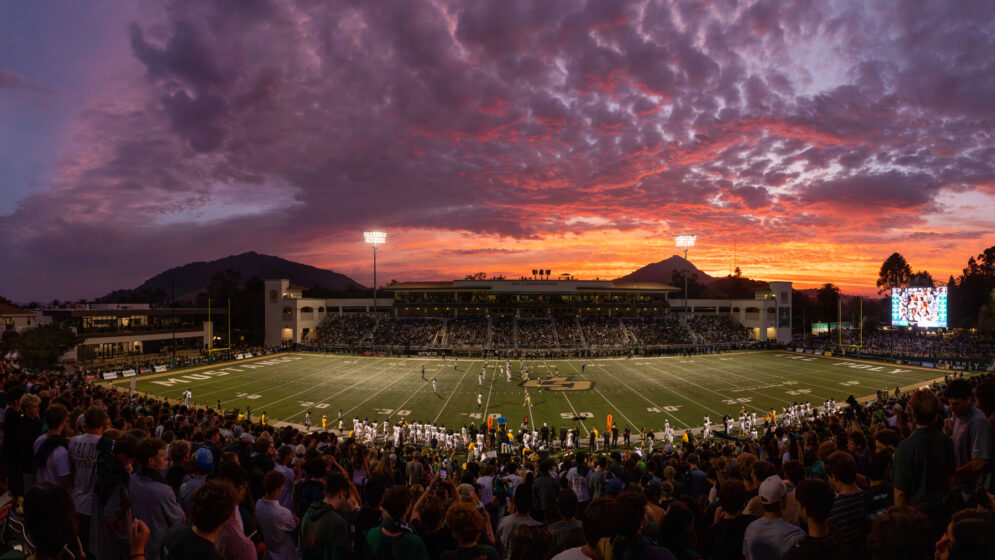

Running back Jaden Green leaps over defenders during a Mustang win in Spanos Stadium on Aug. 28. Photo by Romeo Galvan.
Linebacker Kenny Olson first heard about the John Madden Football Center during a recruiting trip to San Luis Obispo. As he stood on the field, coaches pointed to a parking lot at the south end of Spanos Stadium to indicate where the program’s new home would take shape.
At the time, the center was just a plan on paper and a promise to future players like Olson that their program would have one of the most advanced facilities in the Big Sky Conference. Officials designed the 37,690-square-foot building to centralize the program’s operations — which were scattered across campus — under one roof for the first time in decades.
Four years later, Olson and his teammates have seen that vision become reality. The Madden Center opened in June, symbolizing a resurgence within the program that has been years in the making. A new coaching staff, led by head coach Tim Skipper, has recruited dozens of new players and refocused the squad on building a winning culture grounded in fundamentals.
“I think it’s gonna be a historic season, honestly,” said Olson. “Coach Skipper has brought this team to a whole new level. His motto is ‘always on the rise,’ and I think we live that daily. The sky is the limit.”
Members of the Cal Poly Football team work out in the Madden Center in August.
The facility brings more than convenience to the more than 100 athletes and staff who work toward excellence year-round. The shared space strengthens the players’ camaraderie, improves coordination between innovative support programs, and elevates the program’s ability to recruit and retain the best talent in an era where players can transfer schools to chase lucrative deals leveraging their names, images and likeness.
“It’s a game-changing building,” said Skipper. “It changed our whole perception: the way recruits see us, how high school coaches see us, how our competition within our conference sees us, and how the national landscape looks. It has completely changed everything.”
This momentum shift comes at a critical time for Cal Poly Football. The team has a long history of championships, tragedy and perseverance, but it hasn’t had a winning season since 2016. Today’s players and coaches see this center — and the investment from donors behind it — as their opportunity to rewrite the program’s story into an enduring source of pride for every Mustang.
“There are no excuses anymore,” said Skipper. “We got everything you need right here. We can get down to work.”
Walk through the Madden Center with this year’s team as the Mustangs train for a season that could be a turning point in the program’s legacy.
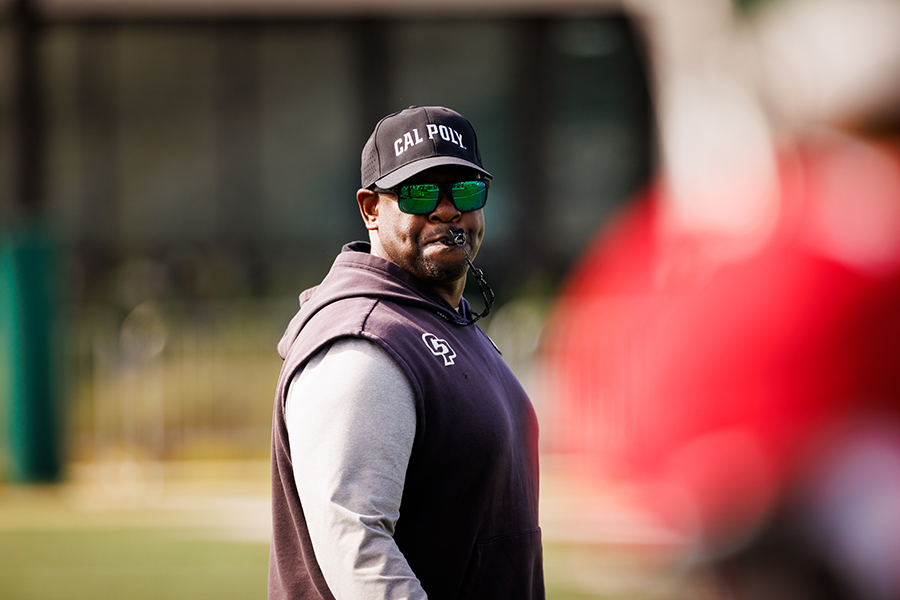
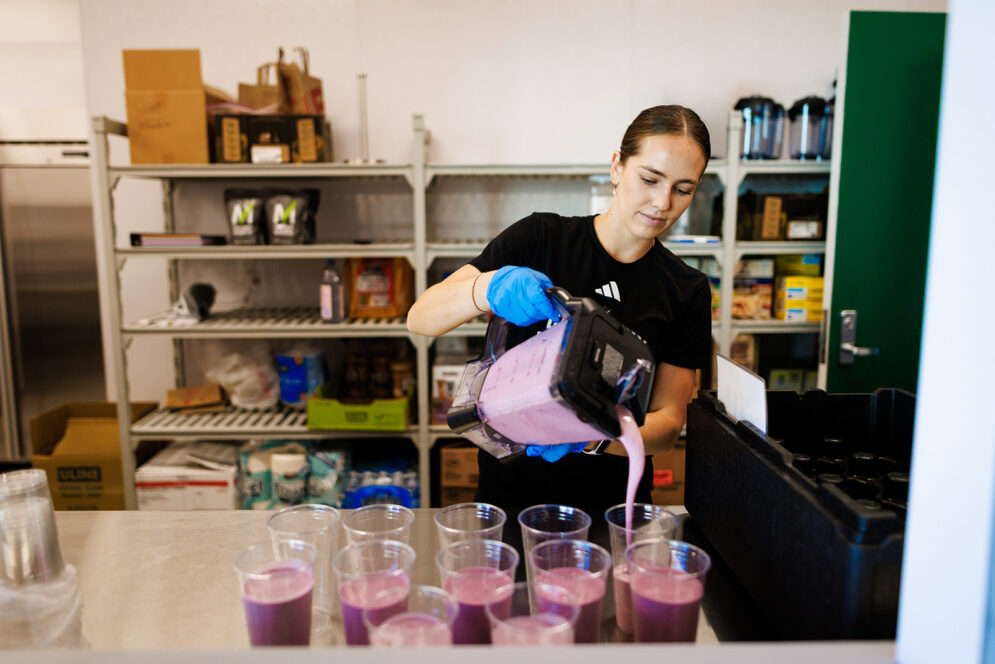
First photo: Head Coach Tim Skipper runs a team practice. Second photo: Nutrition student Sage Morrison prepares post-workout smoothies. Third photo: Wide receiver Fidel Pitts sprints on the turf at Spanos Stadium during a conditioning workout.
Coach Skipper’s philosophy is rooted in a tough, physical style of play that relies on overpowering opponents at the line of scrimmage and outlasting them late in the game to claim victory. That means the Mustangs have been hitting the weight room.
The center’s 5,900-square-foot weight room, complete with 18 racks and a range of high-tech tools, allows 50 athletes — about half the team — to work out at once. Those sessions breed strength, speed and confidence among teammates as they push each other to get better daily.
“When we were in the Natatorium gym, it was shoulder to shoulder,” said offensive lineman Anthony Patt of past workouts in smaller facilities that could only accommodate a few dozen athletes at a time. “Now you’re able to superset. It’s just so much easier for everybody on the team.”
Strength and conditioning coach John Brasher uses wearable technology to collect data about each player and build workouts tailored to the demands of different positions. In the weight room, he tests hamstring health, vertical jumps and more so players can see their progress and potentially flag a developing injury.
There are no excuses anymore. We got everything you need right here. We can get down to work.
Tim Skipper, Head Coach
On the conditioning field, players wear GPS trackers that measure how far and fast each athlete moves.
“Our staff tries to be creative within our field sessions, matching similar demands of football while training in the off-season,” said Brasher. “Sprinting is a really potent stimulus for all other things. Obviously for skill positions, mid positions and quarterbacks, speed is king. And our big guys, believe it or not, take part in that training, too.”
The small weight rooms the team previously used forced the players to divide into groups and stagger their workouts throughout the day. Now, they work through challenges together and cheer each other on, building the kind of team chemistry needed to win games. Coaches and players are also out to prove they deserve the investment the building represents.
“The foot is on the gas, for sure,” said Brasher. “It’s been a pleasure to be around student-athletes that are hungry to get better every day. These guys are setting the foundation for a new culture here.”
“I’ve been telling everybody: this place is heaven. The only thing it was missing was this facility,” said Patt. “Now that we’ve got this, the potential of the program is through the roof.”
The Madden Center also solves a problem the team had lived with for years: getting athletes the right food at the right time. That’s where the Oberhelman Nutrition Hub comes in.
For a decade, nutrition professor Scott Reaves has partnered with Cal Poly Athletics to give teams convenient access to healthy food, nutritional supplements and counseling to build healthy habits. The Madden Center brings that model home with a dedicated space where Reaves, members of the sports nutrition team staff and a group of student assistants prepare smoothies, stock snacks for the center’s lounge areas and organize premade team meals.
“That location gives us the proximity to athletes that can minimize the things that come between them and good nutrition,” said Reaves, who was a student-athlete at Cal Poly in the 1980s. “As soon as they walk out the door, they’ve got a million other things to do. If we can feed them well and try to support them while we’re in the Madden Center, it’s way more effective.”
The nutrition team prioritizes post-workout smoothies just after weightlifting sessions to help athletes rebuild their muscles and stay hydrated. Student assistants mix fresh fruit and protein with a unique carbohydrate powder that Reaves developed specifically for athletes to maximize the effects of their training.
The program also works with body composition and metabolism data on each athlete and provides resources to support sports nutrition team education sessions.
Applied nutrition student Sage Morrison is one of 25 undergraduates earning hands-on experience in food service and nutritional counseling while getting a preview of a career as a dietitian. Over the last year, she has done everything from food production to handing out snacks on the sidelines during home games.
“It’s been really fascinating to see these connections and how — from a nutrition and training standpoint — we can really elevate their performance,” said Morrison. “We’re setting specific goals that include what they’re eating, their sleep, hydration and all these different components that go beyond what’s on the field.”
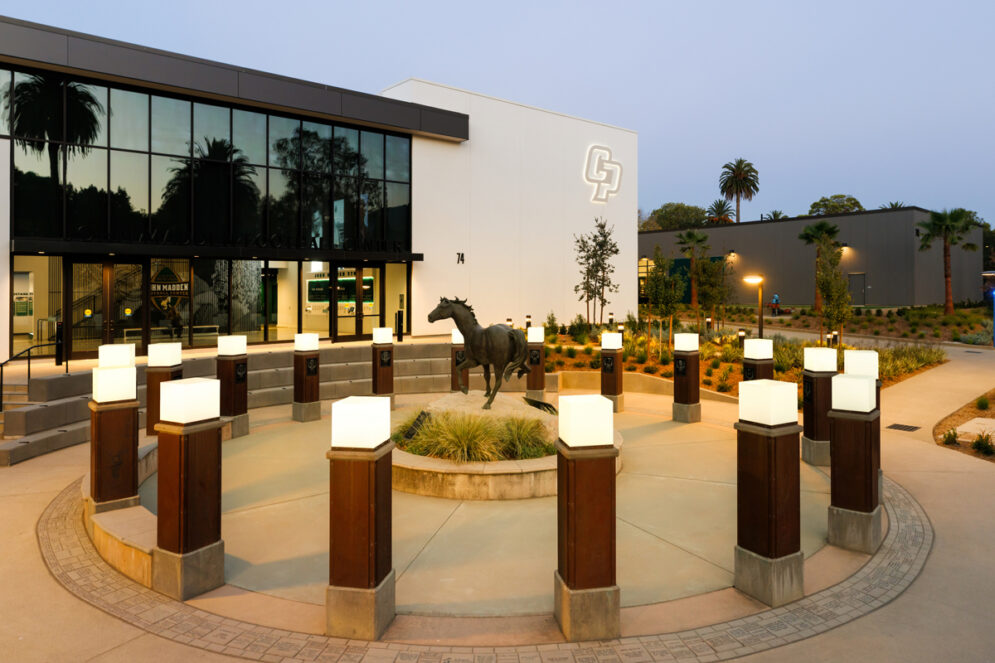
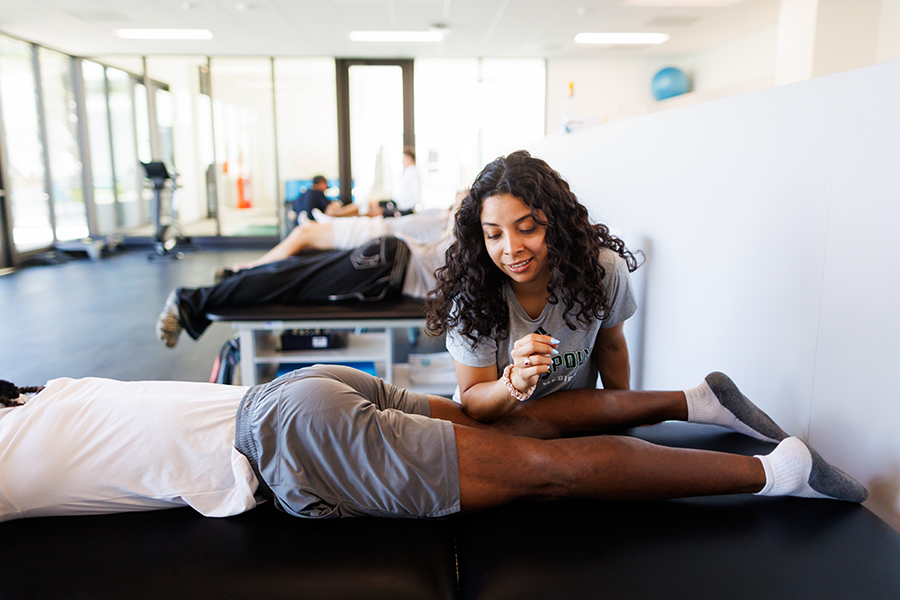
First photo: The Mustang Memorial, celebrating the lives of those who died in the 1961 plane crash in Ohio, glows just outside the Madden Center. Second photo: Athletic trainer Giselle Avila works with an athlete in the training room. Third photo: Coach Skipper leads a morning meeting with the team.
When football players are recovering from an injury or looking to prevent one before it happens, they turn to the Madden Center’s athletic training room. The space has 10 treatment tables where professional athletic trainers assess injuries, tape ankles before practices and help athletes recover properly.
Chris Ritter, who has spent 15 years as the team’s lead athletic trainer, is aware of a stark reality: the sport has some of the highest rates of injury per practice and per game in the NCAA.
“The challenge is the violence of the game. They hit each other every single play,” said Ritter. “How are we working with all this equipment and then trying to either help prevent or protect an injury so they can go back out and play?”
Players are in the athletic training room daily, using cooling compression boots that help legs recover after workouts and electrode stimulation systems that relax muscles and ease pain. Outside, hydrotherapy pools offer hot and cold plunges to help relieve soreness. During treatments, the athletes can look out the windows toward Spanos Stadium for inspiration.
“There’s this view out onto the field so athletes see what they’re working towards,” said Ritter of the space’s position in the Madden Center.
Having sports medicine, nutrition, strength and conditioning, and Coach Skipper’s staff all under one roof makes collaboration far easier. They’ve instituted weekly meetings where coaches and athletic trainers discuss their plans and identify any red flags in player behavior or performance. The staff says this simple practice has led to more targeted workouts and better understanding of player stress.
“I get reports every week about how much players were lifting, what their speeds were, what their yardage was, what their force plate measurements were,” said Ritter, referring to the data from Brasher. “It almost felt like we were doing a lot of stuff in the dark, and now we have a little bit more of a perspective of why we’re doing what we’re doing.”
“I’ve seen a change in people’s mindset just being in this facility every day,” said wide receiver Fidel Pitts, who transferred to Cal Poly in 2025. “From the nutrition building to the training room to the weight room and into our locker room and our meeting rooms, I see everybody approaching every single thing with a different mentality because of the energy this building brings.”
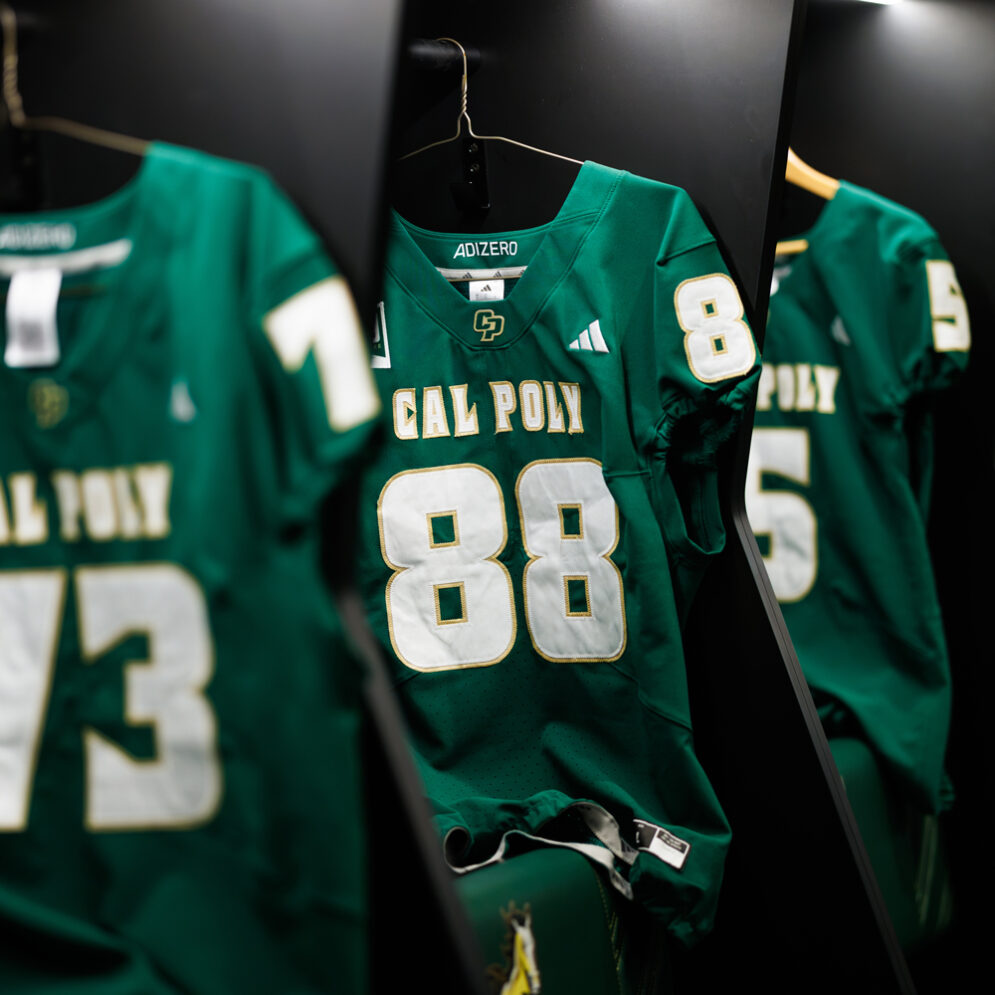
First photo: Jerseys in the Madden Center’s locker room.
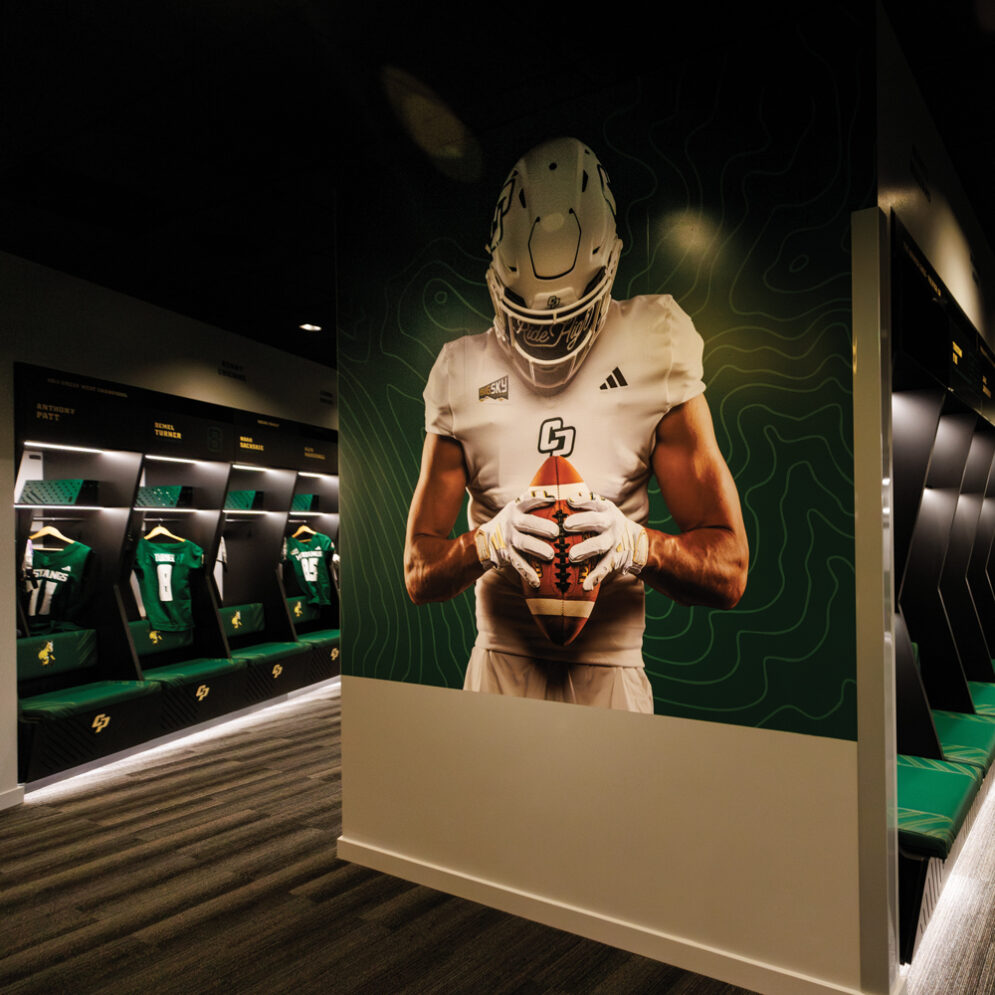
Second photo: Cal Poly Football’s new locker room, a favorite spot among team members.
Ask any football player about their favorite part of the Madden Center, and they’ll probably say it’s the new locker room. Players have spacious lockers with charging docks, storage and speakers to blast music while they lock in for competition.
“It really gives the feeling of a Power Four-type locker room,” said Olson, referring to the top conferences in the Football Bowl Subdivision. “I think this is one of the nicest facilities in the Football Championship Subdivision and probably the nicest in the Big Sky Conference. Now we can say we have the location, we have the school, and now we have the facilities to bring it all together.”
Recruits love it too: “Every time the recruits have come in, they’ve been taking videos of everything, just starstruck by how it looks in there,” he added.
Outside the locker room, players have a dedicated lounge and study space to use between workouts and classes.
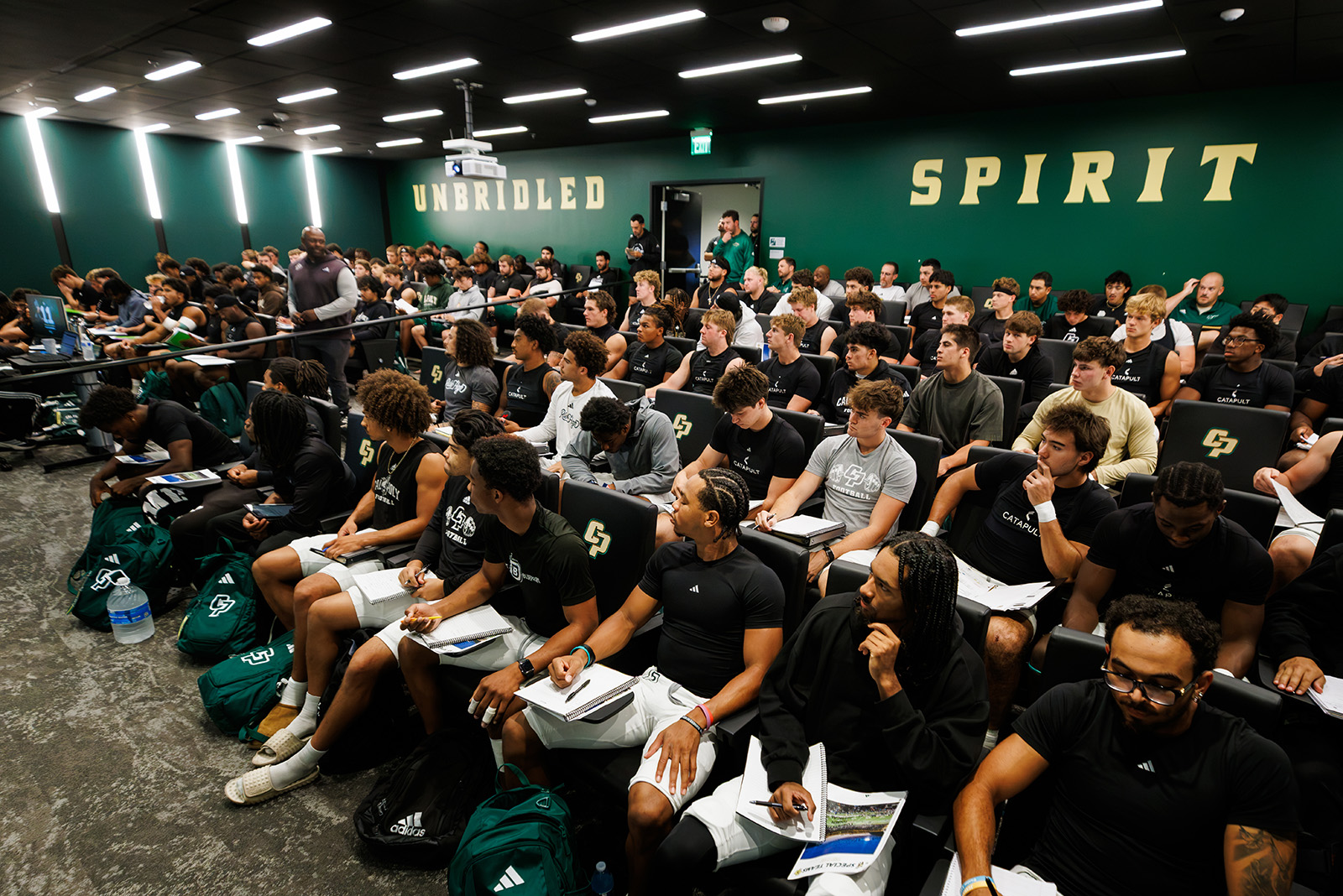
The team meetings, once held in the Business Building’s silo, now take place in a room with enough seats to accommodate more than 100 Mustangs. Each position also has a meeting room where coaches install plays and break down game film in small groups.
Having everything they need in one place reduces stress for athletes and helps them spend more time together. That proximity has quickly become one of the Madden Center’s most tangible benefits.
“The togetherness is huge because you got all these new players — transfer portal guys, high school guys, junior college guys — and we have to mix it all in a short amount of time,” said Skipper. “Football is the ultimate team game, and the only way we’re gonna win is if we become one heartbeat.”
The Mustangs are ready to make more than a statement this season — they want to change the trajectory of Cal Poly Football completely.
“I’m looking forward to showing everybody that Cal Poly isn’t what it’s been for the past two, three years,” said Jaden Green, a running back who transferred to Cal Poly this season. “We want to turn this program around and establish how great we really are. We got the pieces — the coaches, the Madden Center — so it’s just up to us.”

The Madden Center is a bridge that connects Cal Poly Football’s 100-year history: honoring its past players, supporting today’s team and fueling tomorrow’s recruiting potential. It was named in memory of legendary football coach and broadcaster John Madden (Physical Education ’59, M.A. Education ’61). The generosity of his wife Virginia (M.A. Education ’61), his sons Mike and Joe, and other donors made the vision a reality.
According to Mike the building is a perfect way to carry forward the values his father held close.
“If you really want to know who my dad was, he was about excellence and preparation … that’s what this building is all about,” said Mike Madden at the center’s ribbon-cutting event. “If the coaches and players come to this building to prepare and commit to excellence the way that dad did everything, the results on Saturdays are going to take care of themselves.”
“The building obviously is transformational in a multitude of ways,” said Director of Athletics Carter Henderson. “I continue to believe that just as important as the financial contributions that the Maddens provided was their belief in our program and our athletic department. I think the momentum that’s created from belief like that is going to be equally transformational.”
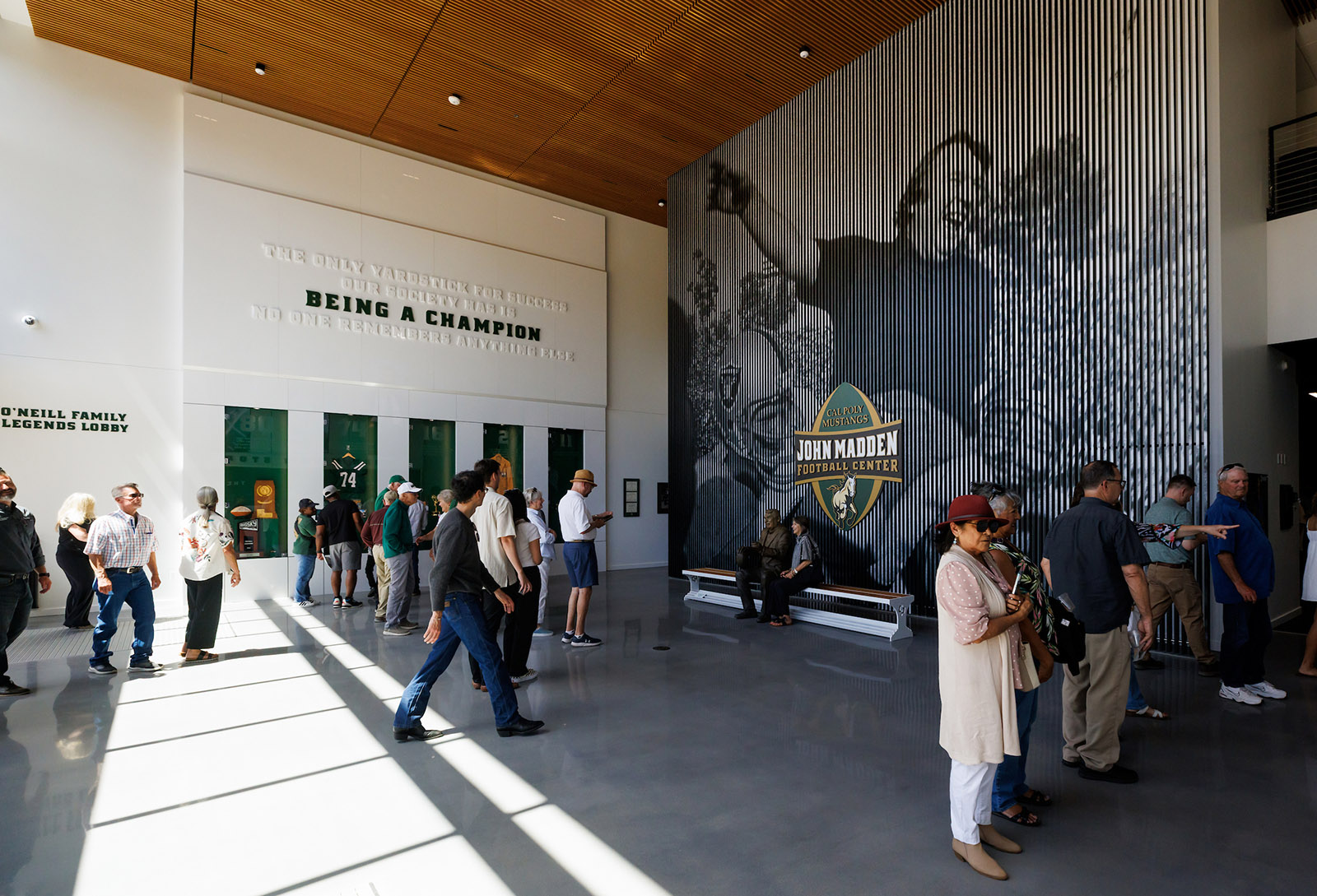
The center’s lobby tells John’s story, with interactive displays that explore his playing, coaching and broadcasting careers. The space also highlights the program’s Division II national championship in 1980, program milestones and other alumni who have won Super Bowl rings. At the lobby’s heart is a bronze statue of John looking out toward Mustang Memorial Plaza, where pillars commemorate members of the Cal Poly Football team who died in a plane crash in 1960, just after John finished his playing career at Cal Poly.
“Knowing the Maddens as people, they truly care about Cal Poly Athletics,” said Olson, who befriended the family while growing up in Pleasanton, California. “The one thing that John wanted was a universal home for the football team.”
Mike said he knows his father would be proud that Cal Poly Football has the tools for success.
“They’ve got their home,” he said. “They’ve needed this. They’ve deserved this for a long time.”

From volleyball to baseball to cross country, catch the highlights from record-breaking competition across the Big West Conference.
The sights, sounds and celebrations that consumed campus during Cal Poly Football’s first win of the season.