Explore the Physics Department’s Photon Lab, where two students recently took on a technical challenge that made campus history.
By Larry Peña Photos by Joe Johnston
Share this article:
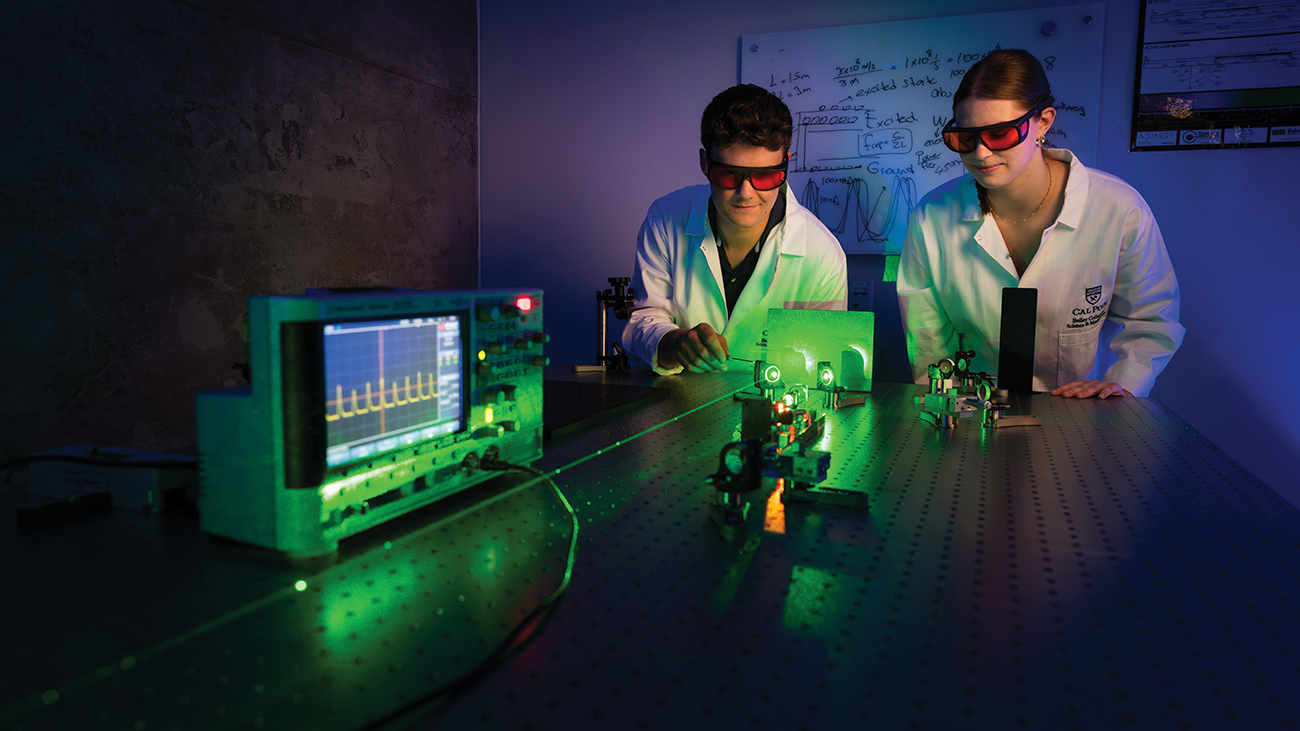
Physics students James Mauck and Hannah Bauer adjust a laser they built in the department’s Photon Lab.
At the Physics Department’s Photon Lab in the Frost Center for Research and Innovation, a team of students led by Professor Isinsu Toker recently accomplished something no other student has done at Cal Poly: build a state-of-the-art femtosecond solid-state laserlaser from scratch.
Fourth-year physics major Hannah Bauer and first-year physics major James Mauck led the effort to build the solid-state titanium-sapphire pulsing laser, which emits precise bursts of light energy every femtosecond, or 0.000000000000001 seconds.
“This is kind of the workhorse of the laser world,” said Mauck. “It’s used all over the place, from biomedical applications to industrial applications. We selected it because it is so widely documented and very well understood, which makes it a great educational tool.”
A grant from the Leonard and Natalie Wall Family Physics Faculty Research Fellowship, honoring an emeritus Cal Poly physics professor, provided many of the components of the device. Additional parts were donated by an alumnus who works at the research company General Atomics.
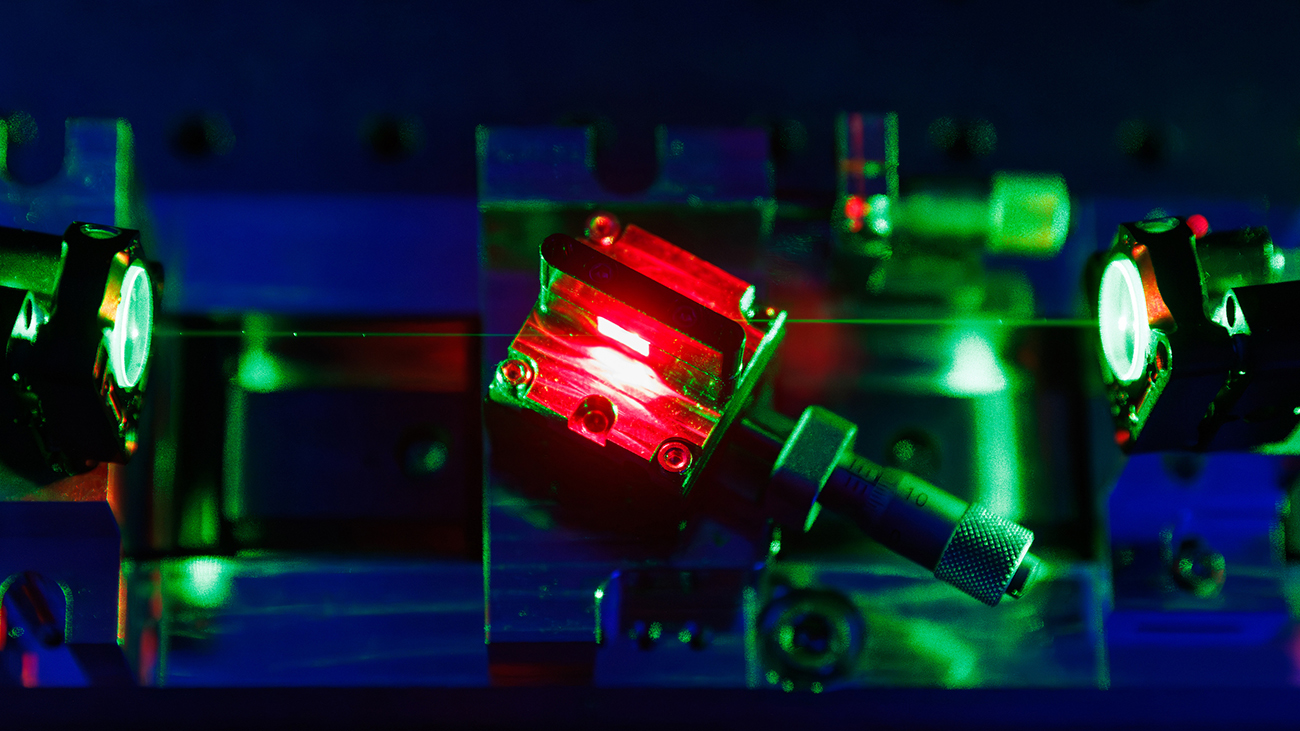
Elements of the solid-state titanium-sapphire pulsing laser.
According to Toker, this is the kind of work that most students don’t undertake until the master’s or even doctoral level.
“A project like this requires optics knowledge, very precise alignments and a lot of patience,” says Toker. “Having these skills at an undergraduate level is rare. They will be a couple of steps ahead of their peers when they graduate.”
Bauer and Mauck were excited to take advantage of this unique Learn by Doing experience at such an early stage.
“I’m constantly amazed by the amount of research opportunities that Cal Poly has,” says Bauer, who undertook the build as part of her senior project. “Dr. Toker is so amazing at explaining these really complex topics, and at pushing me to try new things. I’m heading into grad school having done something that a lot of people in those programs are just learning to do.”
Having these skills at an undergraduate level is rare. They will be a couple of steps ahead of their peers when they graduate.
“I think that’s part of the beauty of Cal Poly really, that undergraduate students have those opportunities because that doesn’t happen in many other places,” said Mauck. “A lot of the time you have to fight with grad students for a spot on the team, and you’d never even really see the lead researcher.”
The laser is now a core part of the Photon Lab, which also houses a variety of equipment designed for highly precise laser analysis, including a nanosecond transient absorption spectrometer and a micro-tuned optical table that eliminates ambient vibrations.
“I’ve already started using the laser in my classes,” says Toker. “Before this system, demonstrating some of the abstract concepts about optics we discussed in class was not possible. Now they can visit my lab and see the application of the concept.”
In the future Toker hopes that the laser tools that her students are building will be used in collaborations with other campus departments — she says biomedical engineering, chemistry, materials engineering and even archaeology are all areas where laser technology can play a useful role.