How I Learn by Doing
Thinking Outside
the Box Score
A mathematics major has helped Cal Poly Baseball revolutionize its analytics program to help Mustangs excel on the diamond.
By Gabe Riedel, mathematics major
Photos by Joe Johnston
Share this article:
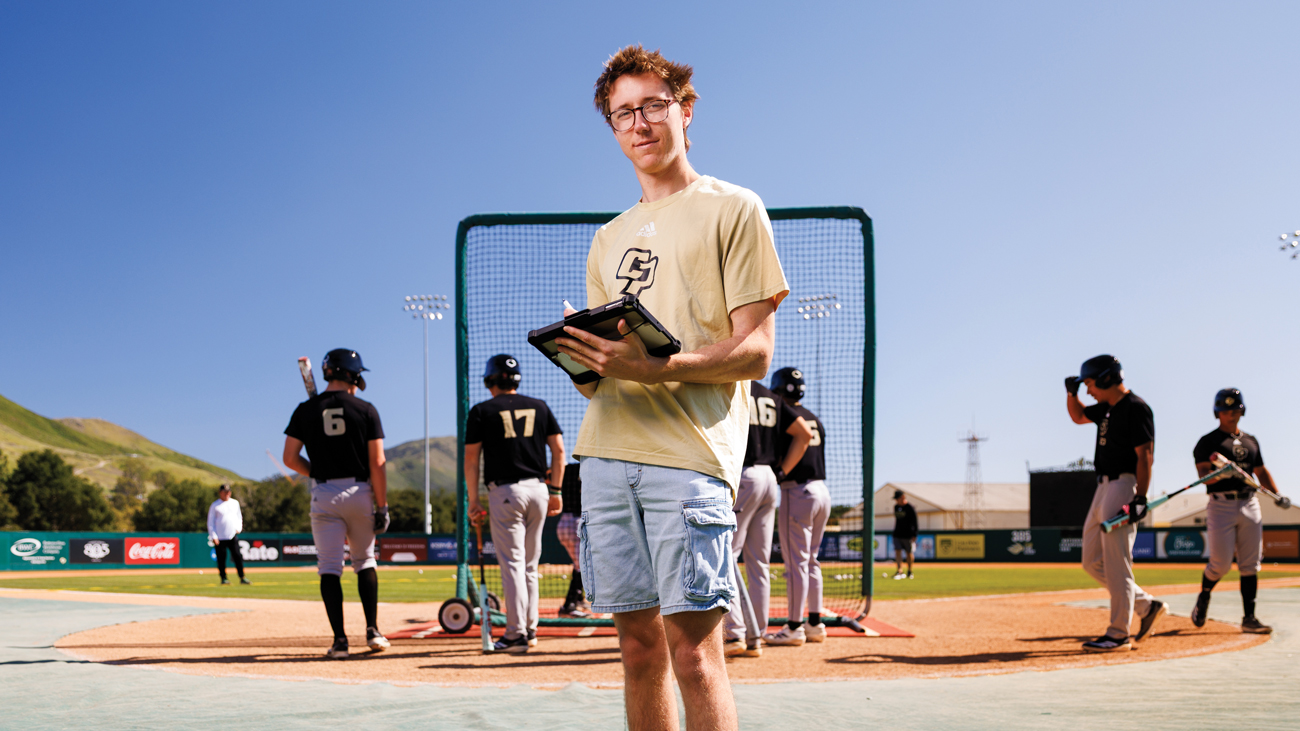
Riedel at a spring practice with Cal Poly’s baseball team at Baggett Stadium.
As a mathematics major and lifelong baseball fan, I knew when I set foot on Cal Poly’s campus as a first-year that I wanted to work with statistics for Cal Poly Baseball. I reached out to head coach Larry Lee asking if there were any opportunities. He connected me with a small group of student managers working in analytics. I joined in, forever changing my college career.
When I first started as an analytics student manager, our team compiled video at games and filled out basic scouting reports. I showed up to as many scrimmages and games as I could. The office in the baseball clubhouse became my permanent study space. The work gave me purpose, and I loved being around people who were just as passionate about baseball statistics as I was.
Over the past few years, our small group of five has grown into something much larger. We now have 25 student managers working across data engineering, research and development, scouting, and baseball science (biomechanics) departments.
What once centered on tagging video and organizing reports has evolved into a fully built analytics pipeline. We design databases that house years of pitch and player data. We build models that evaluate performance and project development. We integrate video, advanced metrics and biomechanical information to support internal player development, transfer and player acquisition decisions and competitive scouting analysis.
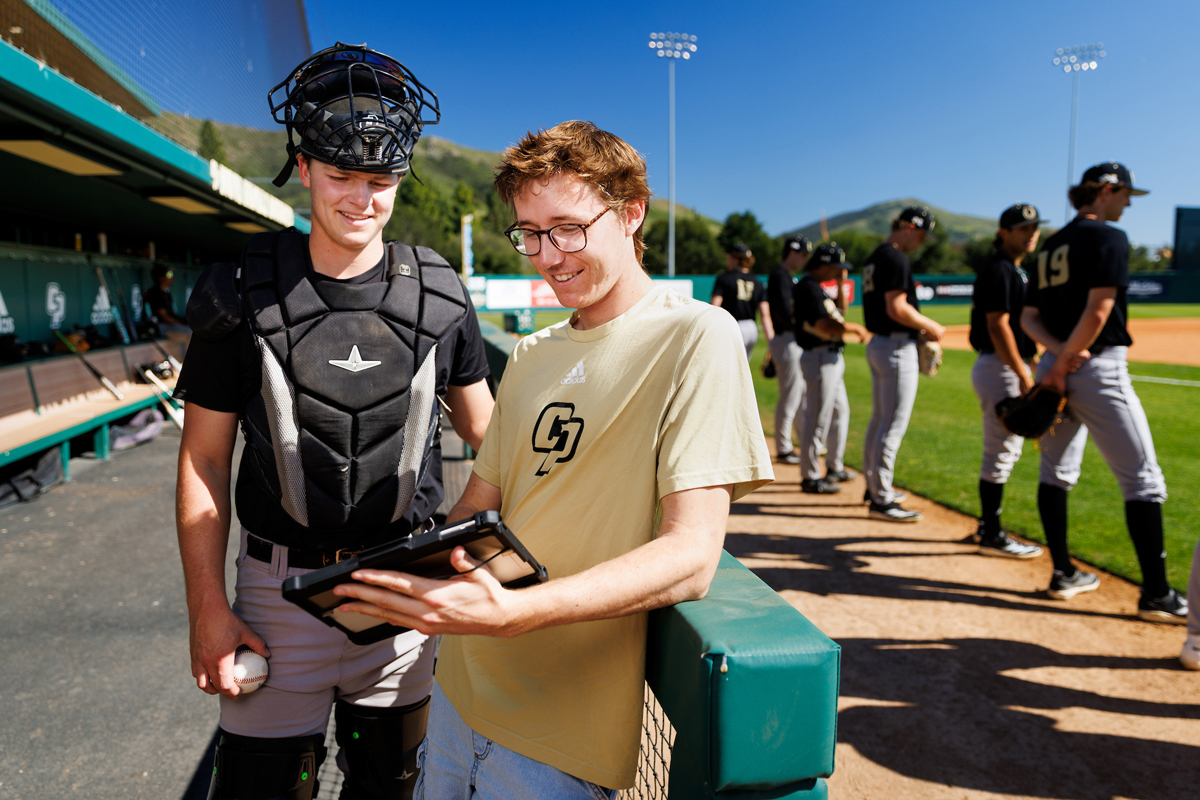
Catcher Vinnie Van Der Wel (left) consults with Riedel during a Cal Poly Baseball practice.
The most meaningful part of this growth has been seeing how directly my mathematics degree connects to this work. When I sit down to evaluate a pitcher’s pitch mix, model swing decisions or analyze player development trends, I am using the same probability, statistics and logical reasoning skills I practice in my math courses. The classroom gave me the theory, and the baseball diamond gave me the application.
Studying math has trained me to break complex problems into smaller parts, search for patterns and question assumptions. In analytics, that mindset is everything. Data is rarely clean or straightforward. Results are rarely black and white. My math background has helped me become comfortable working with uncertainty, building models that make assumptions explicit, and validating whether conclusions are actually supported by evidence.
Higher-level math strengthened the way I think. Writing proofs forced me to justify every step of a process, and more abstract courses pushed me to think structurally rather than procedurally. That discipline translates directly into analytics work and how I approach solving any problem in my life.
This program has shown me that mathematics is not just abstract theory but rather a tool for understanding things that happen in the real world.
Gabe Riedel
What makes this experience truly Learn by Doing is that I am not just solving textbook problems. The questions we tackle affect real players and real decisions. The feedback is immediate.
If a model is flawed, it shows. If an insight is valuable, it gets used. That accountability, which played a part in helping the team win the Big West Conference in 2025, has accelerated my growth far beyond what I could have imagined when I emailed Coach Lee in the first quarter of my college career.
This program has shown me that mathematics is not just abstract theory but rather a tool for understanding things that happen in the real world, like performance, decision-making and human movement. It has given me purpose, and most importantly, it has prepared me for what comes next.
After graduation, I will be joining the Seattle Mariners’ research and development team, where I will continue applying the critical thinking and quantitative skills I developed at Cal Poly to the game I love.
I found a way to turn my love for math and baseball into something real, and I can’t wait to see where it takes me.
Your Next Read
Head coach Caroline Walters breaks down the factors behind Cal Poly Volleyball’s latest conference championship and epic postseason run.
Two alumni developed an alternative to chewing tobacco that is making its way into professional baseball, football and hockey.