Alumni
Getting Ready for Takeoff
Air Force engineer Ivan Cheng’s time as a Cal Poly Scholar prepared him for a career fueled by a love of flight and a passion for service.
By Larry Peña
Photos courtesy of Ivan Cheng
Share this article:
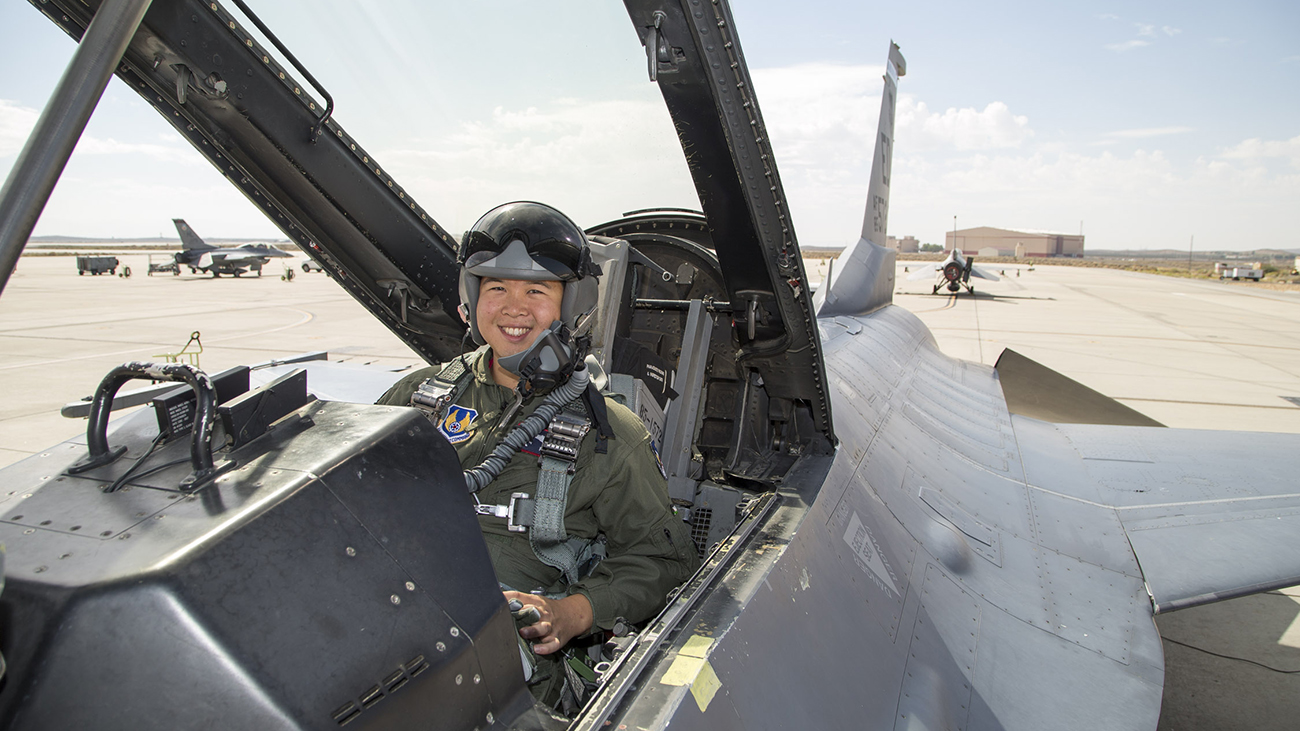
Ivan Cheng in an F-22 Raptor on the runway at Edwards Air Force Base.
For lifelong airplane enthusiast Ivan Cheng (Aerospace Engineering ’16), working with some of the most advanced aircraft in the world is a dream come true.
Cheng is a flight test engineer at Edwards Air Force Base in Southern California, where he leads a team of engineers who make sure that the nation’s aviation assets are safe and ready to fly.
“Whether it’s a completely new airplane like the new stealth bomber or upgrading existing platforms such as the F-22 jet fighter, we have to check out every aircraft and make sure they go to field without any bugs,” he says. “The last thing you want is for pilots to have issues with their own systems in the air.”
At Edwards, flight test engineers generally work on one of two objectives: flight sciences, which examines how the aircraft fly and maneuver through the air; and mission systems, which examines all the other tools the pilots use to complete their objectives. Cheng supervises a mission systems team that ensures good working order for critical non-flight components such as radar, communications and even weapon systems.
“Being able to work with aircraft directly is a treat for me,” he says. “I basically get to see an air show every day.”
Cheng has loved airplanes since childhood. Growing up in Southern California, he recalls his excitement every New Year’s Day seeing the B-2 bomber fly over his family’s home on its way to the Rose Bowl. But breaking into the aerospace engineering field was a challenging journey.
Cheng’s parents were both immigrants from Taiwan and he was the first in his family to attend college for a STEM degree, so navigating that transition was a major hurdle.
“It was a completely new environment and a huge culture shock going to college,” he said.
Fortunately, Cal Poly was in the process of launching Cal Poly Scholars, which was designed to address his exact situation. Cheng was admitted to the university as part of the program’s first cohort.
“Cal Poly Scholars was the only reason why I attended Cal Poly, and I’m so glad I did,” he says. “They provided the resources I needed, whether it was technological or advisors, to set me up for success in going to school. Every quarter I was speaking with an advisor to figure out my plan to get to graduation.”
For me, it’s about serving the public and looking out for our people. Civil service is not a business. There’s no such thing as profits — it's all to accomplish the mission.
Ivan Cheng
From the first year, Cal Poly’s aerospace engineering program was a challenge. Cheng recalls diving into the deep end right away, when he had to design and build a working model aircraft from scratch in an introductory class.
“We hadn’t had any conceptual teachings yet of how wings worked, how weight and balance worked,” he said. “It was just, ‘Go figure out how to make an airplane.’ I remember working for hours on one component, and then actually seeing the whole thing come together and fly. It was really joyous to see the fruits of your labor come to fruition.”
One particularly formative class for Cheng was Conceptual Design of an Aircraft System, in which teams of engineers tackle a specific problem. The experience showed him the importance of engineering skills beyond the technical.
“It was about more than just figuring out our mechanical problems,” he says. “We had to communicate with not only our teammates and our instructor, but also outside stakeholders, and learn how to communicate technical and complex issues and explain your reasoning so that others can buy in.”
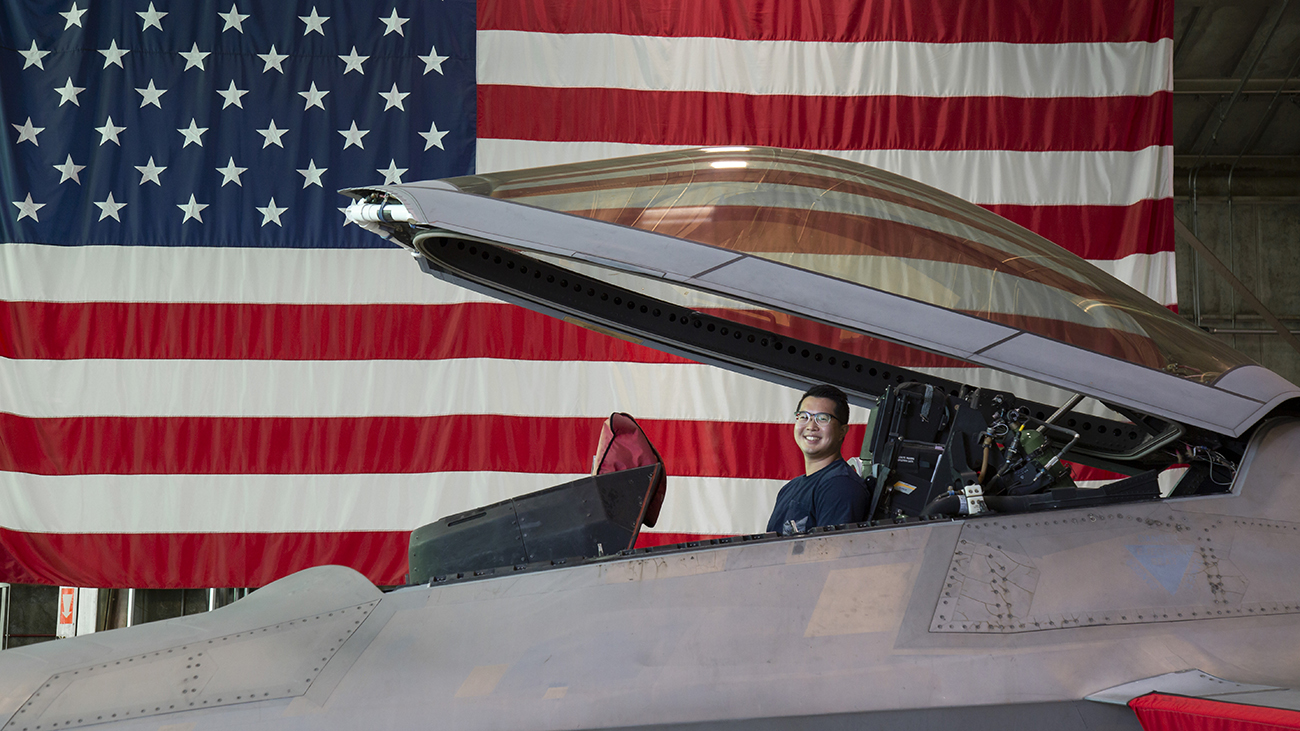
Cheng on the job inspecting an F-22 Raptor in the hangar at Edwards Air Force Base.
The course also introduced Cheng to the idea of working with the Air Force. He knew he wanted to work in aviation, but he didn’t have a particular direction until a class visit to Edwards.
“The presenter described the mission of the flight test engineering team — serving the country, serving our national defense and protecting people,” he said. “I fell in love with that mission very quickly.”
As a kid, Cheng had watched his mother work as a civil servant in the Los Angeles County Department of Children and Family Services, where she ensured that struggling families had access to assistance. He realized that he wanted to prioritize service in his career.
After graduation, he said he received a lot of promising aviation-related job offers, but a role at Edwards appealed to him even though it wasn’t the most lucrative.
“For me, it’s about serving the public and looking out for our people,” he says. “Civil service is not a business. There’s no such thing as profits — it’s all to accomplish the mission. And the mission isn’t completed without people, so I get to prioritize taking care of my people. I get to go home every day feeling better that I am protecting my friends, family, neighbors and Americans overall.”
Your Next Read
When Nailah Dubose completed her bachelor’s degree, she left a legacy of change and community. Now a graduate student, DuBose reflects on her leadership journey.
At a university whose name literally means “many skills,” meet four students driven to excel in multiple ways.