Featured
I Am Polytechnic
At a university whose name literally means "many skills," meet four students driven to excel in multiple ways.
By Larry Peña
Photos by Joe Johnston
Share this article:
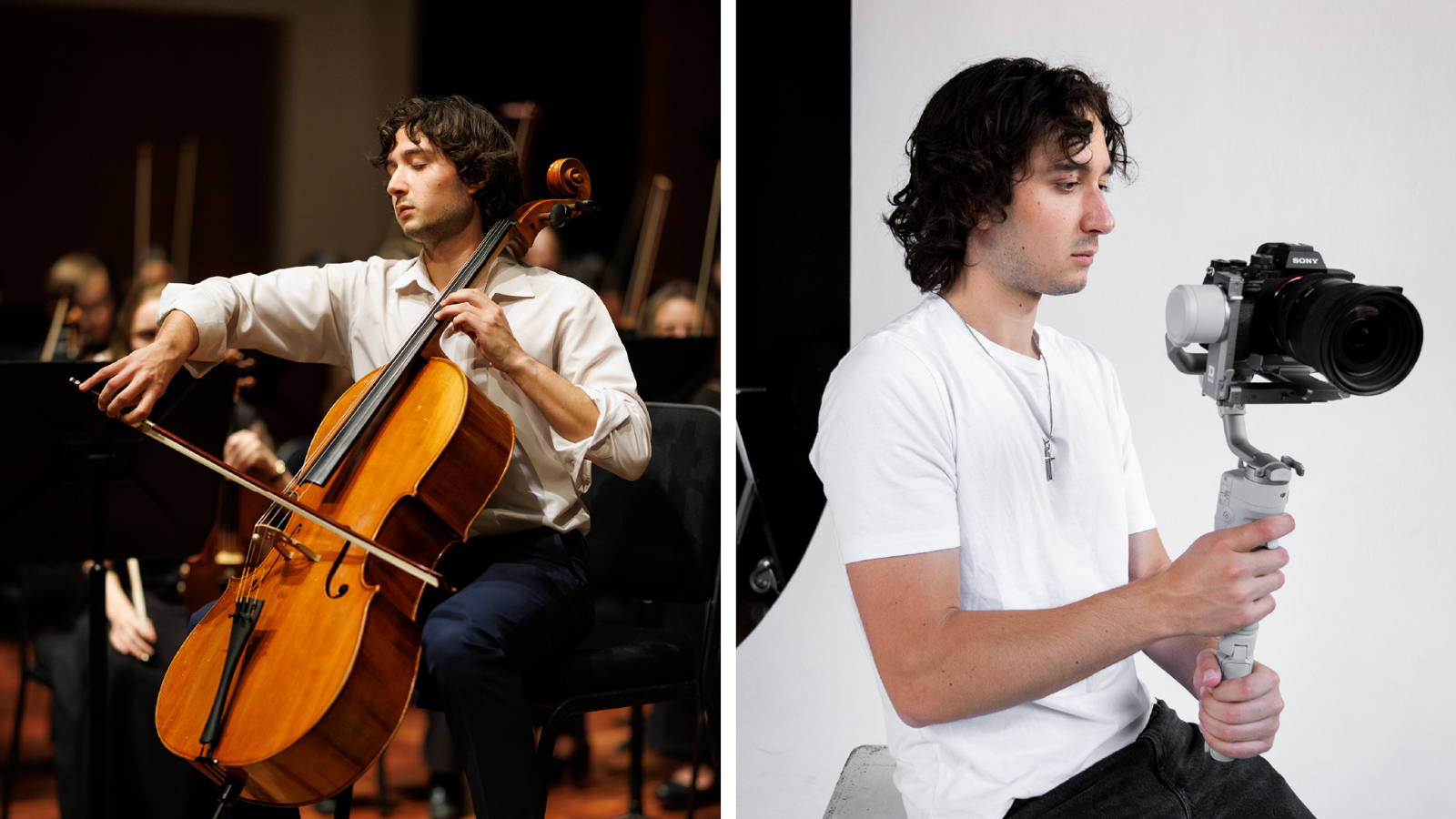
Business major, photography and Spanish minor Ayden Gregory performing a solo with the Cal Poly Symphony (left) and on the job as a freelance photographer (right).
For many students at Cal Poly, doing one thing well just isn’t enough. It’s in the name — the word “polytechnic” means “skilled in many arts,” and while in higher education that usually refers to schools focused on applied and hands-on learning, many Mustangs take that meaning very literally.
We met with four of the many students at Cal Poly who embody the polytechnic ideal: people with diverse combinations of interests, skills and experiences who are forging their own paths and finding unexpected connections in the classroom and beyond.
Keeping Busy with Cal Poly Symphony
Ayden Gregory, third-year business major, with minors in photography and Spanish
Onstage at the Performing Arts Center last spring, Ayden Gregory experienced a musical highlight of his life. As he glanced out at a sold-out audience of more than 1,200 people, he gripped his cello and prepared to play Elgar’s Cello Concerto in E Minor.
He last played the piece onstage four years before, at an audition for a solo with the Sacramento Youth Symphony. That time, he didn’t get the spot. This time, the spotlight was on him.
“I couldn’t contain my joy. It was crazy,” he said. “And the weirdest thing is, I wasn’t even nervous in front of an audience of more than 1,000 people. I was just purely joyful.”
Gregory, who has played the cello since he was 9, devotes at least six hours a week to various rehearsals, both in groups and solo. It’s a hefty time commitment, especially considering that it’s not remotely connected to his major or two minors.
I'm constantly reminded, with anything I'm doing, it's not about perfection, but it's about showing up every day and being consistent in whatever it is.
Ayden Gregory
“I’m always trying to find ways to have more time, and thinking about what I need to be doing right now,” he says. “Do I need to drop something? If I want to put more time into X, do I need to reevaluate Y? But cello has never been one of those things where I want to compromise.”
The business major chose a concentration in marketing and a photography minor to help grow a freelance photography business he has had since high school. His clients have included local restaurants, the City of Rancho Cordova (near Sacramento), and Cal Poly Athletics — and he’s always working to build new client connections as he aims to leverage what he’s learning in class to turn photography into a full-time job after graduation.
“Business marketing allows me to have a broad scope of knowledge for whatever I go into,” he says. “Even if I’m good at my craft, if I don’t know how to manage the business side of things or connect with potential customers, I won’t be as successful as I could be. This knowledge will help me in my career wherever I go, because they are essential skills to possess in order for any business to thrive.”
Last year he added a new minor in Spanish. He had already studied the language for six years before starting college, but he hadn’t considered continuing to study it formally until a recent mission and humanitarian trip to El Salvador. His background in Spanish enabled him to communicate better with locals, and he realized that by learning more he could be of greater service.
“I’m just interested in so many different things — it can be monotonous doing the same thing every day. I’d rather be good at a lot of things than great at just one thing,” he says. “I’m constantly reminded, with anything I’m doing, it’s not about perfection, but it’s about showing up every day and being consistent in whatever it is.”
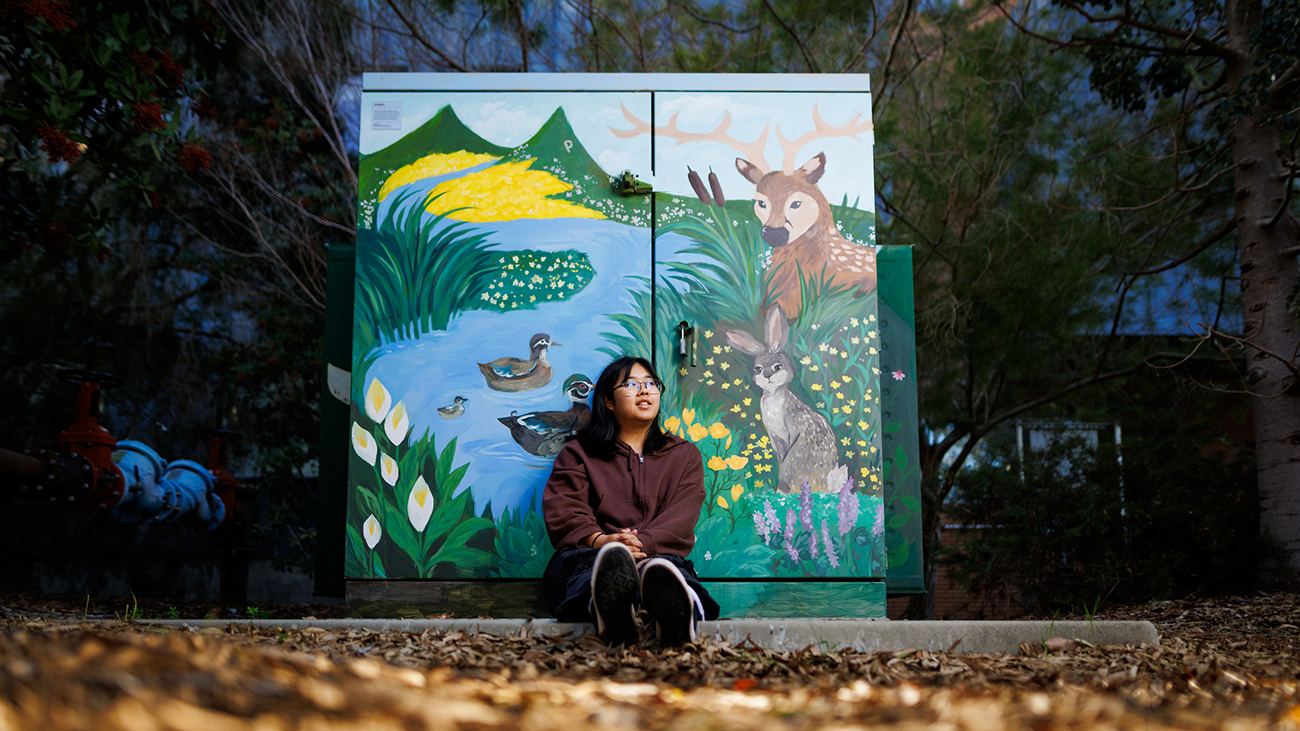
Electrical engineering student Victoria Dai in front of a campus utility box she designed and painted last fall.
Cultivating Creativity in Engineering
Victoria Dai, third-year electrical engineering major, agriculture researcher and artist
Engineering was never the obvious choice for Victoria Dai. An avid artist, she had been accepted to study at top art schools including Parsons, Rhode Island School of Design and ArtCenter. But she was discouraged by the impact of AI on the art world and turned to another passion she had developed in high school.
“I was an FRC girlie,” she said of her work on her school’s FIRST Robotics Competition team, where she had specialized in the robot’s electrical subsystems. With that experience in mind, she decided to explore a career in electrical engineering (EE).
Even with EE’s famously demanding course load, Dai knew she was never going to focus on just one thing.
“I think that being a jack of all trades is really important,” she says. “It’s part of being a well-balanced person. You can’t put all your eggs in one basket, you know?”
Some of the most important experience she’s gotten in EE has been affiliated with an entirely different field of study: agriculture.
In her first year, Dai got involved with GrowCrew, a student club affiliated with the BioResource and Agricultural Engineering (BRAE) Department focused on advancing innovative sustainable farming practices. In her second year with the group, she was a technician and paid researcher at the department’s experimental vertical farm facility, and this year she’s the group’s president.
I think that being a jack-of-all-trades is really important — it's part of being a well-balanced person. You can't put all your eggs in one basket, you know?
Victoria Dai
Her work with BRAE professor Sara Kuwahara involves harnessing the power of microscopic bubbles to deliver vital nutrients more efficiently to hydroponically-grown food crops.
“You wouldn’t think that something agriculturally-focused would be related to electrical engineering,” she says. “But on a vertical farm, there’s so much electricity and energy powering the whole operation, and you need people to design and manage those systems.”
As she hits her upper division EE classes this year, she says the higher-level physics and math courses have been a challenge — those subjects were never her strong suit.
“But the people here are so wonderful and there’s so much support,” she says. “Honestly, everything’s doable. You’ve just gotta put in the work.”
Even though her courses, club activities and research projects demand a lot from her, she still makes art in a variety of media, from oil painting and ink drawing to woodworking and found material sculptures.
She’s painted murals on the walls at the student experimental farm, and last year won the opportunity to paint a series of large utility boxes around campus. One design she completed this fall featured a gathering of wild animals on the electrical unit near the Baker Center.
She even recently won the Platinum Award at an art competition hosted by the College of Engineering. Her entry, “Little Bug City,” was an intricate drawing of a miniature cityscape packed with a shocking amount of detail.
“Art is something that I would be doing no matter what I chose to study,” she said. “It’s just vital to who I am as a person. It’s mentally stimulating, and also it’s just a great way of giving back to your community.”
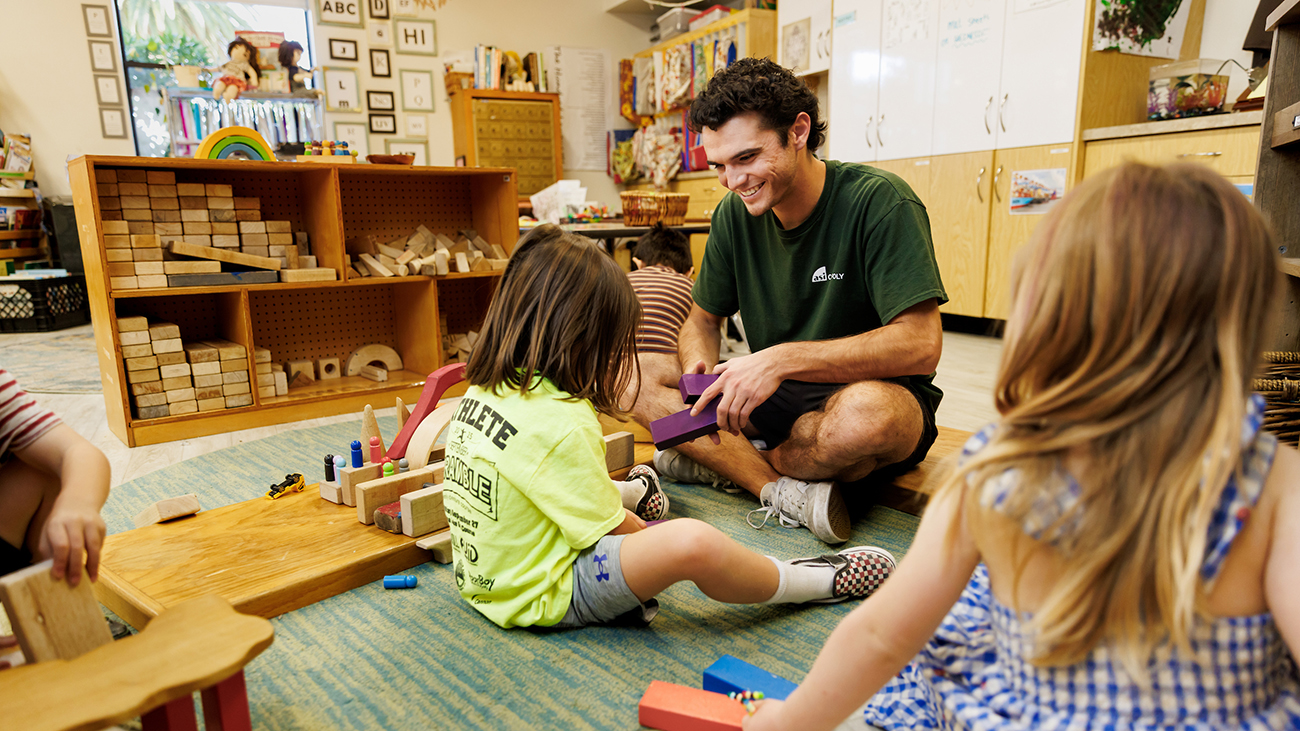
Construction management student Jacob Perch at his day job at the Orfalea Family & ASI Children’s Center.
Going Into the Family Businesses
Jacob Perch, third-year construction management major
All his life, Jacob Perch watched his dad run the construction company his grandfather built in Visalia, California. Starting in high school, he spent every summer interning with the company, getting hands-on experience in the family business.
When it came time to think about college and the future, he already knew what he would do. He wanted to study construction management at Cal Poly — just like his dad — and one day lead crews and eventually oversee larger projects with the family’s company.
“This was the school I always wanted to go to and follow his footsteps. They have a great program here,” he said. “I know that path works. He’s done it, so I can figure out a way to do it myself.”
But while in school, he needed work to help pay bills in between summer construction jobs back home. For that, he took inspiration from his mom’s time as a Mustang. She studied child development and worked in the Orfalea Family & ASI Children’s Center.
“The cool thing about on-campus jobs like ASI is that they work around your school schedule,” he said. “And I’ve always liked kids, especially 3- and 4-year-olds.”
While most Children’s Center student employees tend to be education or child development majors looking to build experience in the field, there are no specific major requirements for students to work there.
Perch usually spends a few hours per week at the center between classes, supervising the young kids and helping facilitate classroom and outdoor curriculum.
It feels good when you're with a kid and you're able to make them laugh, or help them work through a problem with something they’re building — just to see the smiles on their faces and see them get really excited about something.
Jacob Perch
In his construction management courses, he’s building walls and pillars and pouring concrete — things he’s done before. But now, he’s doing it in a lab while conducting stress test measurements and getting a lesson on the physical and mathematical principles behind the familiar processes.
“A lot of what I’m learning are things I already know at some level, but my teachers break it down in a much deeper way than what I’ve been taught so far,” he said.
Other courses give him a chance to study other sides of the industry that are new to him. Last quarter he took a class on surveying, a critical process that happens before construction gets underway.
“We’re out in the field once a week and we’re getting to use all these different pieces of technology — measuring angles, using satellite imaging and ground penetrating radar,” he says. “That’s been really interesting and new to me.”
While his studies and his day job don’t overlap much, being a construction guy doesn’t hurt when it comes to Lego time in the Children’s Center classroom.
“I was huge into Lego as a kid — I still probably have thousands of dollars’ worth in my closet back home,” he says. “It feels good when you’re with a kid and you’re able to make them laugh, or help them work through a problem with something they’re building — just to see the smiles on their faces and see them get really excited about something.”
Perch says his parents seem to enjoy watching his college experience mirror both of theirs.
“My dad thinks it’s great — I still work with him every summer and he knows my ultimate plan is to come and work for him,” he says. “My mom knows I’m not going to work in education long-term, but she calls me all the time wanting to hear about my experiences with the kids. She loves every bit of it.”
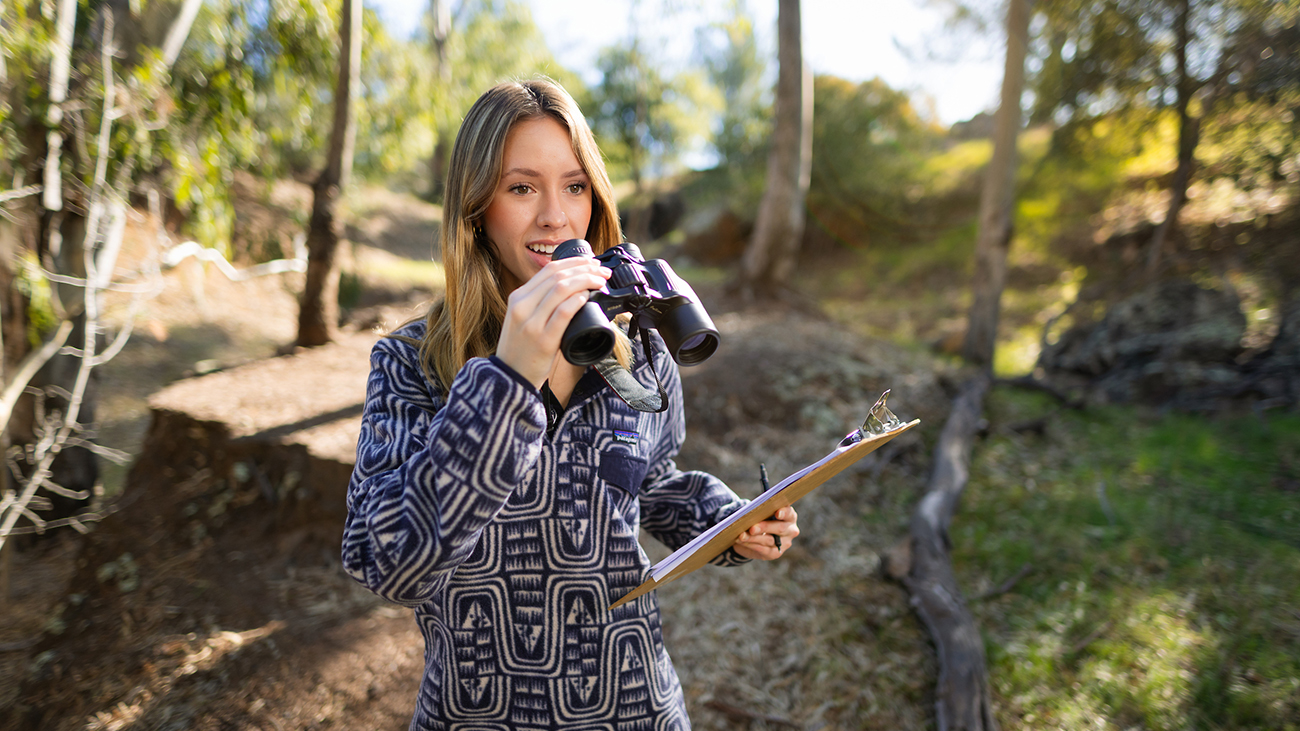
Biological sciences/theatre arts double major Kiana Brumbaugh scoping out local wildlife on campus.
When the Stage is Your Natural Habitat
Kiana Brumbaugh, third-year biological sciences and theatre arts double major
Kiana Brumbaugh was just about to start college as an English major when her life changed.
On a family vacation to Yosemite National Park, Brumbaugh, an avid wildlife lover, was listening to a park researcher give a presentation on efforts to protect the habitats of fishers, a small weasel-like mammal, when something clicked in her mind.
“I realized like right then and there that whatever this guy’s job is, whatever his title is, that’s what I want to do,” said Brumbaugh, who grew up fascinated with wildlife. “I went up to him after and asked, ‘What do you do?’ And he said, ‘I’m an ecologist.’ So I switched my major.”
But animals aren’t the only thing she’s been passionate about since childhood. She first began performing in youth theatre in third grade and has been involved in school and community productions ever since.
Majoring in both biological sciences and theatre might not seem like the most natural combination, but Brumbaugh has managed to find unexpected synergy between the two programs.
Getting involved in the theatre community at Cal Poly, she landed a supporting role on stage in the musical “The Lightning Thief” and the dark comedy “Mr. Burns: A Post Electric Play” in 2024. In 2025 she was part of the costume crew for “Clue: The Musical.”
Because Cal Poly theatrical productions are open to students from all over campus, they often become melting pots of people with many different interests. While working on “Clue” last year, a chance interaction with a crewmate opened up a completely unrelated opportunity.
“I overheard her talking about this international biology research program she had done in French Polynesia,” Brumbaugh said. “I walked over to her and said, ‘This is amazing — you need to tell me all about this.’”
It was amazing to be able to combine both of those interests and to know what I'm talking about in the script because I actually have a background in those subjects.
Kiana Brumbaugh
Over lunch, the crewmate explained the research program and how to apply. Brumbaugh was accepted for a summer abroad program in Iceland, where she spent six weeks conducting ecosystem field research on Arctic wildlife habitats.
“We backpacked the whole time and got really immersed in the wildlife there,” she said. “We studied a lot of native species — birds, whales and the arctic fox — and learned about how climate change is affecting them.”
This year, Brumbaugh is working on a Cal Poly research project that brings her full circle to the topic that first got her interested in studying biology: mapping the habitats of fishers in California.
Another project she recently took on involved a rare opportunity to combine the two sides in a more cohesive way. The Santa Barbara Zoo partnered with Cal Poly’s Liberal Arts and Engineering Studies program to produce a series of interactive educational videos for the zoo’s visitor center. Brumbaugh got the chance to preview her career goals by playing a conservation ranger in the production.
“It was amazing to be able to combine both of those interests and to know what I’m talking about in the script because I actually have a background in those subjects,” she says.
But as she thinks about her future long-term, she’s excited about the idea of two distinct paths that don’t necessarily need to intersect.
“I think it is important to have something I love and want to pursue as a career — like ecology and conservation research — while having a separate creative outlet in theatre and performance,” she says. “These different passions help me fulfill different aspects of myself, and I’m hoping that will give me a balanced and well-rounded life.”
Your Next Read
When Nailah Dubose completed her bachelor’s degree, she left a legacy of change and community. Now a graduate student, DuBose reflects on her leadership journey.
In a unique class last fall, a group of students worked with fire professionals to set a portion of university land ablaze.