Editor's Desk

The Meaning of Polytechnic

Editor Larry Peña discusses the value of being a jack-of-all-trades — and a master of bringing them all together

By Larry Peña
Photo by Joe Johnston

Share this article:

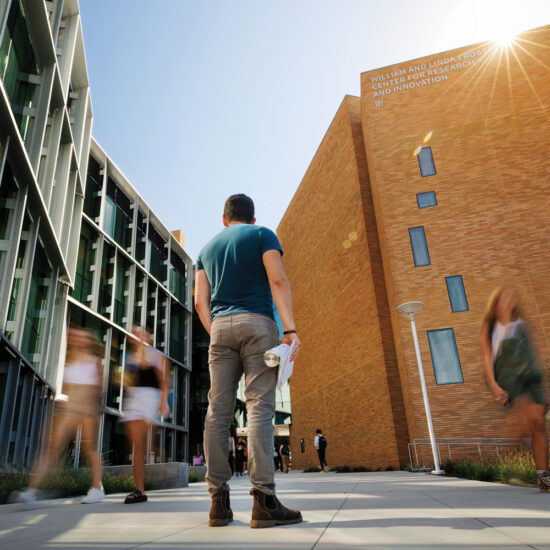
Editor Larry Peña at the entrance of the Frost CenterThis year we celebrate the 125th anniversary of Cal Poly. Since our founding as California Polytechnic School in 1901, that middle word, “polytechnic,” has been almost as central to our identity as Learn by Doing.  

If you look up the literal definition of “polytechnic,” you’ll find it means something closer to “skilled in many arts.” That’s another place where we are once again ahead of the curve. 

Many of my favorite stories I’ve found at Cal Poly are truly polytechnic in nature — students and faculty innovating at the crossroads of disciplines. 

Just to name a few examples, the BioResource and Agricultural Engineering Department brings agriculture experts and technologists together to find better ways to grow food in a changing climate. The Center for Innovation and Entrepreneurship helps students build multidisciplinary teams that bring cutting-edge ideas to life. The Ethics + Emerging Sciences research group pairs philosophy professors with subject matter experts from AI to space exploration to help answer some of the future’s most critical questions.

Mustangs are not content to stay in their lanes — they’d rather build a whole new road going somewhere we’ve never been.

Being “skilled in many arts” doesn’t just make a student a useful, interesting person. It’s an essential value in our ever-changing world. Making connections between different ideas, finding collaborators with diverse skillsets and viewpoints, looking at an old problem from a new perspective — these are critical factors in building a future worth living in. 

At a university where students declare a major before even setting foot on campus, you might expect most students to lock into their areas of study: doing one thing and doing it well. But when we decided to develop a feature profiling students embodying the polytechnic ideal, the problem wasn’t finding the students. It was narrowing down which stories to focus on. 

Cal Poly students tend to be incredibly well-rounded individuals, pursuing a variety of interests or applying their new knowledge in unexpected ways. They’re not content to stay in their lanes — they’d rather build a whole new road going somewhere we’ve never been. 

That’s the polytechnic ideal, and combined with the power of Learn by Doing, it’s why, 125 years in, we’re still just getting started.

Your Next Read

At a university whose name literally means “many skills,” meet four students driven to excel in multiple ways.

When Nailah DuBose completed her bachelor’s degree, she left a legacy of change and community. Now a graduate student, DuBose reflects on her leadership journey.