Featured
What Leadership
Looks Like
When Nailah DuBose completed her bachelor’s degree, she left a legacy of change and community. Now a graduate student, DuBose reflects on her leadership journey.
By Gabby Ferreira // Photos by Joe Johnston and Dylan Head
Share this article:
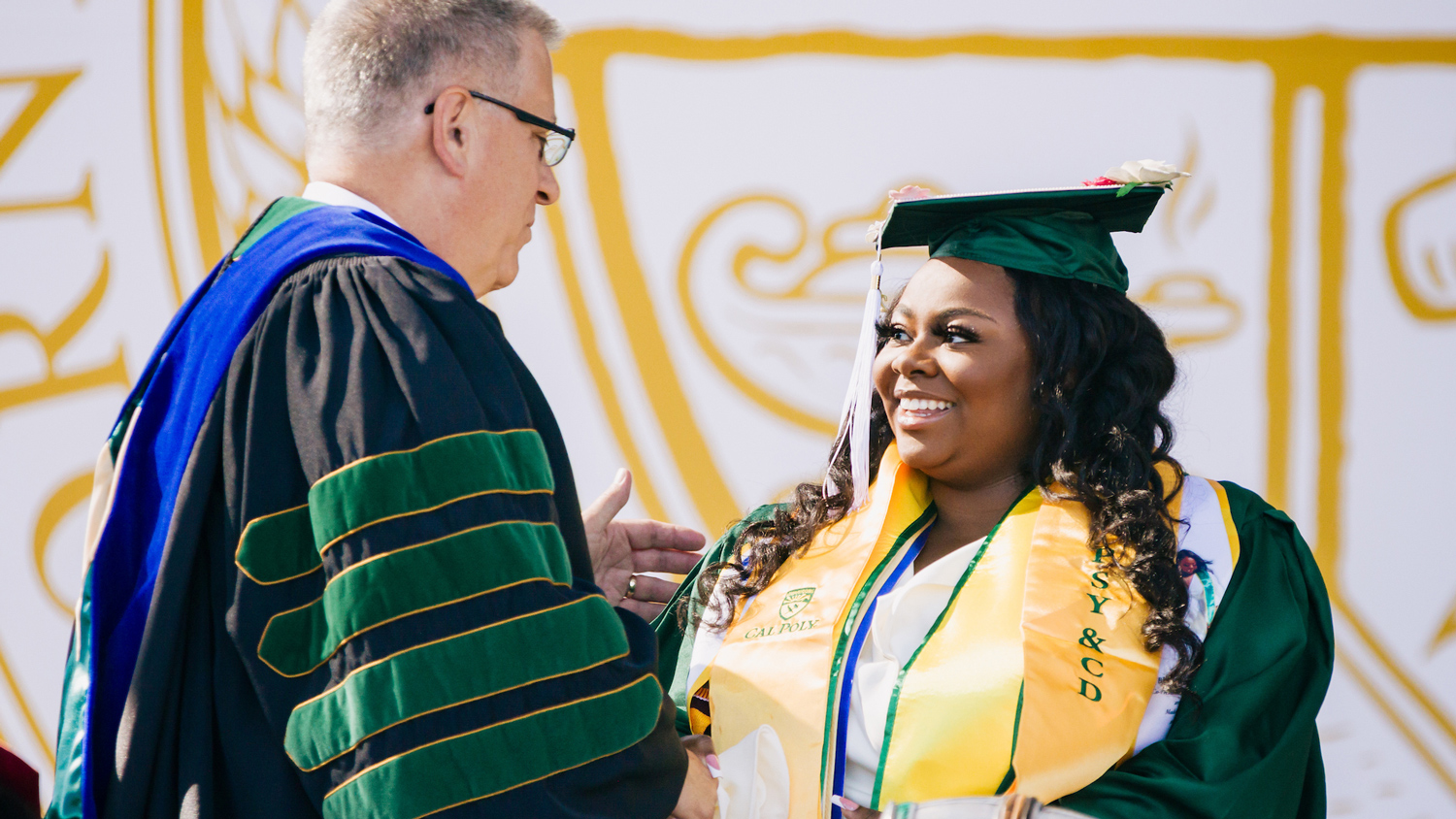
Nailah DuBose (right) shakes hands with President Jeffrey D. Armstrong at Commencement in 2025.
It was a bright, sunny day in May, just a few weeks before graduation. Nailah DuBose was running from a midterm to the President’s Diversity Awards ceremony, excited to support the students, faculty and staff who had become friends throughout her undergraduate career.
Instead, she got the surprise of her life: Denise Isom, a mentor and the former interim vice president of the Office of University Diversity and Inclusion (now Culture and Institutional Excellence), presented DuBose with the Dolores Huerta “Si Se Puede” Award for transformational leadership — making her the first student to ever receive the honor.
Wiping away tears, DuBose shakily made her way to the podium to accept the award and a hug from Isom, as friends from the Black Student Union (BSU) and a spectrum of organizations she’d been involved in cheered. Her parents had even secretly made the trip from Sacramento to celebrate one last Cal Poly accolade for their daughter.
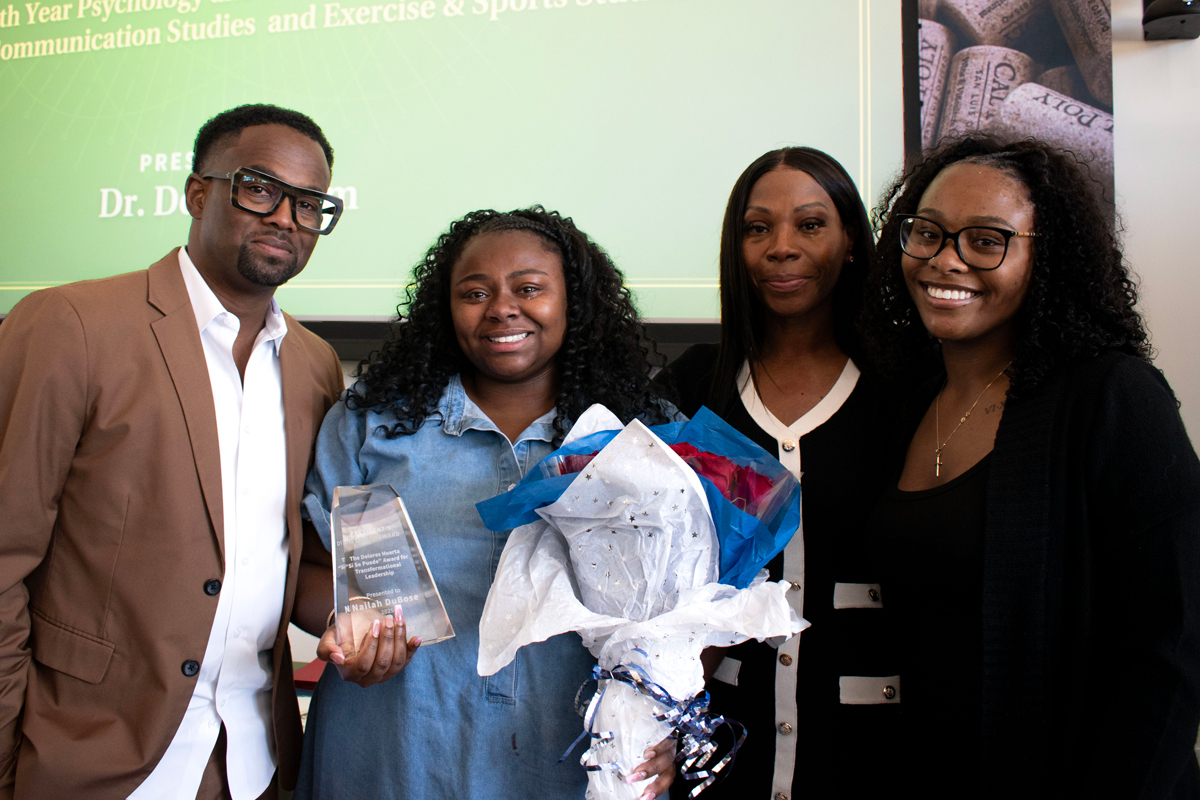
Surrounded by her family, DuBose (second from left) accepts the Dolores Huerta “Si Se Puede” Award for transformational leadership at the President’s Diversity Awards. Photo by Sarah Dinetz.
It was a monumental achievement to cap off four years of community involvement.
Since DuBose arrived at Cal Poly in 2021, she has thoroughly woven herself into the fabric of campus: taking up leadership roles in BSU, getting involved in the Black Academic Excellence Center, chairing the statewide Afrikan Black Coalition Conference held at Cal Poly in 2025, and helping recharter the Zeta Phi Beta sorority. She’s assisted Cal Poly’s partnerships with Texture, R.A.C.E. Matters SLO, and Fortune Schools of Education, and she has worked with Culture and Institutional Excellence as both an intern and graduate assistant.
In addition to the award she received in May, DuBose has been honored with the MLK Legacy Award and the California Community Foundation’s Black Student Scholarship.
But the student who gracefully accepted those awards and bolstered multiple organizations did not know what her journey would look like at the start of her undergraduate career.
“I was a little intimidated. I didn’t think I was going to make it on a larger scale,” DuBose said. “I didn’t think I was going to be hosting a conference. I didn’t think I was going to be bringing back a sorority. I didn’t know what was on the other end of this.
“When I first got to Cal Poly, I thought, ‘I have all this space, I have all this opportunity. Why not make the most of it?’” DuBose said. “It is just not in me to sit down. It is not in me to not connect and be with people. That has really been my motivation, my drive for being as involved as I am.”
Building Community
DuBose said BSU and the Black Academic Excellence Center have played a critical role in her college experience since she started at Cal Poly. Last year, as president of BSU, she played a key role in bringing the Afrikan Black Coalition to campus for the first time — a major achievement.
The Afrikan Black Coalition is a statewide organization committed to developing Black student leaders that holds an annual conference at a different California university each year. Bringing it to any given campus is a lengthy and intensive process, starting with detailed paperwork that must be submitted a year in advance.
“There was some nervousness,” remembered DuBose, who chaired the event. “We were like, ‘Okay, we know we’re a smaller school and we have a smaller population of Black students here, but we know in our heart of hearts that we could really make this happen.’”
It paid off: The conference, held on Martin Luther King Jr. weekend of 2025, drew hundreds of Black high school and college students and staff from across California.
See photos of the 2025 Afrikan Black Coalition Conference hosted by Cal Poly BSU
“It was hard work, but it was good and necessary work,” DuBose said. “Our main goal was to reimagine the conference and to give students the best weekend of their lives. We really wanted to give them that SLO welcome.”
“We had record-breaking attendance. It was beautiful to see the smiles, to see the joy in the room.”
DuBose emphasized that the teamwork between BSU and Cal Poly’s leadership made the dream work.
“When I brought this to our leadership, they instantly said, ‘Yes, we’re going to support this.’ I wasn’t met with any, ‘Hmm, I don’t know.’ It was, ‘We understand the importance of this.’ We took the lead, and they supported,” DuBose said. “It felt like a whole Cal Poly effort. Everybody was tapped in. A lot of faculty and staff showed up to the opening day of the conference. I mean, it was amazing.”
Around that time, DuBose — along with five other women — rechartered the Xi Xi chapter of Zeta Phi Beta at Cal Poly. The sorority is part of the “Divine Nine,” a coalition of historically Black fraternities and sororities. Before then, no Divine Nine organization had existed at Cal Poly for 25 years.
“My [sorority] sister, Maya Glover, who is astronaut Victor Glover’s daughter, really led the charge and then I just came in and supported, utilizing the people I know, the connections we had and my understanding of what it takes to establish a recognized student organization on campus,” DuBose said. “Me and my sisters worked together, and what I love the most is that Cal Poly was so ready to receive us.”
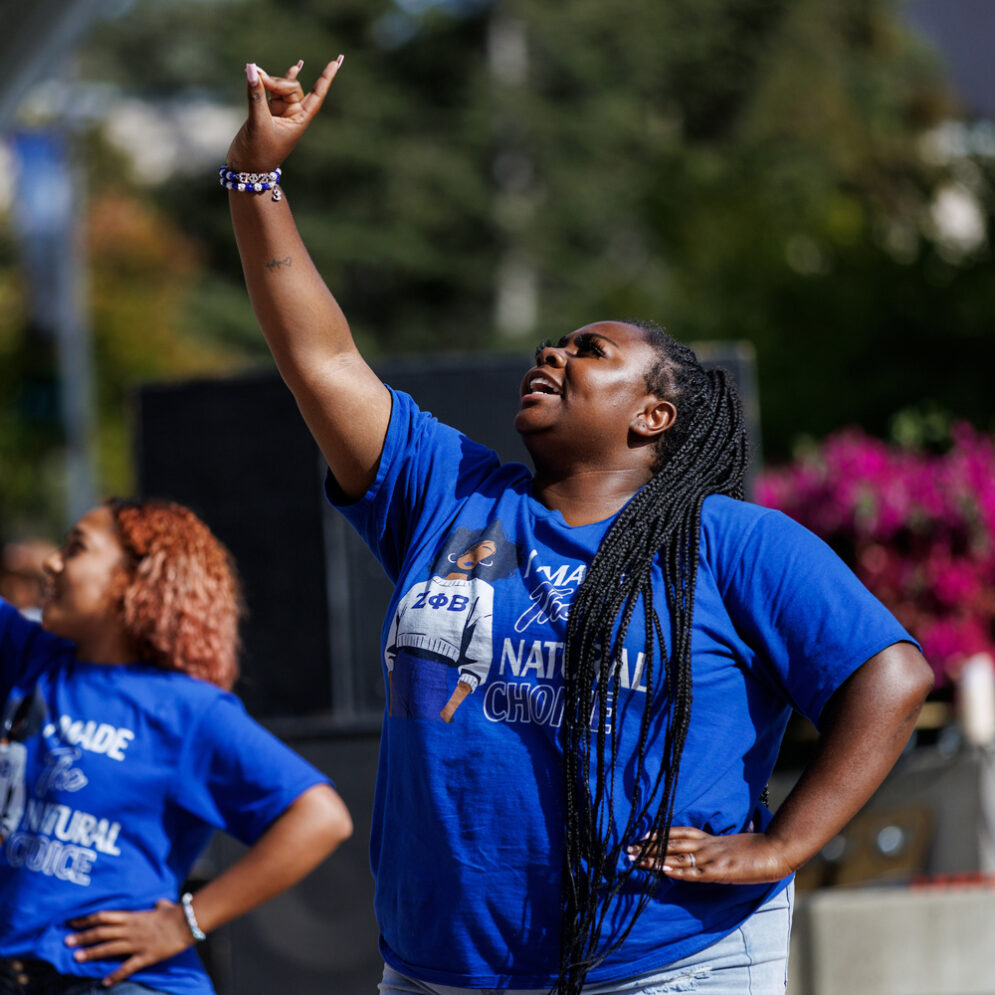
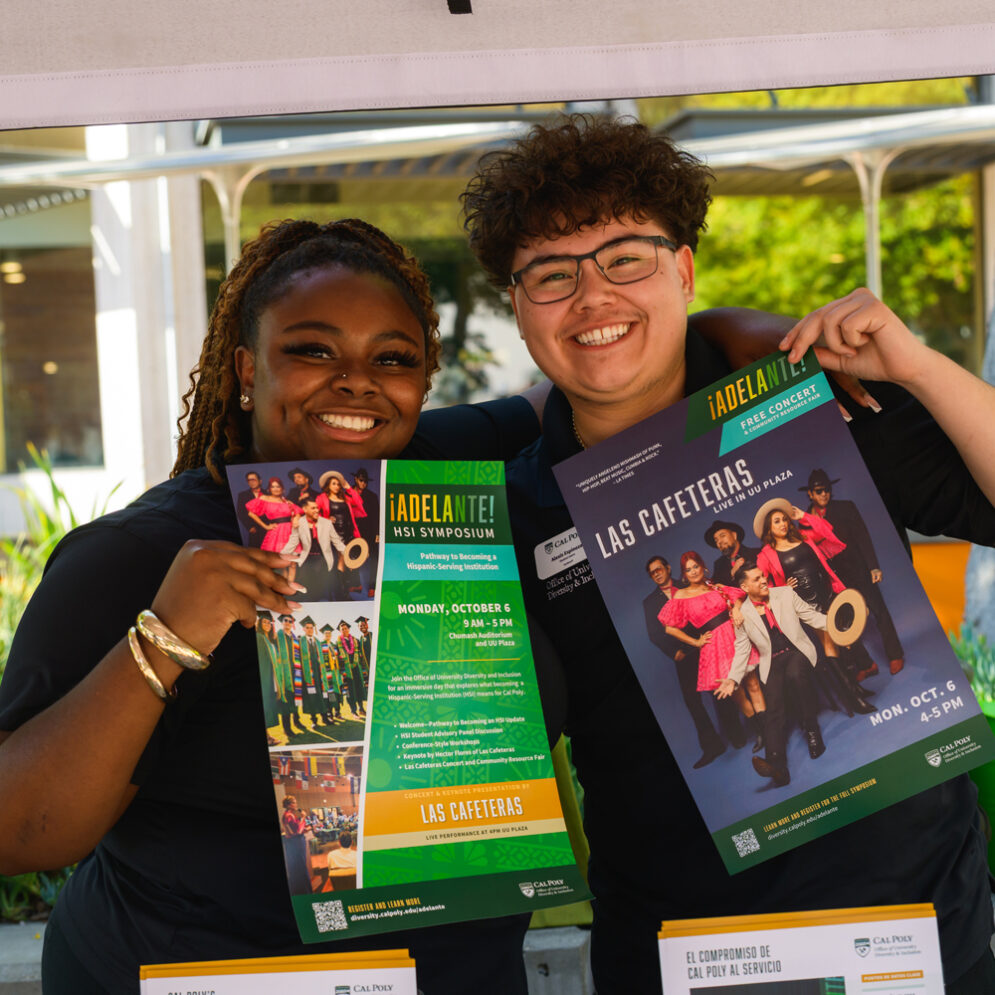
First image: DuBose leads the Zeta Phi Beta sorority members in a performance at Cal Poly’s Culturefest in 2024. Second image: DuBose and Alexis Espinoza promote programs and events to their fellow Mustangs. Photo by Stephan Heraldo.
Before committing to Cal Poly as a high school student, DuBose checked to see if the university had any active Divine Nine organizations on campus. The lack of one wasn’t a dealbreaker for her, but she knew others for whom it was. As part of Zeta Phi Beta, she said she’s been proud to see the interest the sorority has garnered from prospective students.
“It feels so good to have us on campus. All sororities are great, but it’s a little extra special to see young women who look like you,” she said. “Then you learn the history of Zeta Phi Beta and see women that are in our organization and the incredible work they are doing and the charges they’re leading, and it’s like — OK, we really did this!”
DuBose said service and caring for others is the heart of the sorority, and since the return to campus, the organization has been supporting as many different clubs and organizations as they can.
“We hit the ground running with different events. We’ve hosted brunches, we’ve had talks on domestic violence, we’ve partnered with other clubs — we’ve really tried to be a part of building up the Black community here at Cal Poly,” DuBose said. “We really, really care about people, and that’s been our mission since we got on campus.”
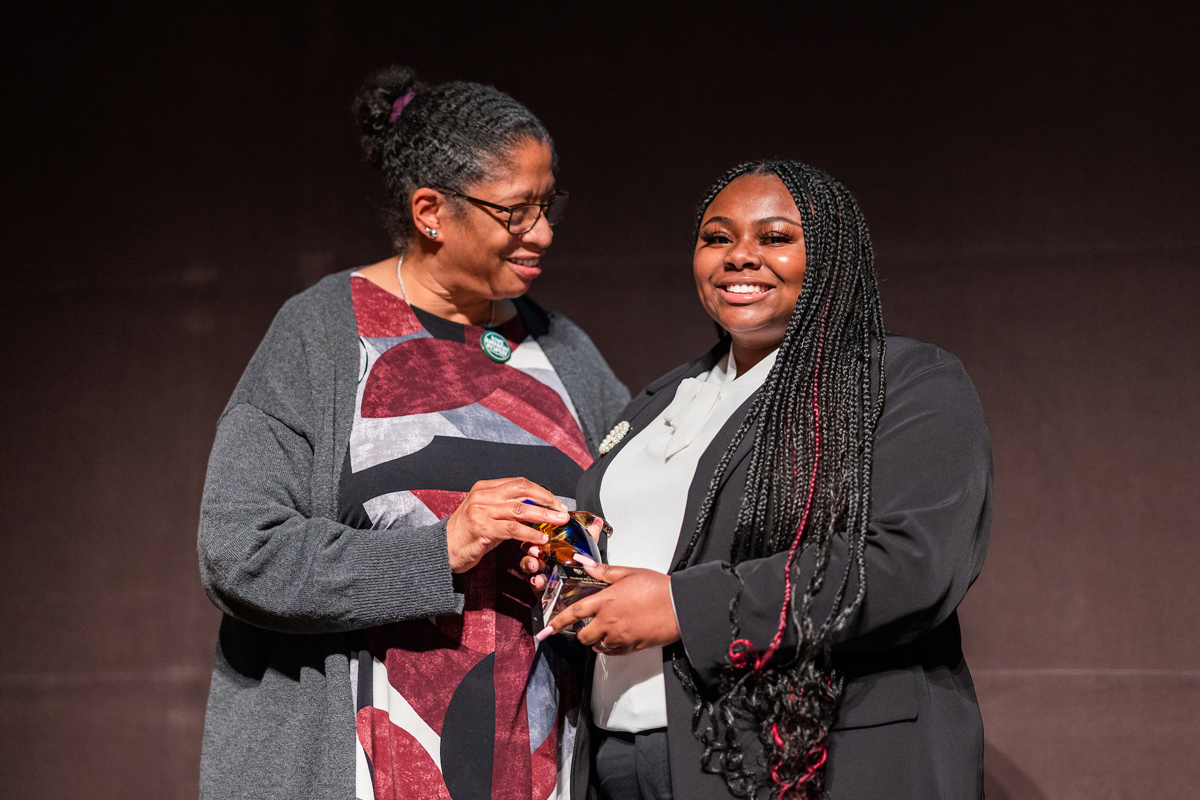
Professor Camille O’Bryant (left) presents DuBose (right) with the 2023 MLK Award. Photo by Dylan Head.
Chasing a New Dream
When DuBose started at Cal Poly, the psychology major had two associate degrees thanks to a partnership between her high school, the Rex and Margaret Fortune Early College High School in Sacramento, and a local community college. She dreamed of a career in sports medicine as an orthopedic surgeon.
But about midway through her undergraduate studies, the dream changed. She started to have doubts when it came to some of the coursework — and then a conversation with a doctor in the field cemented the feeling that it wasn’t the right path for her.
I learned that leadership looks different for everybody ... One of the best things a leader can do is to learn the people that you are leading and adjust accordingly.
Nailah DuBose
“This doctor was doing exactly what I thought I wanted to do, and as he was talking to me, I was like, ‘This does not sound like me. This does not sound like something I would genuinely enjoy doing,’” she said. “I’m so glad I trusted my gut on that.”
DuBose soon realized that her calling was right in front of her — and she’d already been doing the work.
Since her first year at Cal Poly, she’d run a hair braiding service that counted many student-athletes among its clients. The process of braiding can take hours, and DuBose learned to be intentional with the way she set up her space to make it a great experience for them. Often, to pass the time, they’d talk.
“I try to let my clients know, ‘I’m inviting you into this space, and this is your time,’” she said. “I even have some clients who are quiet, and they want a quiet space because they’re around noise all the time. This has really taught me to lean into my intuition, into my gut and learn what it is people need in that moment.”
Then it clicked.
“I just thought, ‘Oh my gosh. I have been doing this. I have been doing therapy work, and I love people. This is everything I want in my career.’”
She realized that her goal was to become a sports psychologist.
“This really feels like what I am called to do,” DuBose said.
Leaving a Legacy
When DuBose started her graduate program in psychology, she decided to lean into her “auntie role,” serving as a mentor who offers guidance, support and a passing of the baton as she turns toward her career.
“I’m being intentional about how I show up,” DuBose said. “As I prepare for practicum and client work, my energy is shifting toward the responsibilities that come with my career, while staying rooted in the community that shaped me.”
Her position in Culture and Institutional Excellence has helped her utilize leadership and mentorship skills she’s honed over the last four years, especially as she works with interns who she first got to know as peers.
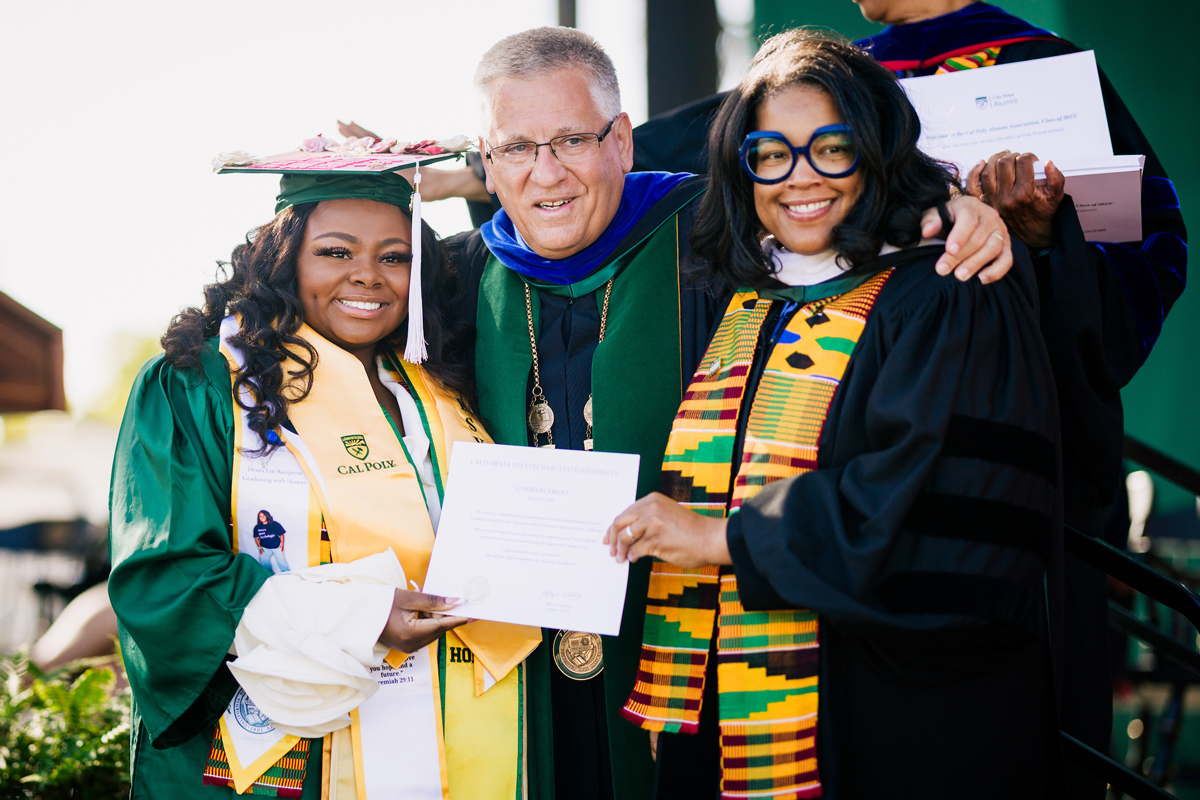
DuBose celebrates commencement in 2025 with President Jeffrey D. Armstrong (center) and Margaret Fortune (right).
“My time as president and co-president of the Black Student Union taught me a lot about task delegation, and that made me extremely organized when it comes to trips and managing people. It also showed me the type of leader I don’t want to be,” DuBose said. “ I know that these are all very capable students, and they’re all leaders in their own rights. I don’t need to micromanage them. If they need support, they’ll let me know.”
She has grown from working as an intern and the Black Student Success Initiatives liaison to managing undergraduate interns, supporting event coordination and helping with programs and initiatives in Culture and Institutional Excellence.
“I learned that leadership looks different for everybody, and you need to personalize your leadership style for each person you’re serving,” she said. “At BSU, we had a board of 11 people. That’s 11 different personalities with 11 different communication styles. I learned that one of the best things a leader can do is to learn the people that you are leading and adjust accordingly.”
Another lesson: accountability is key. So is being human.
“Being okay with holding yourself accountable and making mistakes has really helped me as a leader and kept me grounded,” she said. “A lot of times, people are trying to be perfect and not make any mistakes. If you’re always living like that, you are going to give yourself a big headache. You will make mistakes. You’re human. And people will see that, too.”
But most of all, as she looks back on her undergraduate career, DuBose is grateful for the opportunities she had to develop connections and build a thriving community.
“I really want to make an impact and leave behind a legacy here at Cal Poly. I think Cal Poly has given me so much opportunity, resources, and they’ve really given me the space to develop into the woman and the type of leader that I want to be.”
Your Next Read

At a university whose name literally means “many skills,” meet four students driven to excel in multiple ways.

In a unique class last fall, a group of students worked with fire professionals to set a portion of university land ablaze.