Alumni Startups
What's Your iQ?
Generations of alumni entrepreneurs returned to celebrate 20 years of Cal Poly’s Innovation Quest — a critical launchpad for budding ventures.
By Melina Hernandez
Photos courtesy of the Center for Innovation and Entrepreneurship
Share this article:
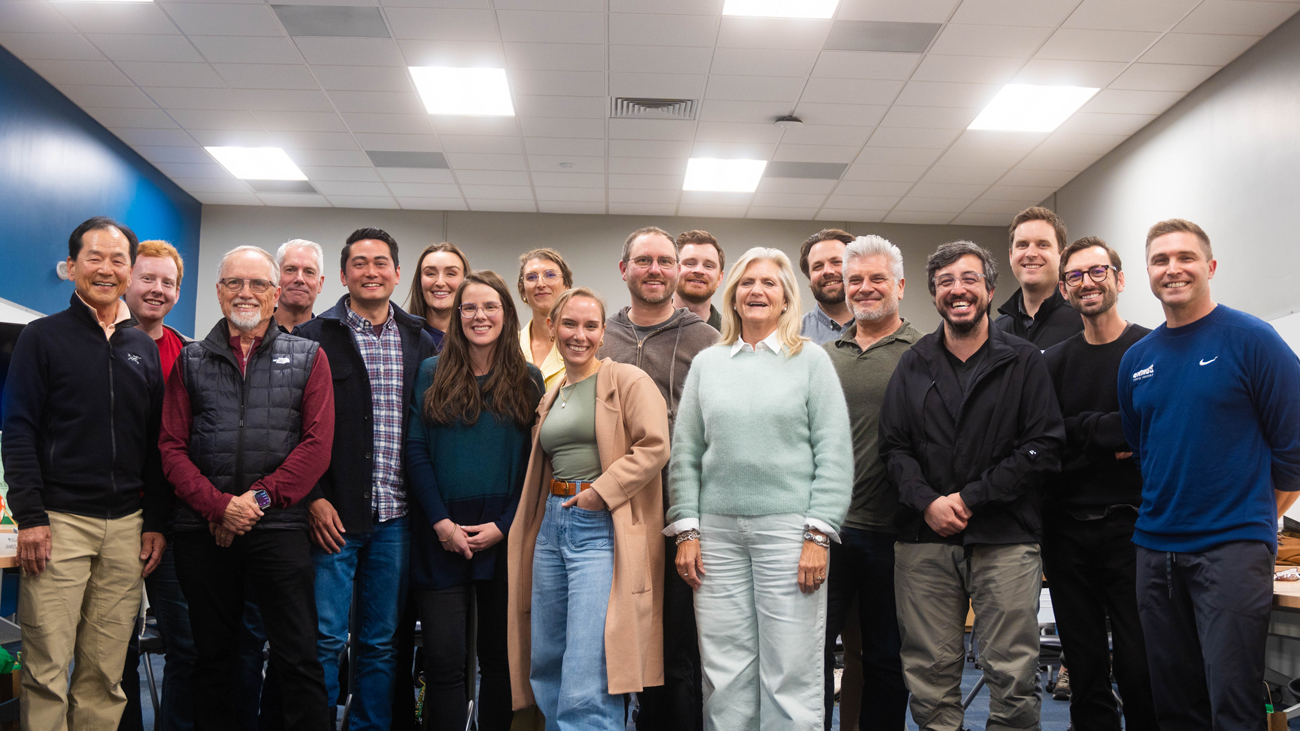
Nearly 20 alumni returned to Cal Poly for the 2025 Innovation Quest competition.
In the early 2000s, three Cal Poly engineering alumni scattered across the Bay Area had an idea: what if they could give students from their alma mater a place to turn their boldest ideas for new technology or a game-changing company into something real?
That idea became Innovation Quest (iQ), a student innovation challenge that has grown into one of the university’s longest-running entrepreneurial traditions. The competition has helped shape companies, careers and a community of changemakers, many of whom converged on San Luis Obispo in 2025 to celebrate iQ’s 20th anniversary and to connect with the university’s latest crop of startups.
Founded in 2004 by Carson Chen (Electrical Engineering ’73), Richard Boberg (Electrical Engineering ’70) and Laura Pickering (Electrical Engineering ’84), iQ began as a way to help student innovators transform their ideas into impact. Over two decades, the competition has awarded more than $400,000 in funding and has become a launchpad for student-built, coded or designed products, many of which later grew into thriving startups.
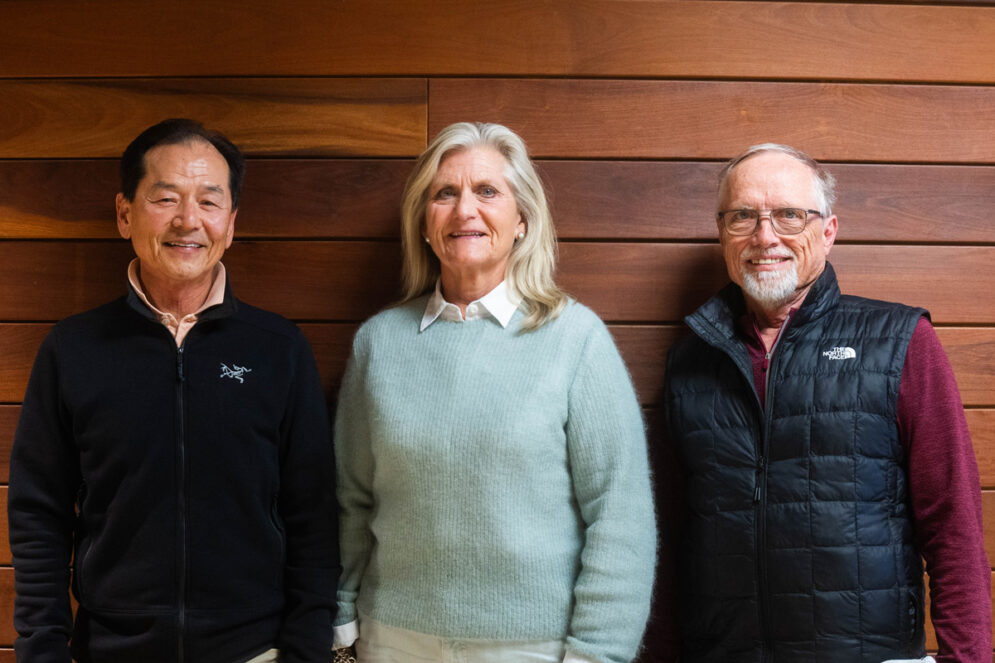

First photo: Innovation Quest founders Carson Chen, Laura Pickering and Richard Boberg. Second photo: Alumni entrepreneurs hear pitches from students during the 2025 competition.
In its early years, the founders coordinated the competition remotely from the Bay Area. Student interest was strong, but Chen, Boberg and Pickering knew participants needed hands-on support. That shift came when they partnered with the Cal Poly Center for Innovation and Entrepreneurship (CIE) in 2014, creating an on-campus home where students could refine ideas with mentorship, prototyping resources and guidance. The integration transformed iQ from a standalone event into an essential part of Cal Poly’s entrepreneurial ecosystem.
Since its founding, iQ has helped catalyze companies such as Pashion Footwear, Mantis Composites, Alydia Health, Guardian Bikes and De Oro Devices, along with countless ventures that began as concepts dreamed up by students and evolved into thriving businesses.
“iQ started as a small idea to give students the opportunity to innovate, create and express their entrepreneurial ferocity,” Chen said. Pickering added that, even after two decades, what continues to inspire her is the creativity and collaboration she sees in every cohort.
For the founders, the competition was never just about prize money; it was about building a regenerative community driven by Learn by Doing.
“Our motto is: Learn by Doing and give back by creating,” Boberg said. “That was the whole purpose — to create a self-perpetuating system of successful entrepreneurs and alumni who give back.”
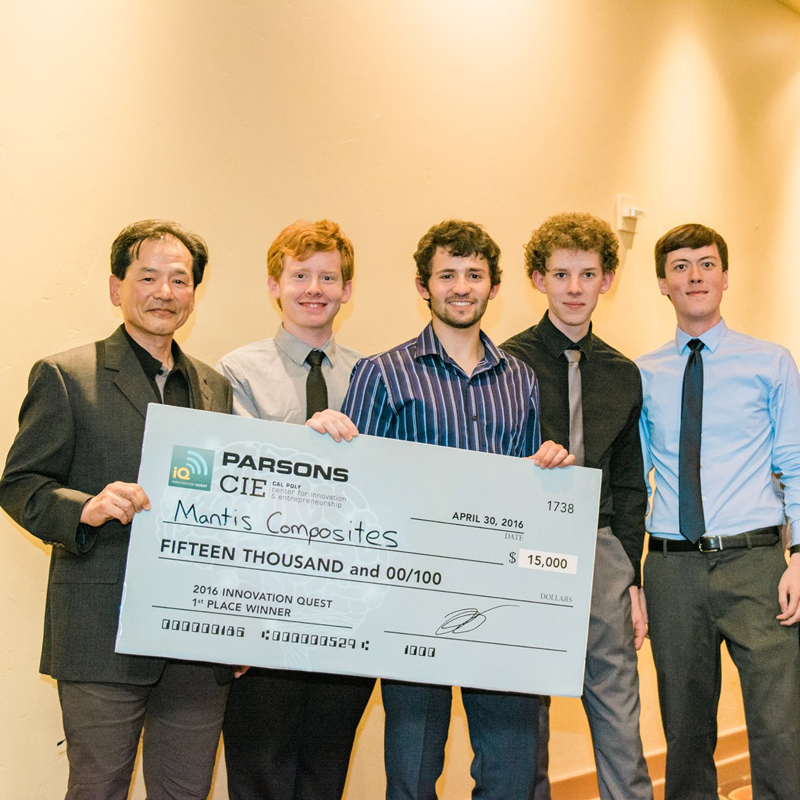
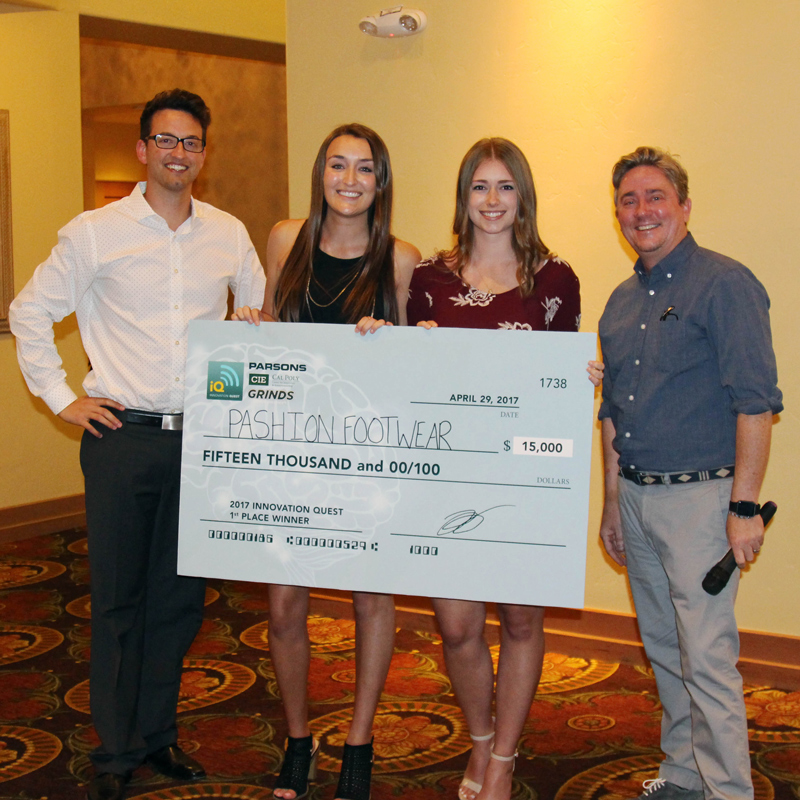
First image: Mantis Composites team members stand with Carson Chen (left) and their winnings from the 2016 Innovation Quest competition. Second image: Pashion Footwear team members stand with CIE leaders after winning the 2017 Innovation Quest competition.
That cycle was on full display at the anniversary event, where 18 former participants returned as judges, mentors and supporters. Among them was Haley Pavone (Business Administration ’18), founder and CEO of Pashion Footwear. Pavone won first place at the 2017 iQ with her early prototype for a fully convertible high heel, the product that would put her company on the map.
“It feels so full circle to now be back this year as a judge,” Pavone said. “iQ gave us the funding we needed to make our first prototype that made the last eight years possible. It’s amazing to help give that opportunity to the students of today.”
Other alumni judges echoed the sentiment. Former engineering student Ryan Dunn, CEO of Mantis Composites, noted the technical depth of the student teams. Jessie Becker-Alexander (Business Administration ’11), co-founder of Alydia Health, which was acquired by Organon for $240 million in 2021, called the event “an incredible experience to see the quality of pitches and prototypes, and to connect with fellow alumni.”
Last year’s competition drew more than 50 applicants and showcased 11 finalists from disciplines spanning biotechnology, sustainability, software and engineering.
iQ started as a small idea to give students the opportunity to innovate, create and express their entrepreneurial ferocity.
Carson Chen
“It was great to see such a diverse group of students from all over our campus, particularly on an anniversary year,” said Thomas Katona, CIE academic director and professor of entrepreneurship. “They represented the full range of students who have been impacted by this program.”
Four teams earned top honors in 2025 — NeuroCom, GreenSight Technologies, Vandra and Preserva Biosciences — each continuing their journey through CIE programs like the Summer Accelerator and the CIE Incubator. This new class of entrepreneurs has a chance to strengthen a thriving feedback loop, where students become founders, founders become mentors, and mentors become the champions of the next generation of students.
After 20 years, Innovation Quest has become more than a competition. It is a catalyst, a spark that has helped thousands of students turn curiosity into invention, and invention into impact. And as its alumni return to guide the innovators following in their footsteps, iQ continues to shape Cal Poly’s legacy of creativity, possibility and Learn by Doing.
Your Next Read

The latest from around campus: Rose Float’s grand prize, new rankings, harvest by the numbers, a refreshed Kennedy Library and research on ancient bacteria.

In a unique class last fall, a group of students worked with fire professionals to set a portion of university land ablaze.