Feature
Designed to Make a Difference
In Cal Poly’s fifth-year architecture course, students move beyond how to be good designers and explore how good design can change the world.
By Larry Peña // Photos by Joe Johnston // Video by Dylan Head
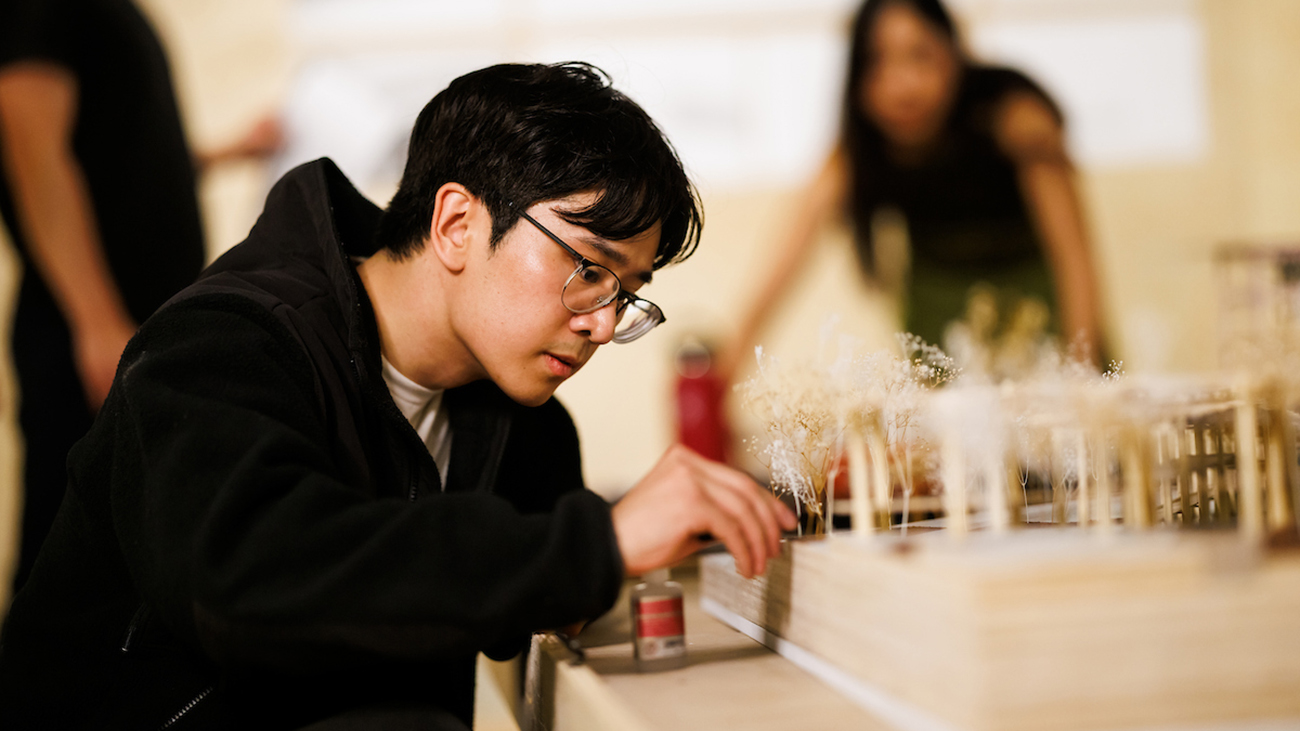
Bao Nguyen puts the finishing touches on the model of his thesis project, “Field of Trace.”
In Cal Poly’s highly respected Bachelor of Architecture program, it’s not enough to have the skills to design the built environments of the future. In the program’s distinctive fifth-year thesis, students focus on one project as they discover how they can use architecture to make the world a better place.
Students devote their entire fifth year to developing an architectural thesis. They identify a problem or challenge that might be solved through architecture, research the factors involved, and design an architectural project with minimal constraints that answers that original challenge.
To develop these individual projects, students join one of eight different architecture studio groups, each headed by a faculty member. In the studios, students can seek guidance from faculty advisors or solicit feedback and support from peers as they pursue the architectural answers to the problems they’ve chosen.
The year culminates in a studio showcase in which students share their concepts and finished designs with the public, as well as a panel in which they present their projects to architecture professionals and solicit feedback.
This year Cal Poly Magazine followed some of these design studios as they prepared their showcases and defended their theses. From the functional to the fantastical, explore the thesis projects that capture the world Cal Poly graduates dream of building.
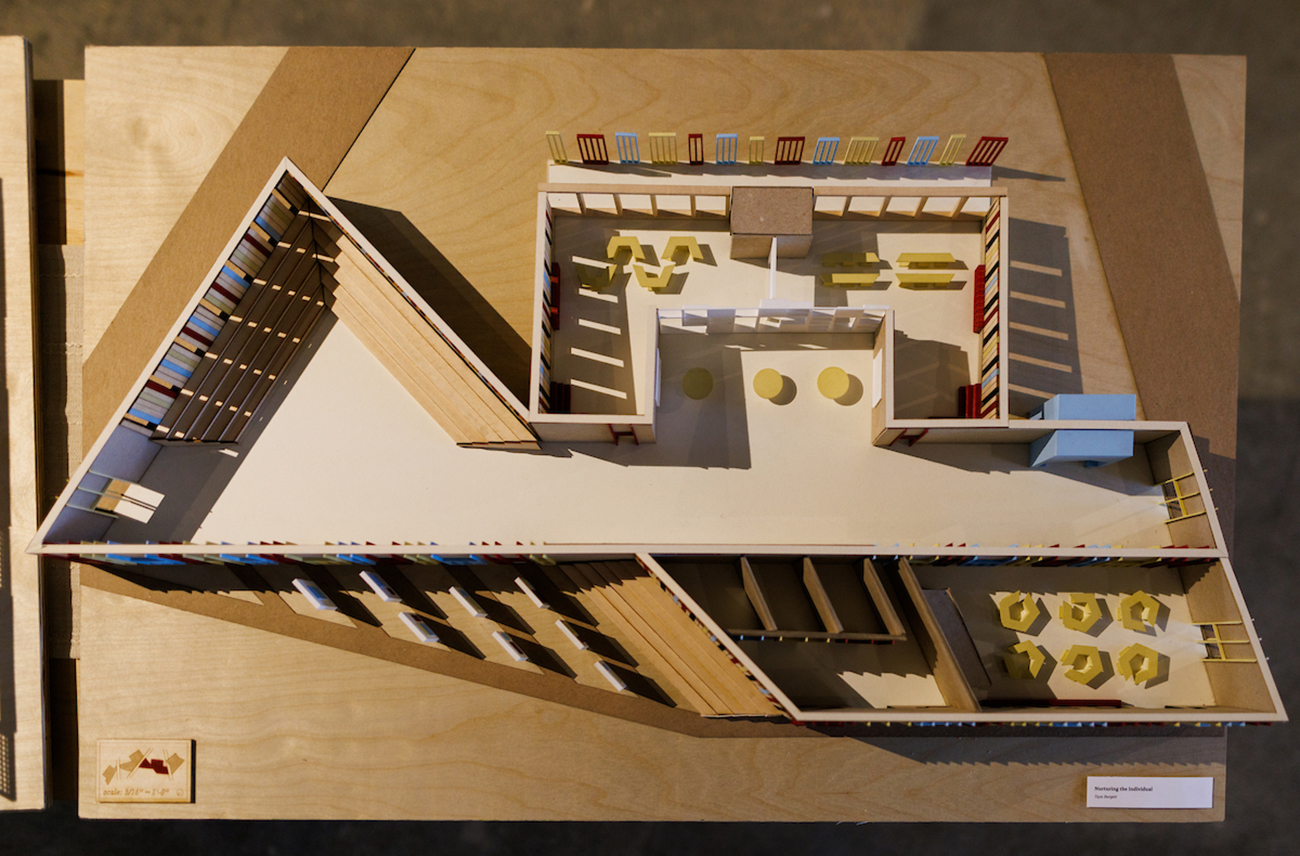
The model for student Taya Burgettʼs thesis, “Nurturing the Individual,” a school designed to facilitate non-traditional learning.
Following Their Passion
Unlike most other projects students work on throughout their major, the thesis has few constraints. Students aren’t given a project site, client or architectural program — the building’s intended functional purpose. Instead, faculty advisors in each studio encourage students to select a real-world problem and then explore any possible architectural solution to address it.
“Just caring about something in the first place gives you more purpose to the project,” said Rocco Struder, an avid biker who focused his thesis on creating the accessible bike and skate park he wished he had in his community as a kid. “You’re going to focus more time if you care about it at the end of the day. It’s constant work — you’re always kind of thinking about it.”
The thesis, we hope, is what will drive them through their careers.
Professor Mark Cabrinha
It’s an important step as students cross the bridge between years of rigorous technical instruction and the start of their careers.
“We really want our students to create a proposition that will help them think about what they want architecture to be and what their role is in creating that world — maybe not in the next year or five years, but 10, 15 years out,” says Mark Cabrinha, head of the Architecture Department. “The integrated design studio project they complete in their third year is probably the project that’s going to get them their first jobs, but the thesis, we hope, is what will drive them through their careers.”
“I think this has really made me more driven about the design,” says Catherine Park, who designed a combination school and grocery co-op using repurposed building materials, and is now exploring a career researching ways to reduce the construction waste stream. “When you’re not handed the program, you have to find your own way.”
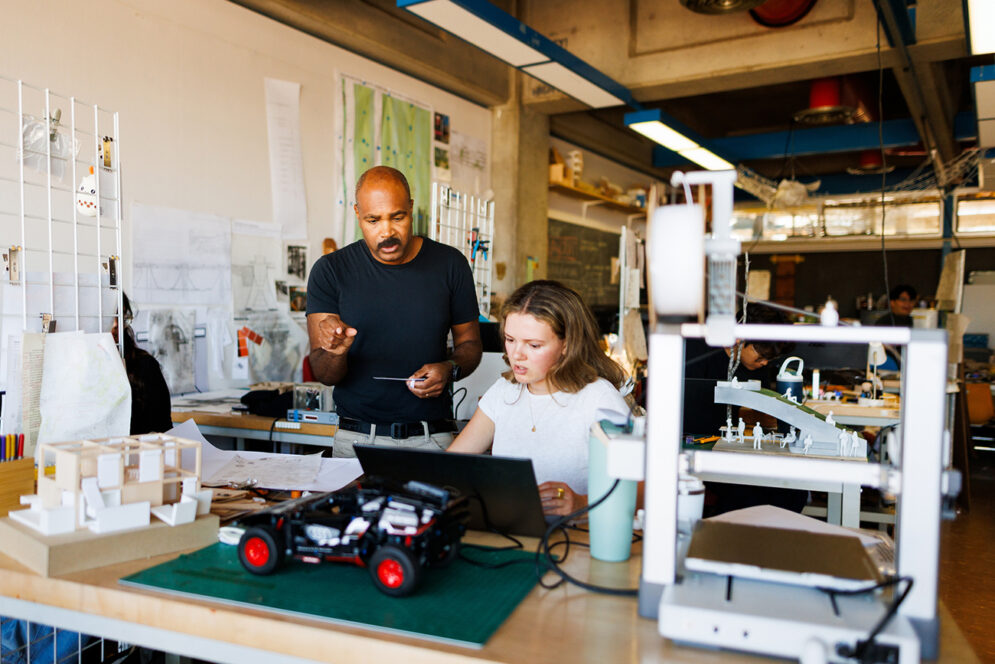
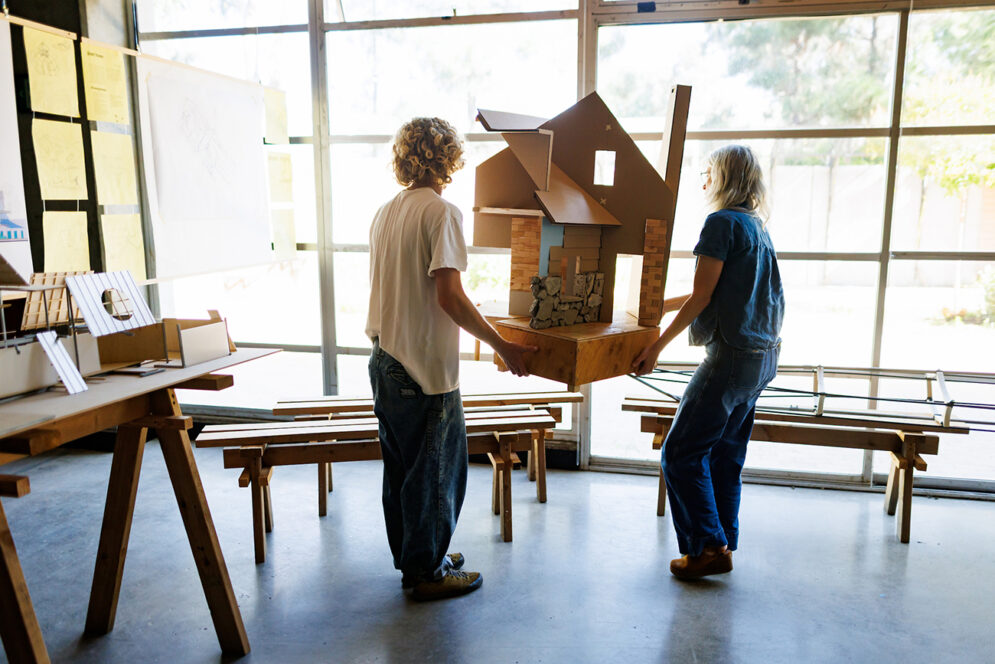
First photo: Professor Jermaine Washington (left), one of the thesis studio advisors, works with student Sydney Felker on revising her thesis on modular architecture in Baja California. Second photo: Thesis advisor Emily White (right) helps student Miles Harvey set up the model for his thesis, “Paper Houses,” which imagines a single living space at multiple points in time. Video: Students and faculty advisors work together to design, develop and present their thesis projects.
Building an Argument
The yearlong project is intentionally designed as a true thesis, not just a design assignment. Unlike a capstone, which focuses on completing an objective and is more common at the end of other architecture programs, the focus is based around making an argument.
“We’re trying to prepare future leaders by making them smart, and then also strong advocates for good ideas,” says architecture professor Doug Jackson, the department’s thesis coordinator. “We don’t want to be the final word on what those good ideas are, but we do want to prepare them to advocate strongly for the things that they believe in.”
Once the students have selected their problem, they spend the first part of the year rigorously researching as they explore the issue from every possible angle before they begin their design work.
Architecture is a quiet way to make an impact in people’s lives even when you’re not there.
Student Nalia Santiago
“The first few months are a lot of writing and reading — really looking at what architecture has been in order to understand what architecture could be,” says Jermaine Washington, a professor who led one of the studio groups.
As they develop their solution, students are encouraged to use their design ideas to make a case for their values and beliefs around the issue. Those solutions are informed by the technical expertise they’ve built over the first three years and an understanding of what has come before in the profession.
For some students, that may mean that the final projects end up very different from what they may have expected at the start. Student Nalia Santiago, for example, began by exploring how to repurpose abandoned infrastructure facilities, but ended up with a final project designed to call attention to how AI construction projects impact the flow of resources to local communities.
“I thought that you had to be a politician or an inventor or something to be able to shape the world,” said Santiago. “But architecture is a quiet way to make an impact in people’s lives even when you’re not there.”
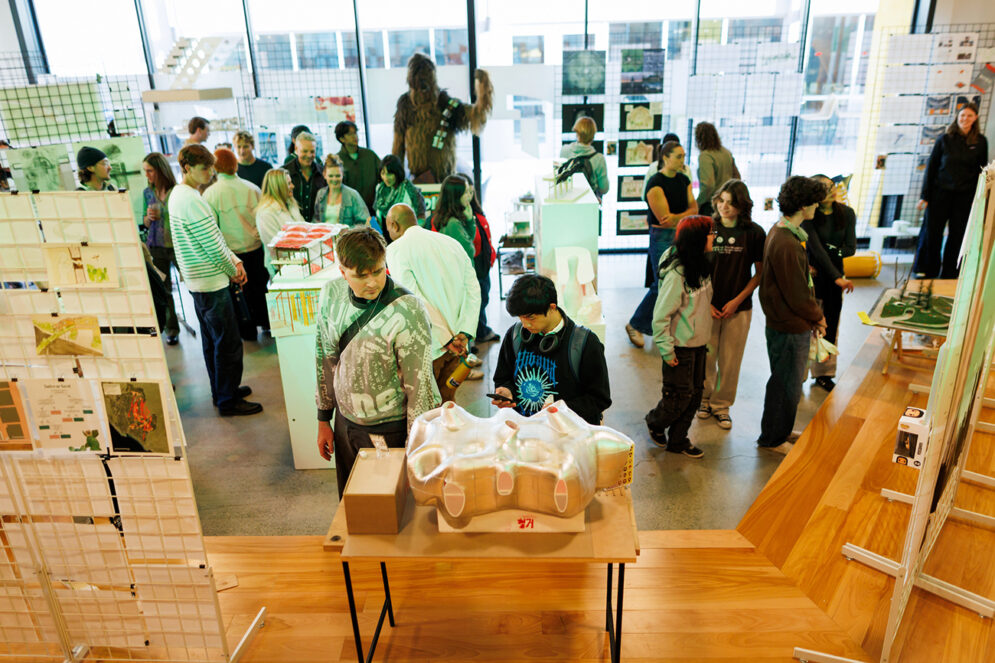
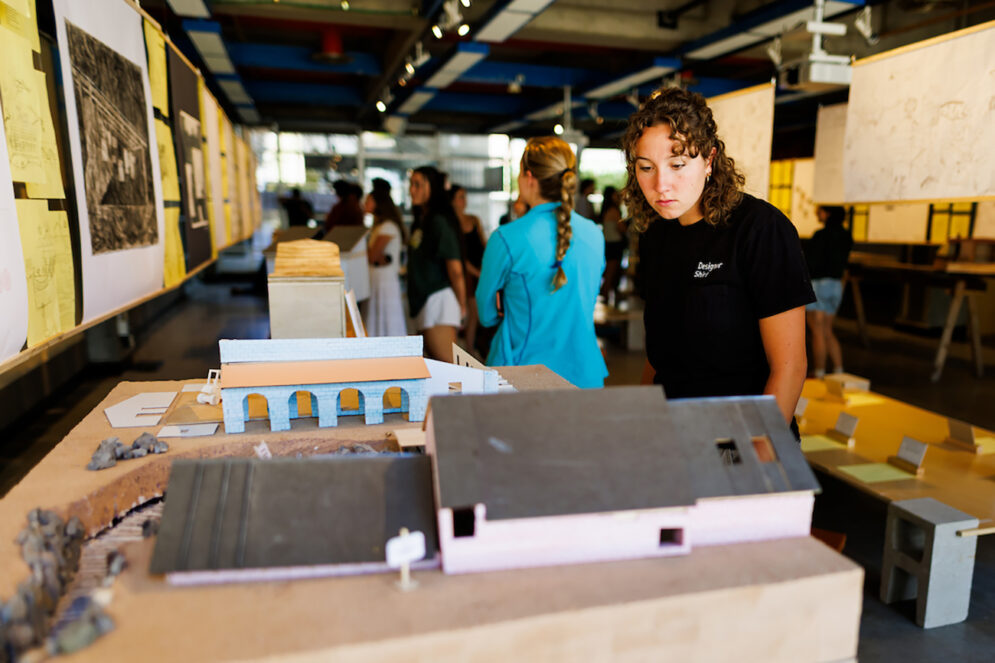
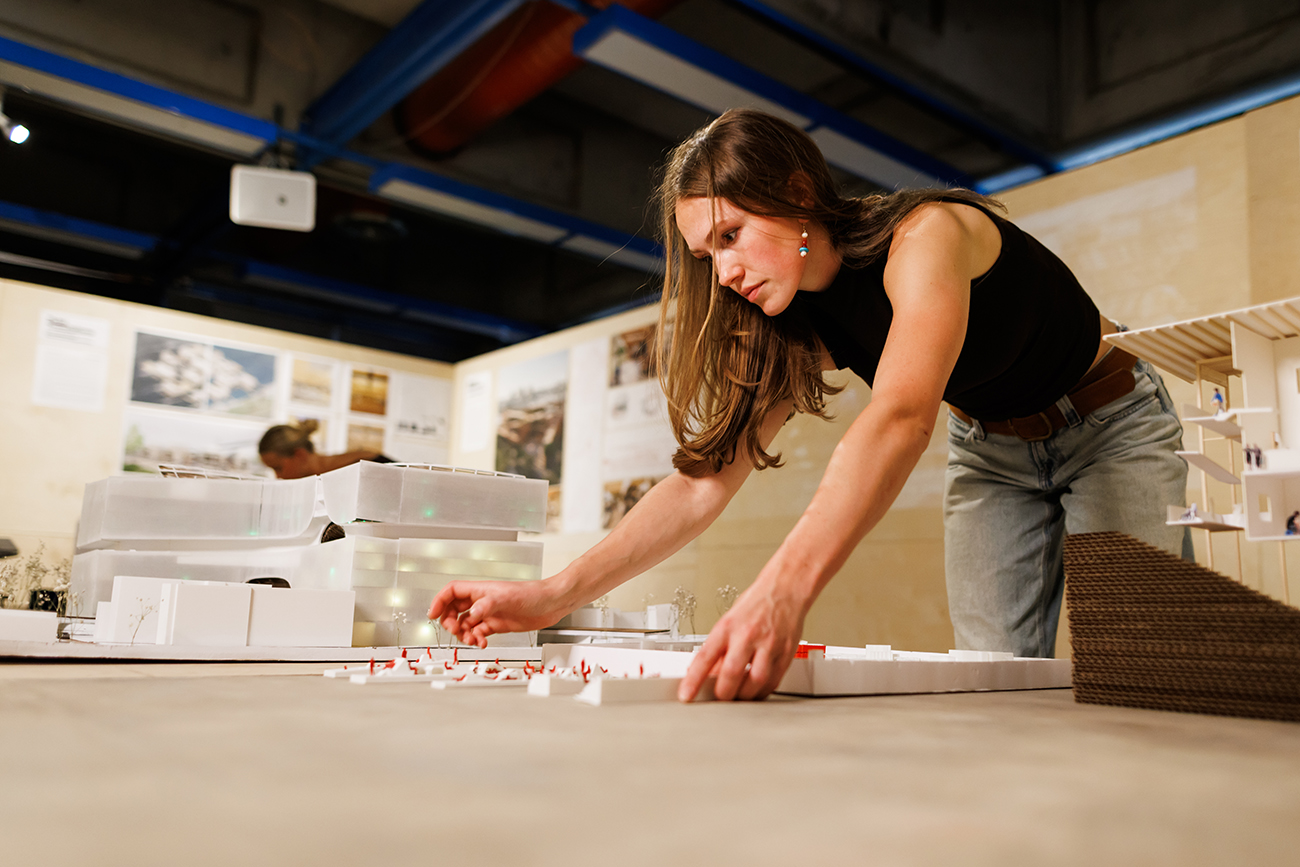
First photo: At a thesis showcase themed around the concept of a comic book shop, visitors inspect Lieyoung Jin’s thesis “The Glassroom,” a futuristic attempt to shed light on Seoul’s historic Red Light district. Second photo: Visitors check out the thesis “Enstranged” by student Victoria Rentsch, a grocery store meant to encourage shoppers to slow down and savor the experience. Third photo: Architecture student Grace Schweigert prepares a model of her project, “Spaces of Recognition: Architecture Against Marginalization” for the thesis showcase.
Defending and Refining
At the end of the thesis year, students must present their projects to a panel of invited judges: program alumni, professional architects and other faculty members. The jury panelists then ask the students challenging questions about their design decisions and give specific feedback on how to improve their projects.
“We want students to think through a problem and understand what they don’t know, and then work with others to find ways around or to even redefine the problem,” says professor Dale Clifford, one of the faculty studio advisors. “Even though they’re individual projects, we do problem-solving as a collective. So rather than having them think, ‘Oh, I’ve made a really amazing project and it’s all mine,’ we want them to understand that their solution is just one possible iteration.”
“This is the closest thing to the reality of what it's like to present your work to others as an architect.”
Daniel Lee (Architecture '11)
It’s a crucial lesson as they prepare for careers in which they’ll frequently have to work in teams and convince clients, colleagues and community stakeholders why their designs will work — as well as incorporate feedback and alternate perspectives into their projects.
“Being part of the larger architecture community, sessions like this are probably one of the most important things that students could have,” says Daniel Lee (Architecture ’11), an architect and alumnus who returned to sit on one of the panels this year. “This is the closest thing to the reality of what it’s like to present your work to others as an architect, to training someone for what it’s going to feel like when you get out there and you’re pitching ideas to your boss or to the client or the developer or the community.”
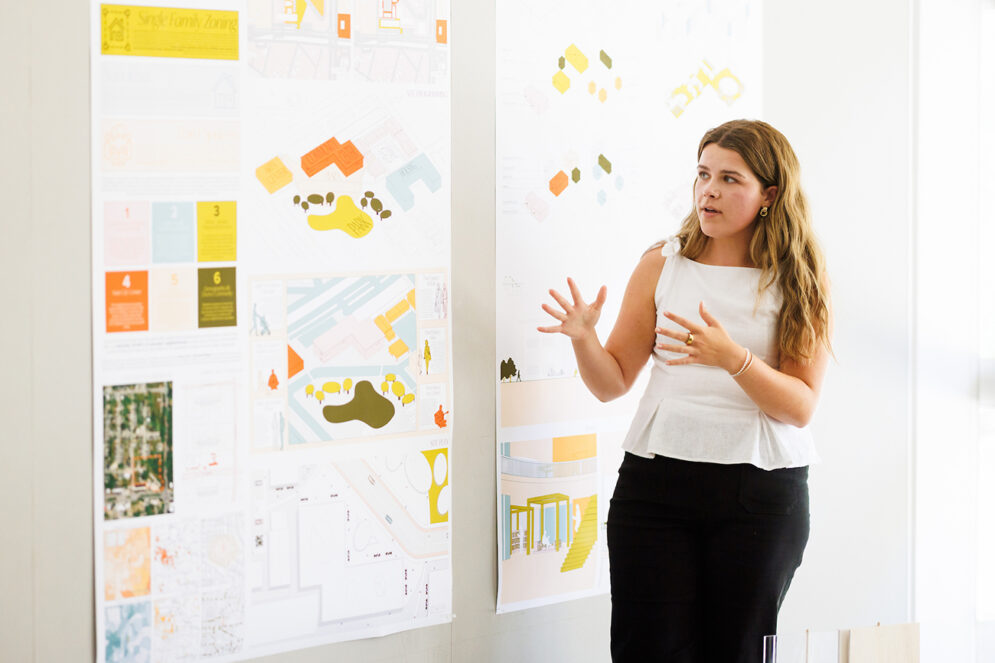

First photo: Mackenna Pollema presents “The Third Space Suburb,” a concept combining a residential community with a vibrant social hub. Second photo: Nicole Cheng presents her thesis, “Add, Remove, Repeat” — a modular solution to a housing shortage in Taipei, Taiwan.
Reshaping the Industry
The cumulative result of all of these experiences is a graduate who has both the skills to hit the ground running as an architect and the imagination to approach old problems in new ways.
“What we hear from industry is that Cal Poly students are so sought after because of that burst of inspiration,” says Washington. “They understand that architecture needs to continue to evolve and change, and in order to do that, we need people that ask different questions than people that may have been here for 20 years.”
In addition to the burst of creative inspiration, the thesis year is also often an opportunity for students to explore a possible direction as they face the start of their careers.
What we hear from industry is that Cal Poly students are so sought after because of that burst of inspiration. We need people that ask different questions than people that may have been here for 20 years.
Professor Jermaine Washington
“In my class there are a lot of people that have already landed jobs that relate very closely to what their thesis projects are,” says student Preston Runk, who is preparing to start a job at Studio Vara in San Francisco after spending his fifth year designing a building that works with the surrounding vegetation and water flow to promote a more vibrant local ecosystem. “There are so many things within my thesis that I still want to tackle, so hopefully it’s something I’ll be able to bring into everything I do.”
Perhaps most critically, the thesis experience is designed to equip Cal Poly architecture graduates to carry a clear sense of purpose over the long trajectory of their careers as they take their place in — and eventually reshape — the industry.
“By learning to research complex challenges, articulate values, test ambitious ideas, and persuasively defend them, students become prepared not only to contribute to the work at hand, but to question what architecture can be and how it might better serve society,” says Jackson. “As they grow into the profession, that capacity for innovative vision and persuasive advocacy can help them create more inclusive, meaningful, and impactful spaces—and make architecture a force for making a positive difference.”
Your Next Read
Meet the alumni behind a recent expansion at the Seattle-Tacoma International Airport.

The National and International Fellowships and Scholarships Office helps students succeed at home and abroad – and learn how to tell their stories.