Introducing our new campus.
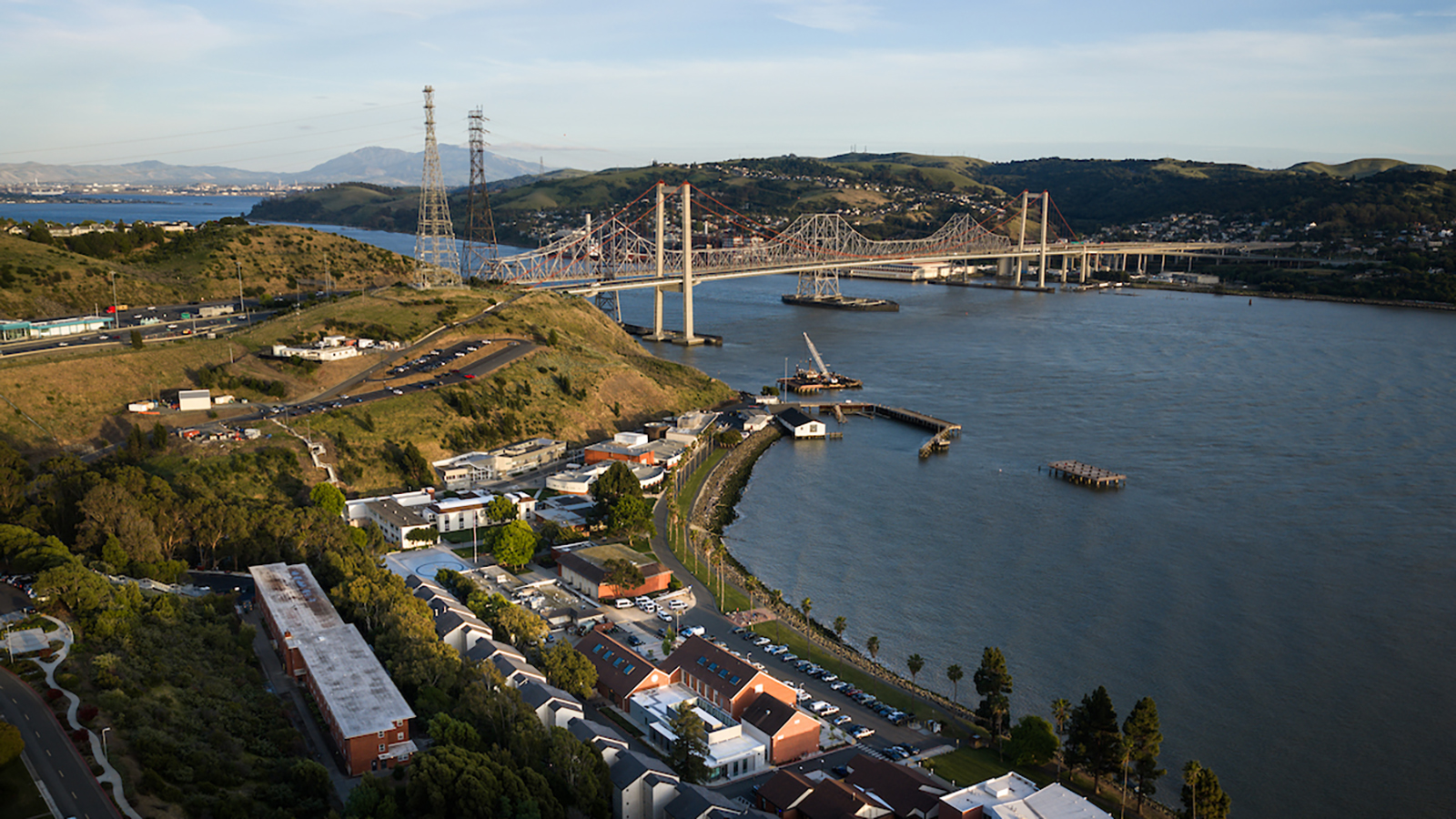
A view of the Solano County campus on the shores of San Pablo Bay.
In 2024, the California State University Board of Trustees voted to integrate Cal Poly and the California State University Maritime Academy, creating one university that spans two campuses. Students at the Maritime Academy campus in Solano County are officially Cal Poly students as of this fall. What does this all mean? Keep reading to learn more about Cal Poly’s new campus on the Bay, where Learn by Doing sets sail on the high seas.
The former CSU Maritime Academy, now known as the Cal Poly Maritime Academy, is located in the San Francisco Bay Area. It educates its students with a distinctive mission: to utilize Learn by Doing in preparing a new generation for seafaring careers in areas such as marine transportation, energy production, engineering and logistics.
Maritime careers play a crucial role in the global economy while providing graduates with a high return on investment.
“More than 90% of the world’s goods by tonnage move by ship,” says Rear Admiral (Retired) Eric Jones, the superintendent of Cal Poly Maritime Academy. “I can guarantee there’s something in your home, something you’re wearing or even something in your hand right now that came on a container ship.”
There are seven maritime academies in the United States, and Cal Poly Maritime Academy is the only one on the West Coast. It is also one of only a few institutions in the U.S. where aspiring mariners can earn a license from the Coast Guard to work as deck or engineering officers on ships of any size — an internationally recognized certification in the maritime industry.
For students at the academy, Cal Poly’s Learn by Doing culture is very familiar. Earning a bachelor’s degree and a demanding professional licensure simultaneously requires a high level of hands-on work and dedication.
I'm blown away by our students' ability to get things done and solve problems on their own.
Corey Cook, Cal Poly Maritime Academy CEO
“It’s an intensive program that’s already year-round for most of our students,” says Corey Cook, vice president and CEO of the Cal Poly Solano campus. “Having been on a number of different campuses, I’m blown away by our studentsʼ ability to get things done and solve problems on their own.”
The integration of the two campuses provides an opportunity for students in Vallejo and San Luis Obispo to benefit from shared expertise in some of the world’s most critical emerging fields: renewable energy, autonomous vessels, and even the intersection of marine and aerospace technologies. Cal Poly leaders plan to roll out new academic programs where students can spend significant time on both campuses.
“Becoming one Cal Poly with two distinctive campuses enables us to maintain each one’s unique academic programming while also exploring these extraordinary intersections across both campuses,” says Cook. “It will benefit our students in terms of not just their academic programming, but what type of careers they’re prepared for when they graduate.”
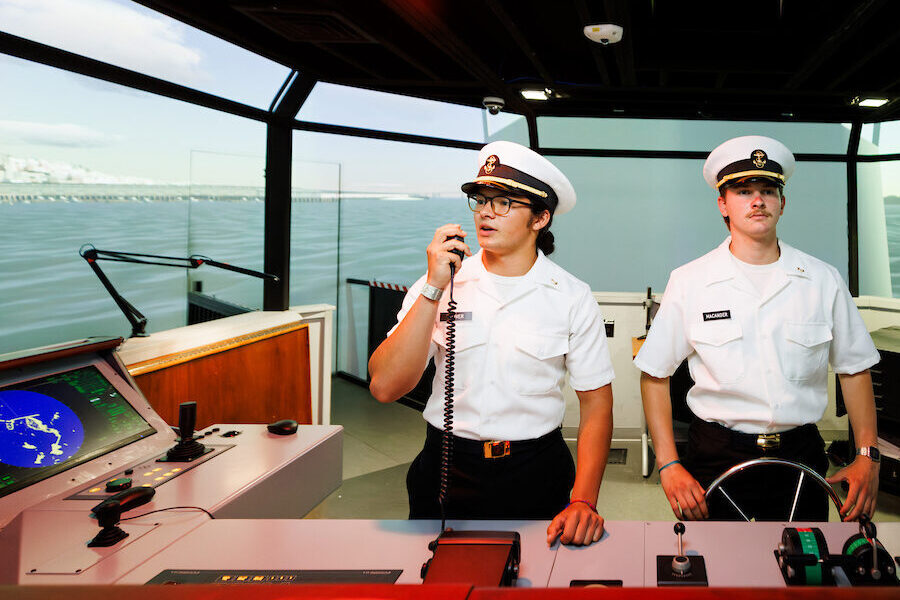
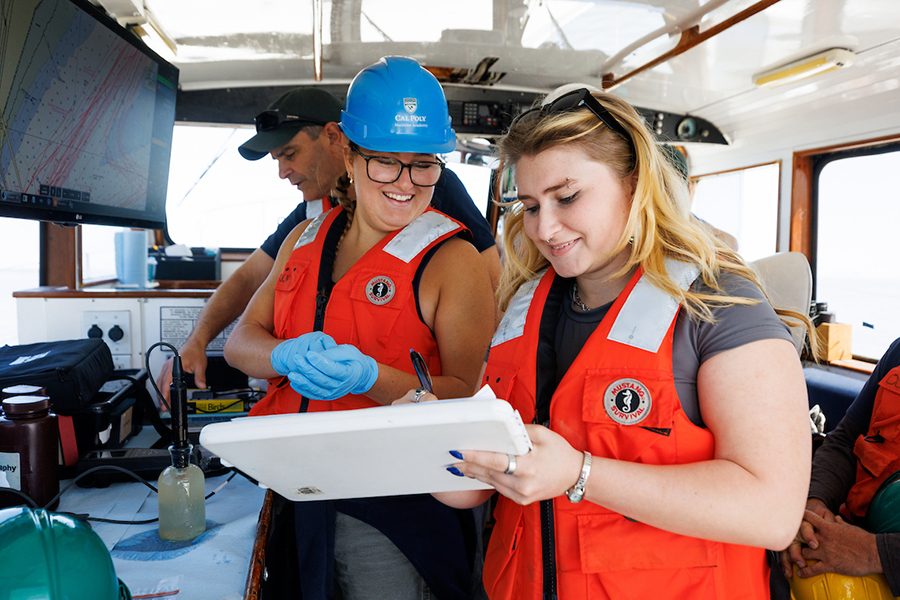
First photo: Cadets learn how to navigate in Cal Poly Maritime’s marine simulator room. Second photo: Oceanography students collect and log seawater samples on one of the academy’s research vessels.
Cal Poly Maritime Academy has long been ranked as one of the nation’s best investments in higher education. Graduates of the Coast Guard licensing program are qualified to serve as either third mates or third assistant engineers on any large ship, from fuel tankers to cargo ships to cruise liners. Other common careers include maintaining or operating port facilities, shipbuilding, international business and logistics, and managing large-scale energy and utilities projects on land.
“Our students graduate with skills that will help them in all sorts of industries, whether that’s in the Port of Oakland or the Port of Los Angeles, in shipbuilding, in offshore wind and wave energy, in aquaculture or tracking weather patterns,” says Cook.
“I can’t think of two universities better suited to come together,” notes Cal Poly President Jeffrey D. Armstrong. “By bringing together the best of both campuses, we can better serve our students, support key industries and advance California’s future.”
Cal Poly Maritime Academy in Vallejo is located in Solano County, a four-hour drive from San Luis Obispo on the northeastern edge of the San Francisco Bay. The waterfront campus gives the academy direct access to the bay and the open ocean and gives Cal Poly an unprecedented outpost in the Bay Area.

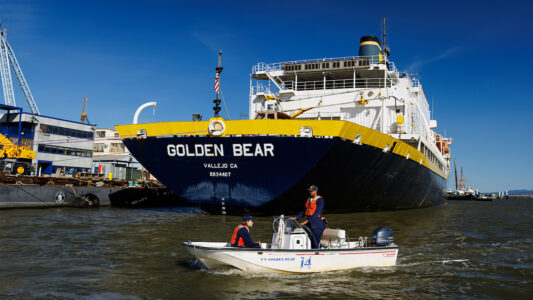
While the terms are often used interchangeably ashore, mariners make a distinction. Generally, a ship is a large oceangoing vessel capable of carrying boats, while a boat is smaller. Refer to the Training Ship Golden Bear, Cal Poly Maritime’s 499-foot training vessel as a boat in front of a mariner, and you’ll likely get a quick correction: “It’s a ship.”
One of the most crucial learning experiences for students working toward a maritime career is spending time on the ocean. That’s why Cal Poly Maritime Academy maintains its own training ship, on which students conduct a “summer sea term,” an annual 65-day voyage across the Pacific.
Each summer, a crew of hundreds of students work under the guidance of licensed faculty officers, managing every aspect of navigating the ship from California to Japan and back, with stops in a variety of ports including Hawaii, Guam and Tahiti.
In addition to giving academy students the opportunity to put their learning into practice, the summer sea term has also often been an opportunity for Cal Poly marine science students to join the voyage and conduct open sea research.
The Training Ship Golden Bear has been the academy’s flagship vessel since 1996, but next year a larger, state-of-the-art ship, the Training Ship Golden State, will replace the Golden Bear giving even more students the ability to Learn by Doing.
Check out an excerpt of one of this summer’s updates, from Cadet Lotus Garcia.
The first few days underway have already taught me so much about life at sea. Before cruise started, I expected everything to feel extremely strict and intense right away.
Instead, there has been a balance between discipline and adjustment while everyone settles into shipboard life. Even with that adjustment period, one thing has been constant: drills, drills and more drills.
At first, the drills felt long, especially while waiting at muster stations, but I quickly realized how important they are. Without practicing emergency procedures over and over, I do not think I would feel prepared for a real emergency.
The drills also became more enjoyable once I got to know the people around me. Having friends at my muster station made the experience feel less stressful and more like teamwork.
One thing I did not expect was how much trust is placed in the students. Work orders are assigned to us, and we are expected to help solve real problems on the ship. Some jobs take only a few minutes, while others can last multiple days. I have learned that engineering is not always about finding the fastest answer. It is about working together, thinking critically and staying consistent.
Read more updates from this summer’s voyage at maritime.calpoly.edu/news.
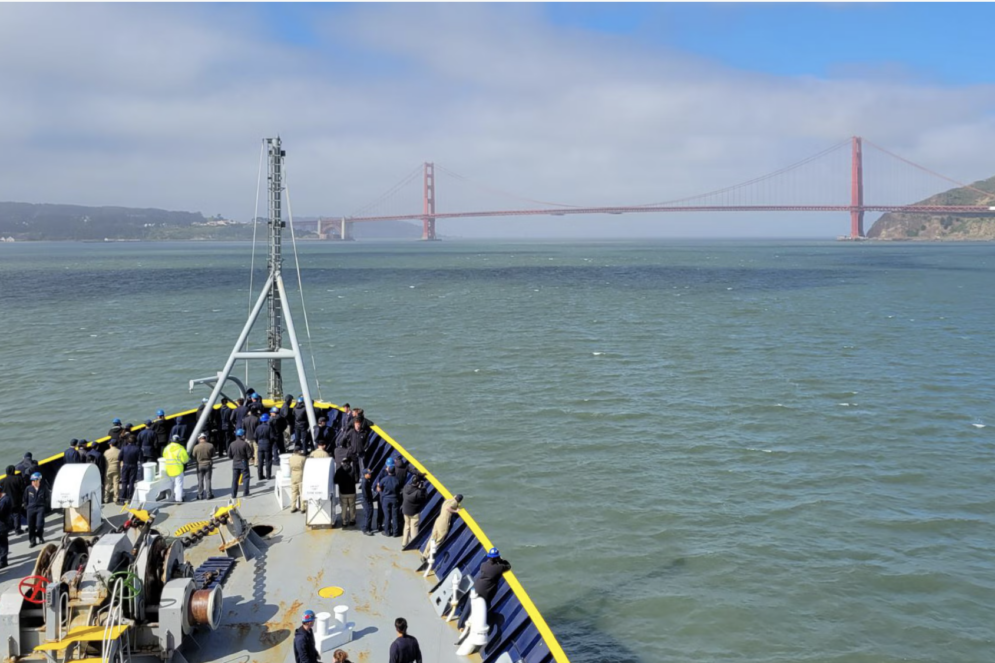
The Training Ship Golden Bear prepares to leave the San Francisco Bay for the summer sea voyage across the Pacific.
What makes a maritime education so important? Check out this numerical breakdown of Cal Poly Maritime Academy’s value and impact.
Amount of total world trade that moves by sea.
Graduates employed or continuing their education within three months of graduation — one of the highest placement rates in the CSU system.
Average salary of Cal Poly Maritime Academy graduates, a reflection of strong demand for maritime professionals and the academy’s career-focused programs.
Number of maritime academies on the West Coast.
Like most industries, maritime professionals have their own language. For those who have never spent much time aboard a ship, here’s a quick guide to some of the terms you might hear students using at the academy.
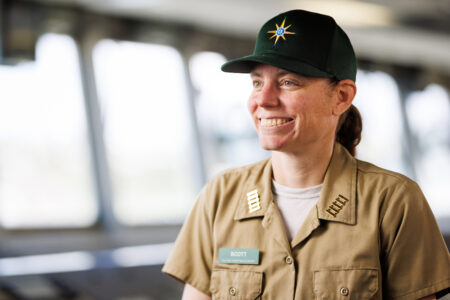
What is life like for students at Cal Poly Maritime Academy? Marine transportation senior Jenny Scott recently served as commander of the Corps of Cadets, the academy’s student leadership organization. We spoke with her about what makes the academy’s culture so unique.
Why did you choose to go to Cal Poly Maritime Academy?
I grew up on the Jersey Shore, learning to sail at my grandmother’s house, and had a few jobs as a deckhand and sailing instructor. I just loved being out on the water and wanted to work on boats full-time. It was just the vibe here — it was very student-focused, with small classes and a small community, which is what I was really looking for in a school.
What is that campus vibe?
The expectations for students are really high. We’re not just learning the hard skills — we’re also learning about the lifestyle of what it’s like to live and work on a ship. So we have to attend formation three mornings per week, wear uniforms to get used to wearing the right clothing for the job, and really practice a lot of discipline. It all transfers onto the ship, so we’re prepared to head out into the industry.
What do you think makes an education at Cal Poly Maritime different from most other college experiences?
It’s hands-on from day one. On the first day, you’re getting out onto boats for marine survival training. First semester engineers are learning how to make their own tools, because out on a ship you might not have the exact tool you need, and you have to be able to think creatively in the middle of the ocean. You’re taking classes and labs in a ship environment, working closely with your classmates. You get a lot of attention from your instructors so you can really learn the industry.
What has been your favorite part of your Cal Poly Maritime experience?
The best part is going out to sea. At most colleges, summer break happens and everyone just goes away. For us, when spring semester ends, we all move onto a ship and head out across the world together. We’re working together, doing what we’re trained to do.
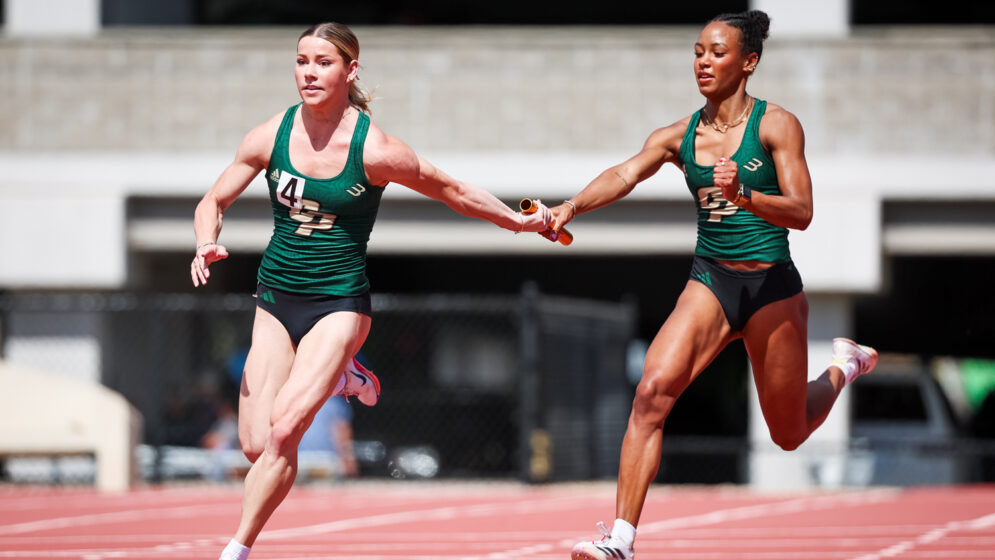
From volleyball to baseball to cross country, catch the highlights from record-breaking competition across the Big West Conference.
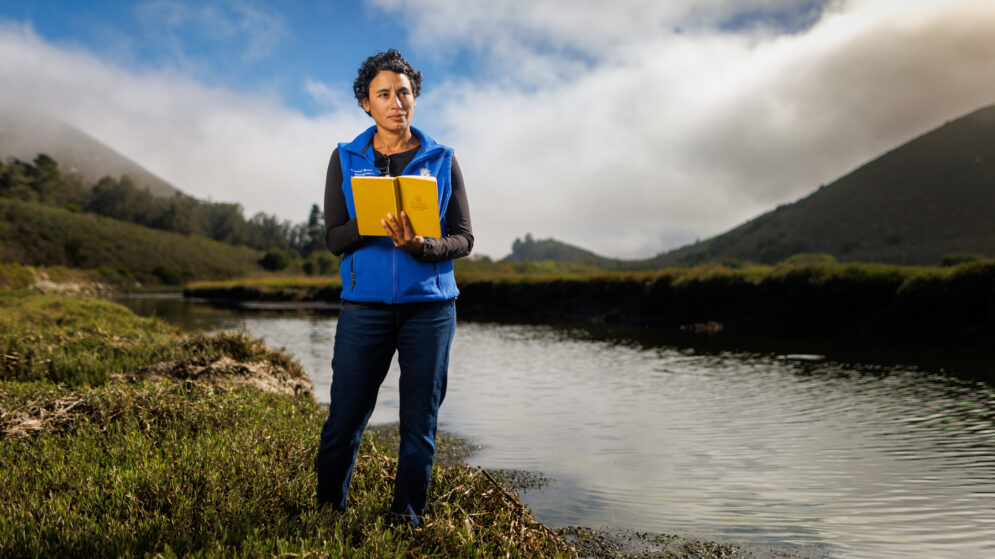
Soil ecology professor Seeta Sistla talks about her research on the impact of plastics in agriculture.