Questions and Answers
Why is Plastic Everywhere?
Soil ecology professor Seeta Sistla talks about her research on the impact of plastics in agriculture.
By Gabby Ferreira // Photo by Joe Johnston
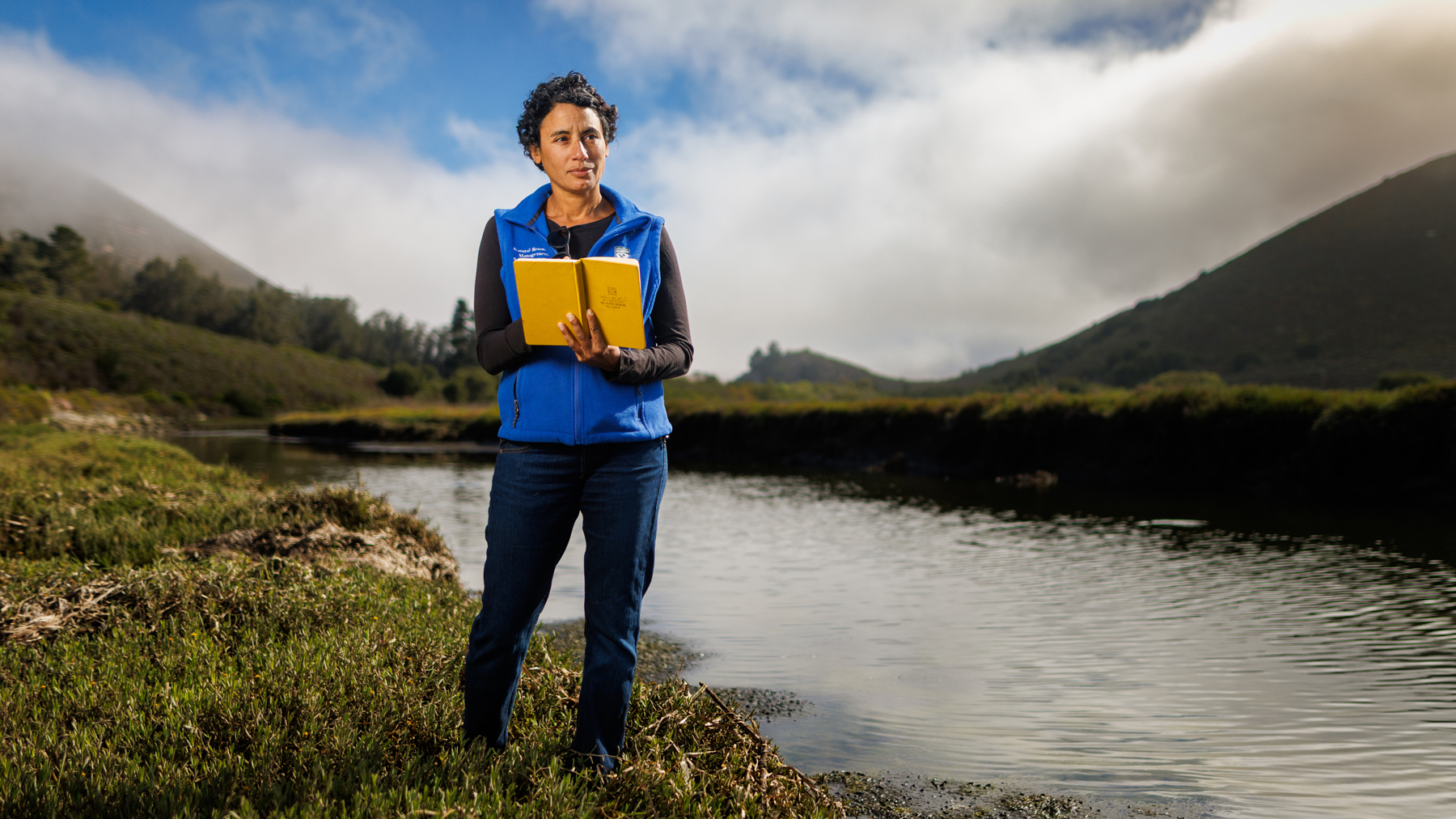
Professor Seeta Sistla investigates the fate of plastics in agricultural and natural ecosystems at the Morro Bay Estuary.
By the time you read this article, you will have already interacted with multiple pieces of plastic today alone — whether it’s the bottle your medication comes in, the packaging on your food or the clothes you’re wearing.
Seeta Sistla, a professor of soil ecology, studies the fate of plastics in agricultural settings. She sat down with Cal Poly Magazine to discuss her research and why it’s important to educate students on the issue.
WHAT IS PLASTICULTURE?
Plastics are an essential component of modern agriculture — so critical that people use the term “plasticulture” to describe the integration of plastic in food production. Agricultural products made with plastic can include anything from mulches to irrigation tubing to greenhouse films. Plasticulture can increase productivity, while reducing water and pesticide use. There are benefits to using, for instance, plastic mulch. It reduces soil water loss and disease risk because you’re separating the soil from the plant leaves, so you’re reducing contact and transfer.
U.S. agriculture alone uses over 1.6 million tons of plastic annually and the global plasticulture footprint is rapidly growing. This growth parallels plastic production and consumption across the world.
But as its footprint rapidly grows, we need to be aware of the unintended consequences associated with especially single-use plastics at scale. In addition to being a major pollutant, virtually all plastics are produced from petrochemicals and plastic production is a driver of climate change. If the global plastics industry were a country, it would be the world’s fifth-largest greenhouse gas emitter.
HOW HAS PLASTICULTURE RESEARCH EVOLVED, AND WHAT AREAS OF FOCUS ARE EMERGING AS A PRIORITY?
Plastic pollution in soils is a relatively novel area of study. The first papers were within the last 15 years, which in terms of scientific research is pretty young.
Most people who focused on plastic pollution were looking at aquatic systems because you see the consequences there: animals entangled or trapped or ingesting plastic. We learned about the extraordinary accumulation of debris in the so-termed Great Pacific Garbage Patch. This aquatic plastic pollution creates very disturbing images. That’s where people really have focused the plastic debris issue.
More recently, I think the public has generally become more aware of the idea of microplastics — the particles that fragment off of larger plastic debris — which are now recognized to be widespread in the environment and even found within us. Alongside that, scientists found that land systems are a large collection point for plastic debris, growing concerns about the accumulation of plastic debris across our landscapes.
To address these concerns, researchers across the world are focused on creating bioplastics, which are novel plastics that are biologically produced and readily biodegradable, developing ways to fully break down existing environmental plastic contamination, reducing single-use plastic dependence and consumption, and getting a better estimate of how much plastic is in our environment, accumulating in people, and the health impacts of this contamination.
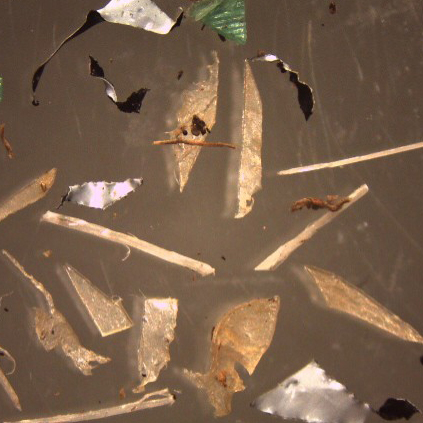
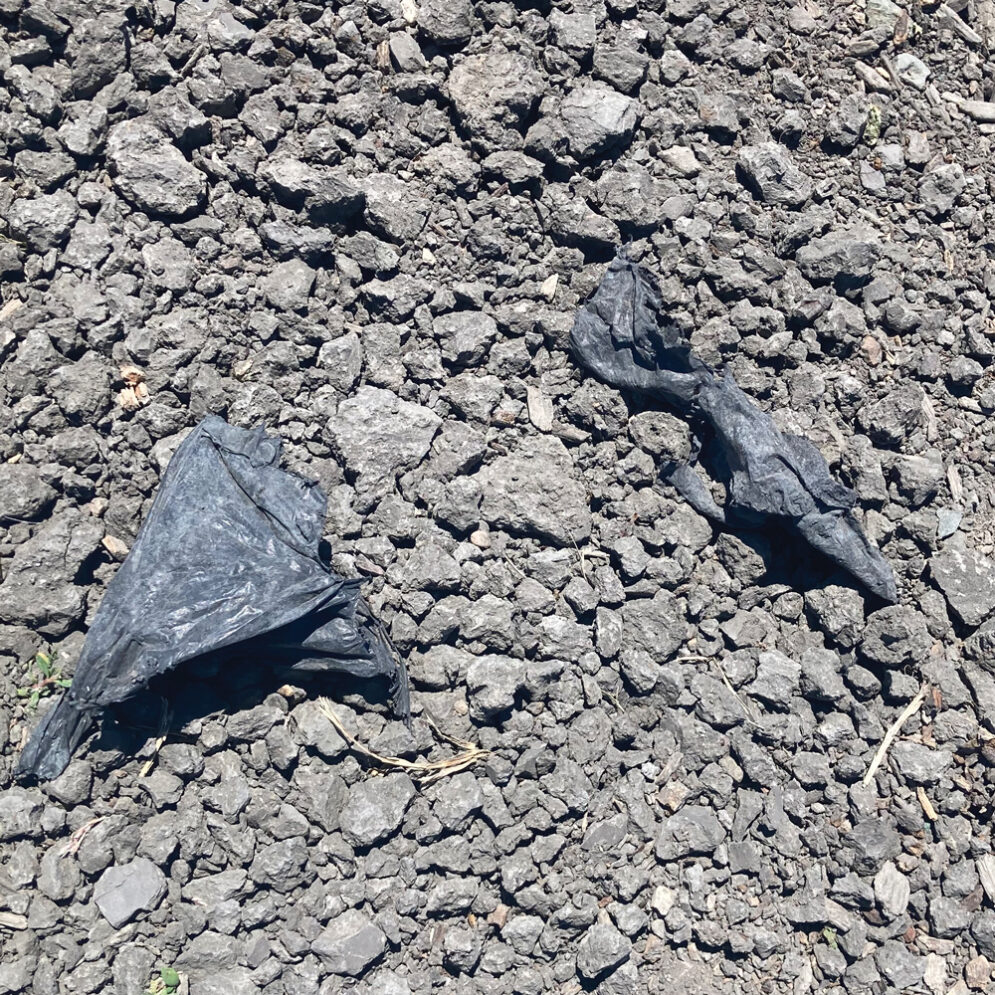
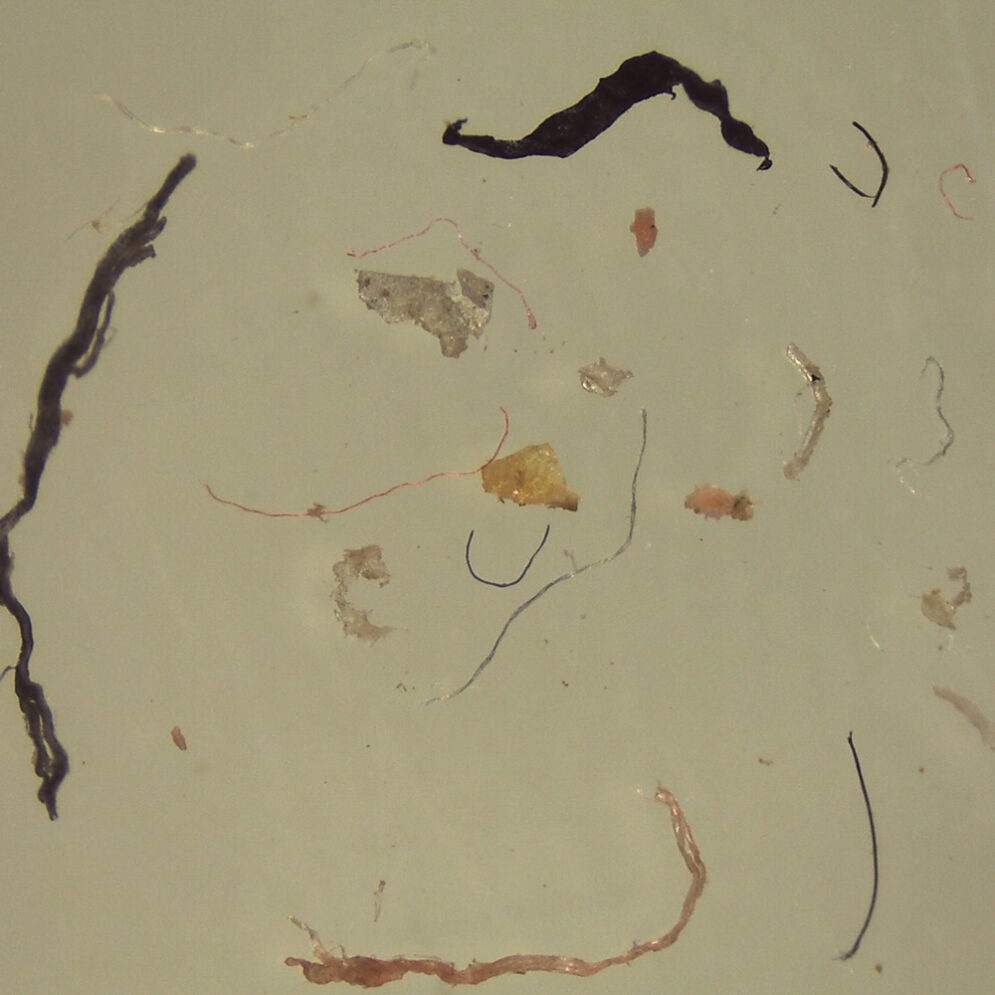
Microplastic samples collected and analyzed in Sistla’s lab. Litter images courtesy of Seeta Sistla and Ekta Tiwari.
HOW DID YOU GET INTO PLASTICULTURE RESEARCH, AND HOW HAS YOUR WORK EVOLVED OVER TIME?
When I started at Cal Poly in 2019, a friend and colleague of mine, who was studying plastics and knew about the agricultural footprint of the Central Coast, suggested that I pursue projects around plasticulture’s environmental impacts and the potential for biodegradable plastic mulches to address some of these concerns.
I wrote a series of grants focused on testing the efficacy of biodegradable mulch in cropping systems, particularly strawberries, because they’re a dominant plasticulture crop. When out in the fields beginning the biodegradable mulch research, a student and I observed the amount of plastic debris in and around agricultural fields. We started asking more general questions about how much plastic is accumulating in these high-value and well-managed fields. Over time my lab’s focus evolved from looking at biodegradable plastic mulches and how they are behaving in situ to thinking more about how much plastic debris is in agricultural systems and where it accumulates.
My lab has done a combination of experiments testing how plastics affect soil properties, and we’ve also gone out and done field surveys and looked at the concentrations of large plastic debris and microplastics. We then looked at the relationship between plastic debris and fence lines. When you survey areas where there are fence lines or barriers to wind movement, you see a buildup of plastic particles. That led us to the question: can we use these barriers as a way to target remediation?
Plastics in the environment either move or fragment or both. It’s not decomposable. One project we’re currently working on is to find ways in agriculture systems to at least trap the debris before it exits and moves into estuaries or waterways using vegetative ditches, fences or other structural barriers.
I think a lot about reduction and remediation, but really reduction because remediation for soils is extremely challenging. It’s hard to retrieve plastic materials, and when you retrieve it, where do you put it? It just becomes another pollution source somewhere else.
HOW HAVE YOU INCORPORATED THIS RESEARCH INTO YOUR CLASSES?
A colleague and I developed a novel lab exercise designed to teach students the methods used to survey, extract, and quantify macro- and microplastics in soils. This past spring, we incorporated the plastic debris research into my senior-level soil science class. Students surveyed a small part of the campus for visible plastic debris and extracted and quantified microplastics from contaminated soil samples we had previously created in the lab.
One of the things that they looked at is how do you quantify contaminants that fall apart or degrade when handling, like microplastics? A single particle can become two, can become four. They fragment and fragment again. It becomes tricky to try to enumerate the amount of plastic contamination as particles become smaller. Weighing microplastics extracted from soils is extremely challenging, so researchers often use a particle count estimate. In addition to things like calculating the percent of plastic retrieved from the samples, the class was asked to consider the various strengths and limitations of estimating soil plastic contamination load using our approach.
Students were shocked by the amount of plastic debris they identified on the campus. They also were surprised that even our negative controls still had microplastic fibers in them.
I think it is critical for our students to understand the complexities intrinsic to quantifying these novel plastic contaminants and understanding their fate and effects on ecosystems and organisms.
The class really liked the lab project. They had no idea about the scope of the plastics problem and for them it was a really engaging exercise.
A few generations of humans have completely transformed what our everyday environment looks like.
Seeta Sistla
WHAT DO YOU HOPE STUDENTS TAKE AWAY FROM LEARNING ABOUT PLASTICS IN SOIL?
As an educator, I try to help provide perspective that is beyond the students’ own lived experience. I think it’s important for younger generations to have an idea of shifting baselines. Their parents’ parents did not have everything in single-use packaging. Their parents’ parents’ parents would’ve had very few things in plastic. A few generations of humans have completely transformed what our everyday environment looks like.
I think having a cultural and ecological history is necessary because otherwise people cannot think of an alternative. For our students, it’s not unusual to see garbage everywhere. They don’t think anything of it because they’ve never had a world that’s not like that. I challenge readers to walk in their neighborhood without passing plastic debris. It’s virtually impossible.
Environmental awareness across generations when we’re living through these very fast technological shifts is critical to creating a world we want to live in.
IN A WORLD FULL OF MICROPLASTICS AND MACROPLASTICS, IS THERE ANY HOPE FOR A MORE PLASTIC-FREE FUTURE?
I think if people were aware of the incredible resource intensity that goes into the products we consume every day, they might opt to pay a higher premium for a system that is lower intensity.
Plastic producers don’t pay the cost of the environmental pollution burden. I think that if people were more aware of the incredible burden of plastic in the environment, they would be more sensitive to the fact that they’re buying these things cheaply only because their true cost is not carried. With the recent weakening of federal support for studying global environmental change issues, we need to grow the public’s awareness and commitment to rapidly reduce our plastic dependence.
Given what we are learning about the extraordinary environmental burden of plastic pollution we need to address this problem through policies that fundamentally restructure plastic dependence. The environmental cost is borne for generations. It’s not there and gone.
Your Next Read
Illustrator Breanna Chambers has combined whimsy, talent and tenacity into some high-profile early career wins.