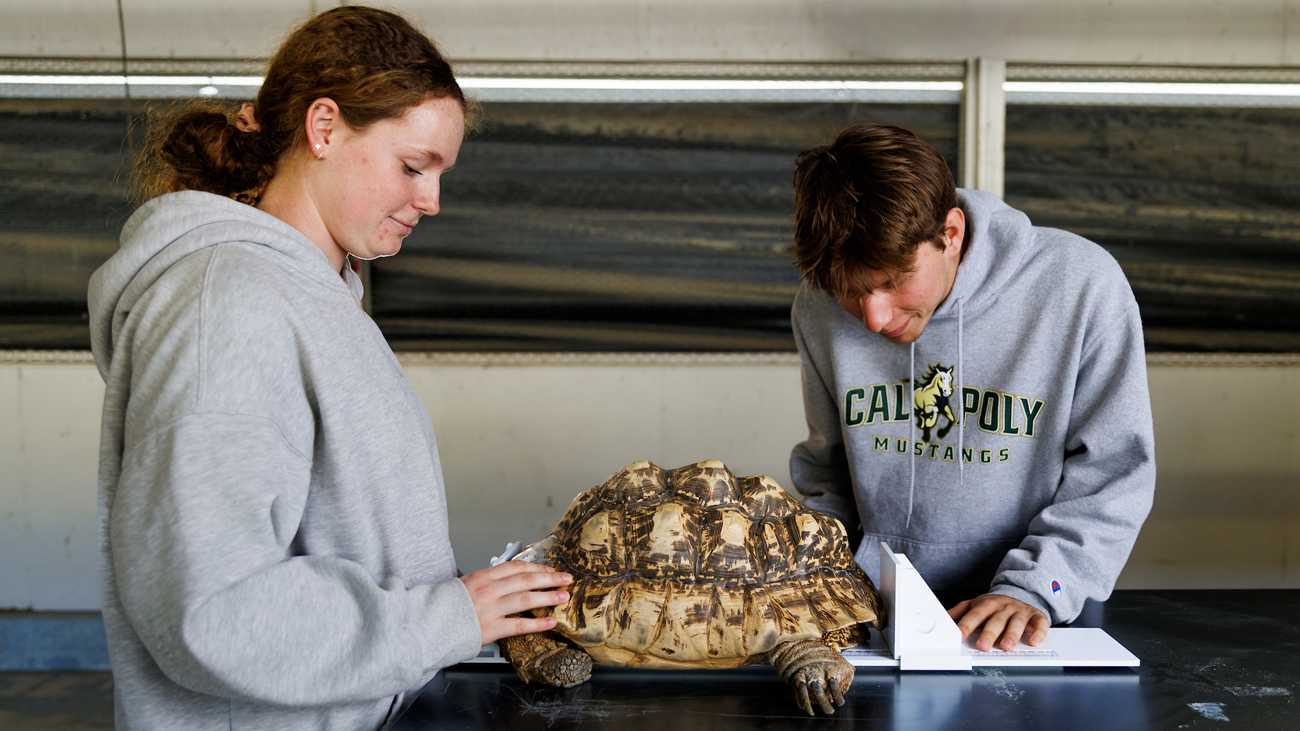
 Modica was interested in working with non-domesticated animals years before she started college. At Cal Poly, Edwards, her undergraduate advisor, encouraged her to get involved with the reptile husbandry enterprise. It turned out to be a great fit.
“In addition to non-domesticated animals, I also had a strong interest in animal nutrition, and the reptile husbandry enterprise was a great way to combine these interests since it was designed to be a long-term nutritional study,” she said.
Modica began working with the tortoises during her junior year, in 2012, and continued with it until she earned her master’s degree in 2016 — even performing her graduate thesis research on the tortoises, where she examined the effects of different dietary cellulose fiber lengths on nutrient digestibility and the gut microbiome.
Modica, now a senior scientist at Mars Petcare, develops new ingredients for use in pet foods for her company’s brands, which include Iams and Royal Canin. She credits her experience in the enterprise with helping her build a solid foundation around animal husbandry and scientific practices that she was able to transfer to her career.
“My experience absolutely prepared me for a career in the animal nutrition field,” she said. “The reptile husbandry enterprise is so much more than daily care of tortoises. It is deeply rooted in practical skills and scientific rigor that students will benefit from for the remainder of their education and well into their professional careers.”
 Luehs, an animal keeper at the Oakland Zoo, has loved exotic animals since she was six years old. For a long time, she thought she wanted to become a zoo veterinarian, but an animal care internship at the Oakland Zoo opened her eyes to the caretaking aspect of working with non-domesticated animals.
Soon after, she was looking through the animal science catalog when the reptile husbandry enterprise grabbed her attention. The opportunity to work with tortoises was too good to pass up, and she signed up during her sophomore year.
“I had already done a different enterprise the year before and learned a lot, so I was very excited to participate in the reptile husbandry enterprise,” Luehs said. “Taking part in enterprises as a student is one of the major ways in which Learn by Doing comes to life.”
Luehs said the detailed responsibilities involved in the reptile husbandry enterprise — including the opportunity to contribute to a graduate research project — gave her hands-on experience in animal handling and caretaking that helped launch her into her career just a few days after graduation.
“Research wound up being a huge part of my job as an animal keeper, and I was able to get a little taste of that during this enterprise,” Luehs said. “There are so many little things you learn through the enterprise that come in handy when you least expect it to.”
The bonds she formed with other students, the tortoises, and Edwards were another major highlight of her experience.
“I gained a wonderful, knowledgeable mentor who has helped me at every step of the way in my career,” Luehs said. “And then there’s the tortoises themselves. Working with these animals and getting to see each of their individual personalities was something truly special.”
“Cal Poly is such a special place with so many opportunities at your fingertips; you just need to be willing to take them.”
 Strachan-Payne, a wildlife care specialist at the San Diego Zoo, came to college with a strong interest in working with wild animals — but wasn’t sure if she’d find a hands-on option to do so.
Before she discovered the enterprise, “I actually considered switching to a biology major for a minute,” she said. “The reptile husbandry enterprise was the only on-campus option to explore my interests.”
Strachan-Payne, who participated in the enterprise during the winter and spring quarters of her sophomore year, said the hands-on nature of the program prepared her to hit the ground running in her chosen field.
“I loved that Dr. Edwards ran the enterprise with a professional standard of practice,” she said. “All the aspects of how the enterprise was run helped prepare me for what working in a zoological setting would be like: from how we conducted research to providing daily enrichment for the tortoises.”
Overall, Strachan-Payne said the enterprise opened up a path to her that she otherwise wouldn’t have been able to explore at Cal Poly.
“The reptile husbandry enterprise fills a very important niche and ensures all students can find an educational opportunity that inspires them.”