Course Description
Animal Care in
the Slow Lane
An animal enterprise on the outskirts of campus teaches students how to work with a different kind of creature.
By Gabby Ferreira // Photos by Joe Johnston
Share this article:
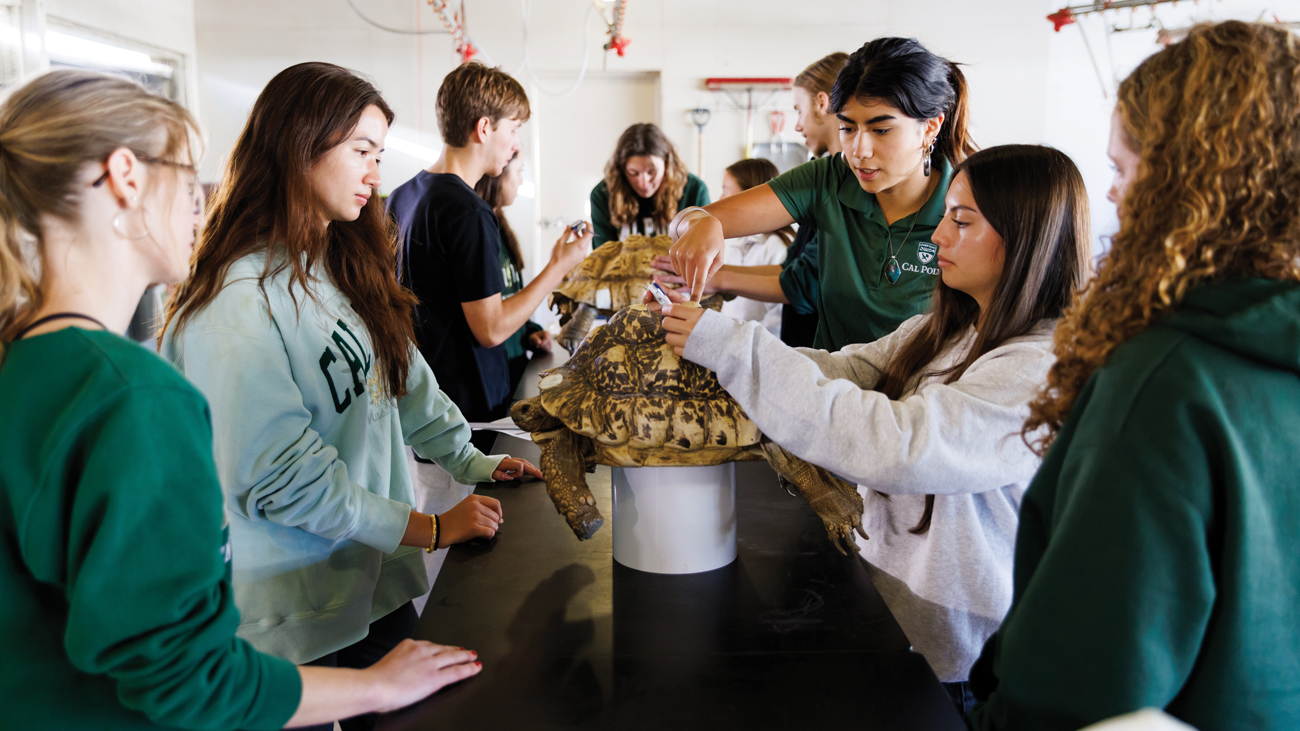
Students in professor Mark Edwards’ ASCI 290: Reptile Husbandry Enterprise take measurements of the tortoises at their weekly class meeting.
On Thursday afternoons, students in a unique animal enterprise meet at the Poultry Unit on the outskirts of campus. They huddle with their professor, Mark Edwards, and the enterprise’s student manager, Lola Mora-Moreno, for a brief lesson and reading discussion, while 17 leopard tortoises — in a range of sizes, weighing 20 to 40 pounds — quietly shuffle around or nap in their enclosures.
Then it’s time to work: the students quickly form an assembly line, picking up each tortoise individually, and running them through a series of about 20 measurements, including weight, width of the plastron (the scientific name for a tortoise’s belly) and width of the scutes (the hexagonal shapes on a tortoise’s shell). Meanwhile, the reptiles themselves wait patiently as the students attend to them like little old ladies at a beauty salon, with some holding their necks out in hopes of scratches.
“I really fell in love with it,” said Mora-Moreno, a third-year animal science student who took the enterprise class last year. “I came to Cal Poly more interested in zoology, and this enterprise taught me about handling and caring for a non-agricultural, non-domesticated species.”
A Truly Unique Course
Since 2008, ASCI 290: Reptile Husbandry Enterprise has helped hundreds of students learn industry-standard animal care methods, conduct research and develop professional skills. It has the distinction of being the only enterprise on campus that focuses on animals that haven’t been domesticated by humans — and according to Edwards, the only program of its kind at an American university.
When Edwards first came to Cal Poly from a position at the National Zoo in Washington, D.C. about 20 years ago, he said he noticed that about a quarter of his animal science students expressed an interest in working with wild animals. But at the time, there were no on-campus opportunities for that.
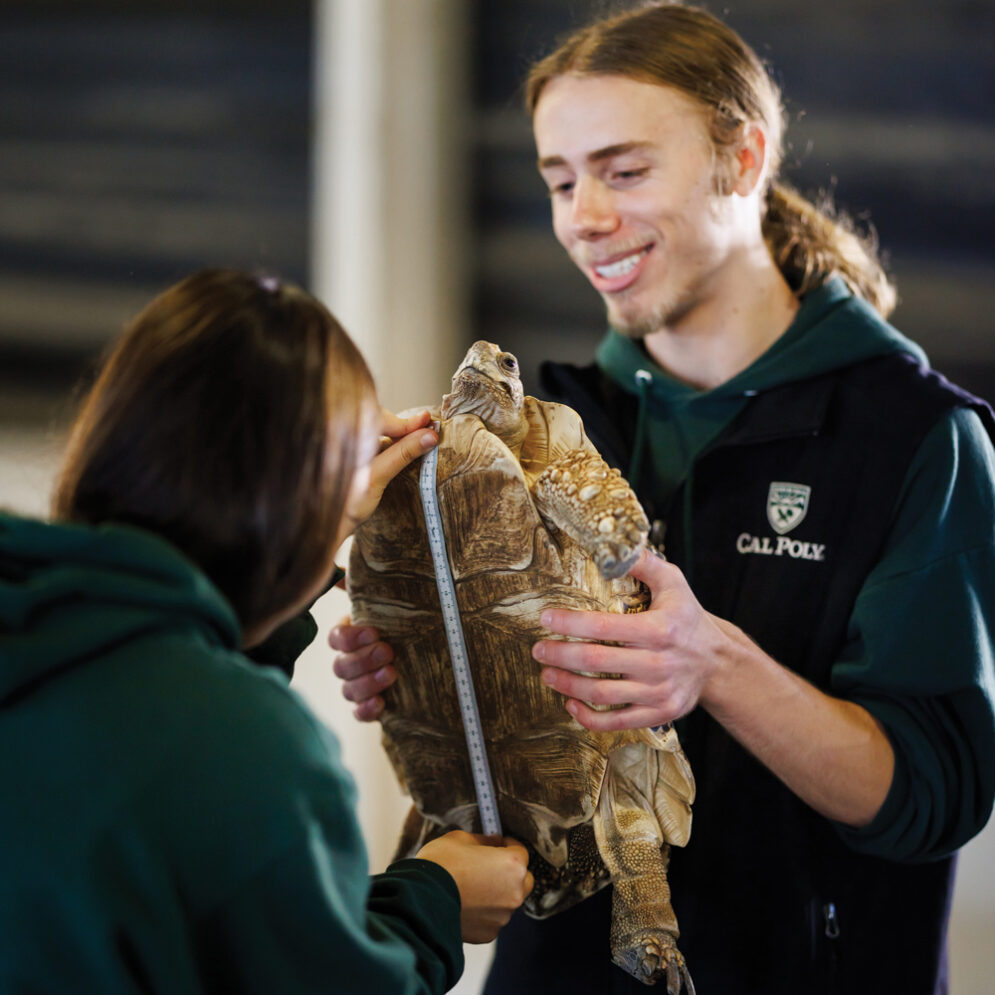
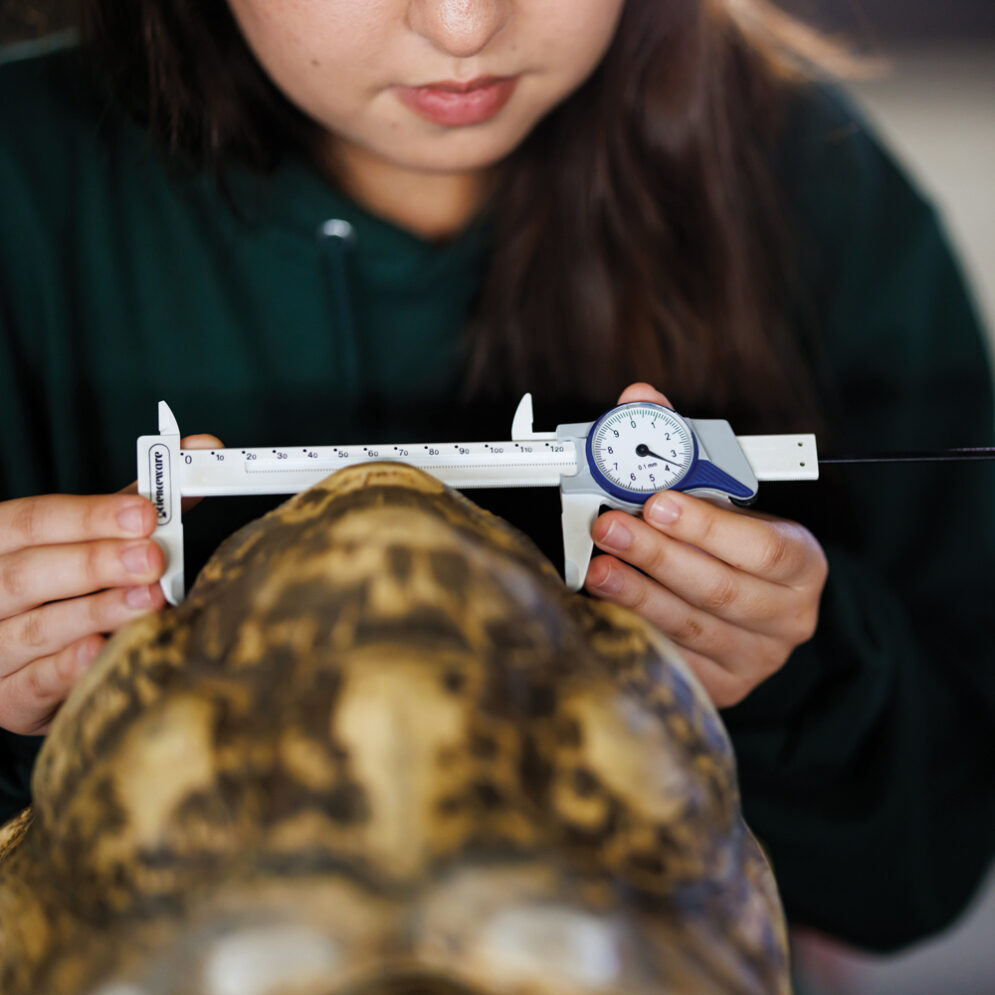
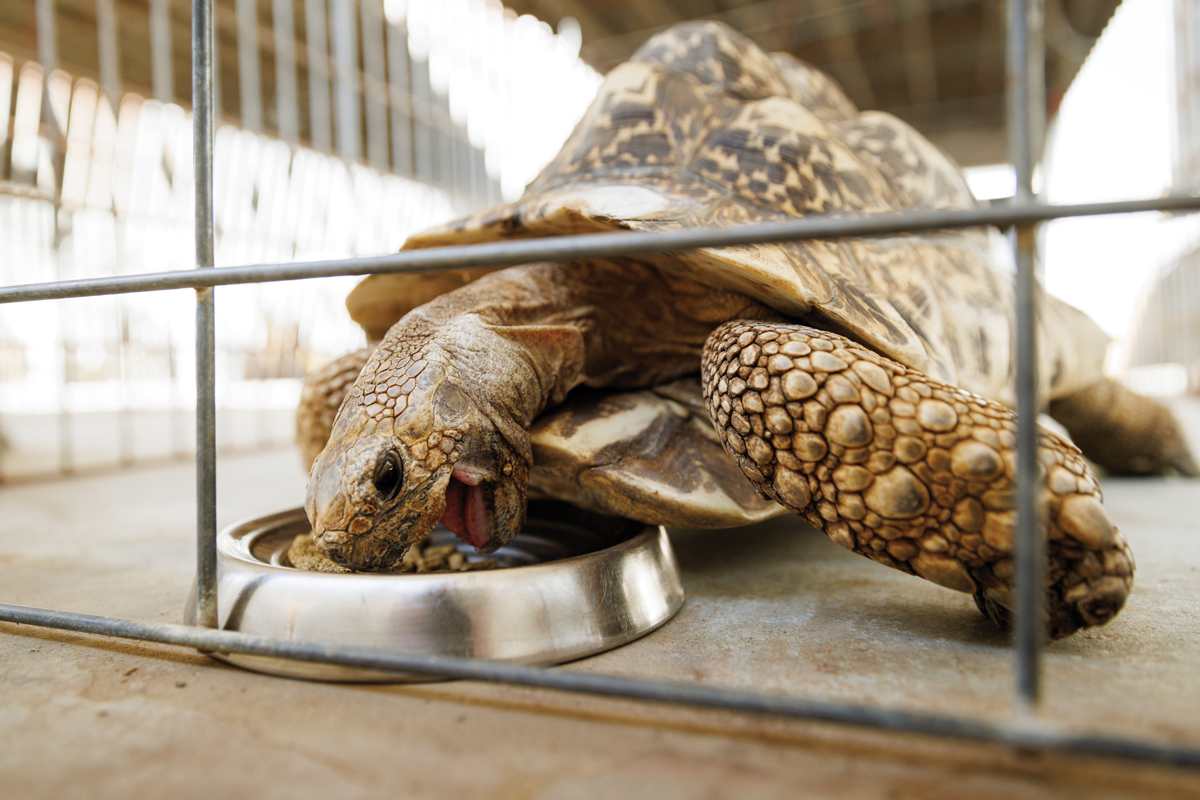
First photo: Student Conlan Bivin holds up one of the tortoises for another student to take a measurement on the plastron, which is the scientific name for a tortoise’s belly. Second photo: A student takes a measurement on a tortoise’s shell. Third photo: A tortoise chows down on its morning meal.
At the time, the National Zoo was home to 17 leopard tortoises, which they happily donated to Cal Poly to establish a research colony. It was a symbiotic relationship: the tortoises provided valuable Learn by Doing experience for students, while the zoo was able to prioritize other species with more critical needs.
“One of the biggest challenges zoos have is that there’s not enough space,” Edwards said. “We were actually helping the National Zoo by taking these animals and freeing up space and resources so they could use it for other high-priority species.”
Real World Research
In addition to teaching students how to properly care for an exotic animal, one of the primary goals of the enterprise is answering long-term research questions. Student research findings on the tortoises’ diet have been used to develop tortoise feed for Purina’s Mazuri line of exotic animal food.
The tortoises are about 21 years old — a little older than some of the students who care for them — and can live to be more than 100, meaning that they have the potential to impact multiple generations of students.
“Because tortoises are so long-lived, there have been very few studies where people have actually tracked their growth and development for more than a five-year period. And we’ve been doing it for well over 10 years now,” Edwards said. “This teaches students that they can interface their passion for living things with science. And for students that express an interest, we encourage them to learn how we use the data that they generate.”
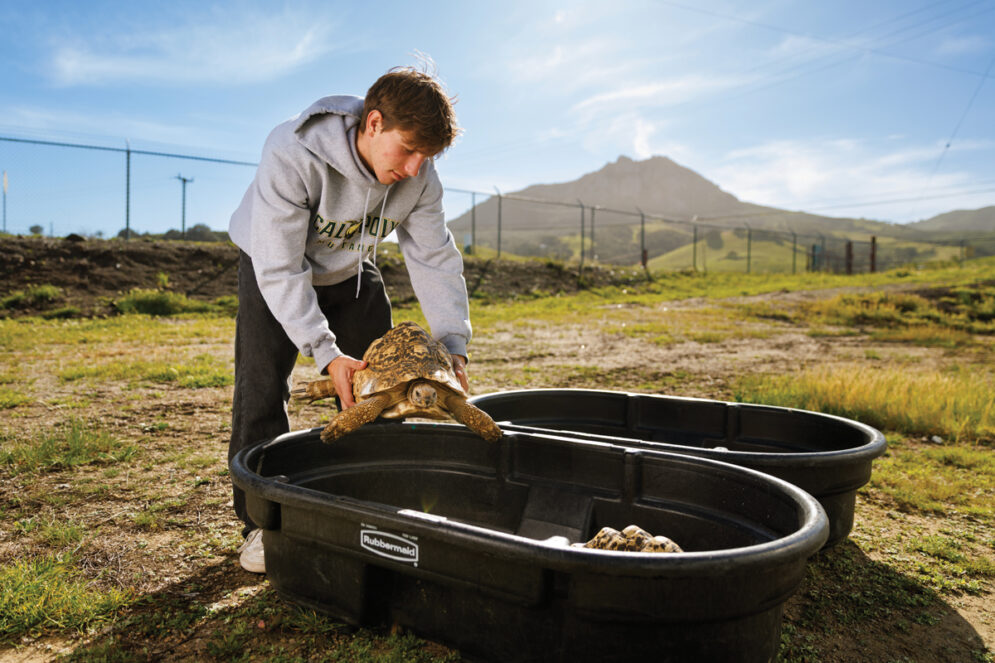
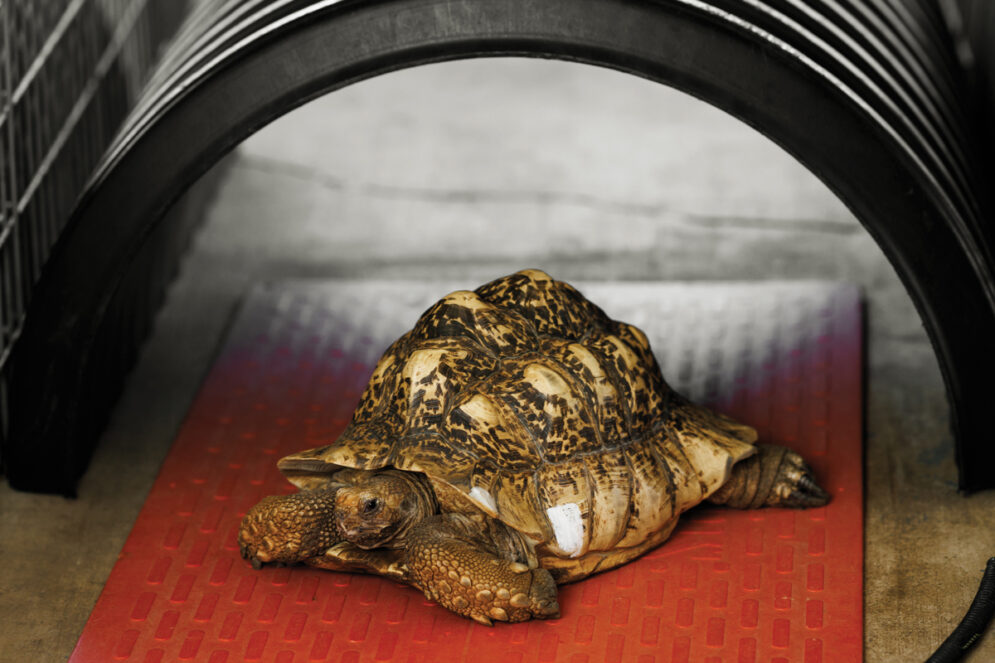
First photo: Student Owen Britt takes the tortoises outside at midday so they can get some much-needed sunshine. Second photo: One of the tortoises lays on a heat mat in their enclosure.
Even though the team meets once a week, taking care of the tortoises is a full-time job — and the students care for them in shifts three times a day, seven days a week.
“I consider this experience to be the student’s job for the quarter. They are ‘hired’ as an animal technician,” Edwards said. “This is a very low-stakes way of introducing them to things like performance reviews before they’re actually in the workplace.”
Hands-on Herpetology
But the best part of the gig is the hands-on experience of providing industry-grade care to a unique animal.
First-year environmental management and protection student Mikaela Clabaugh grew up catching lizards in the Sierras. But working with the tortoises has helped her see reptiles in a different light.
“I had very little experience in animal management prior to this,” Clabaugh said. “Before this, I hadn’t considered herpetology as a career or an animal care path. But after this enterprise, I’ve begun to consider it.”
Over the years, Edwards said he’s seen the positive impact the tortoises have had on students, many of whom come into the class with little experience caring for this kind of creature.
“I have a lot of respect for these animals,” Edwards said. “What keeps me going is knowing that there will be a few students that go on into the field. And some of these students may never work with a tortoise again, but they’re going to take the knowledge of the system that they worked within, and they can apply that to any animal they’re working with.”
Your Next Read
Rodeo returns to Spanos Stadium; researchers help cities fight fires; the College Corps marches on; Kal Penn agrees to disagree.

A mathematics major has helped Cal Poly Baseball revolutionize its analytics program to help Mustangs excel on the diamond.