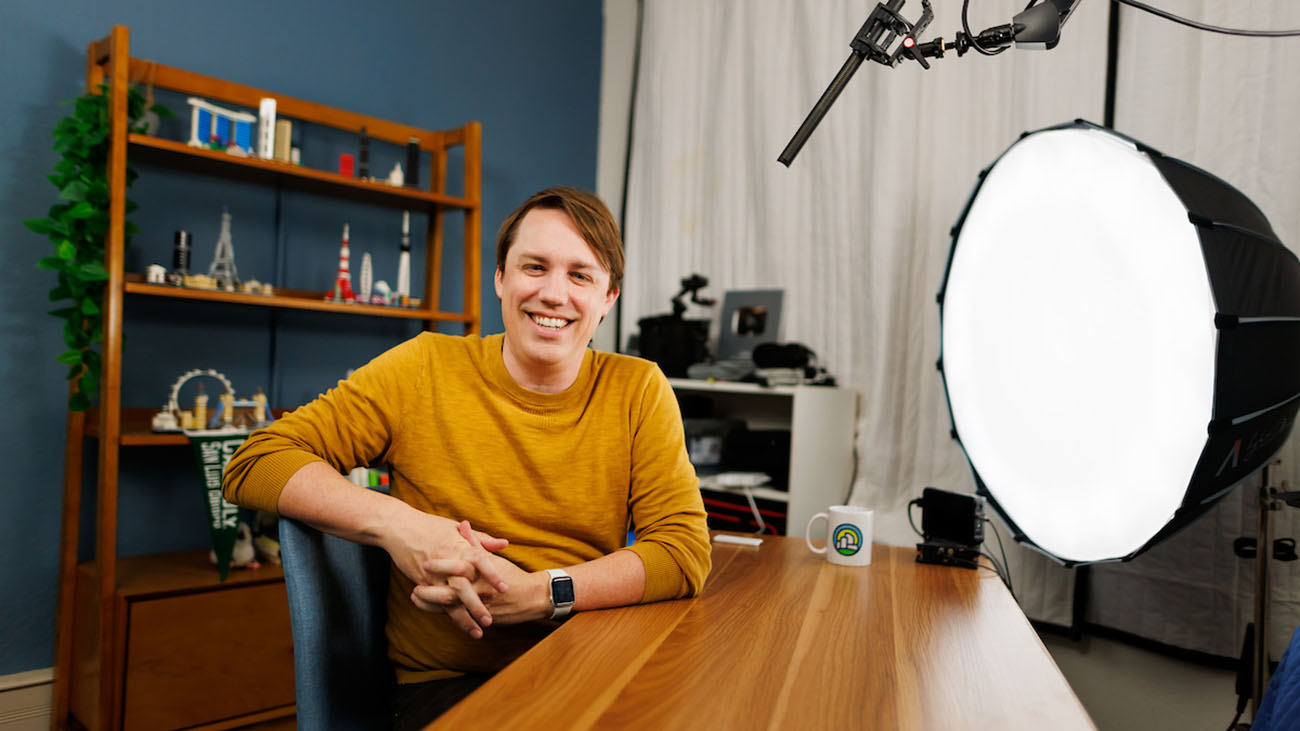

Professor Dave Amos in his production studio in downtown San Luis Obispo, where he records his YouTube series.
What makes a city work? That’s one of the big questions that drives City Beautiful, a YouTube channel run by city and regional planning professor Dave Amos. He launched the channel in 2016 after working as a land use planning consultant and discovering how little the public knew about how urban design works. Nearly a decade later, his videos have racked up millions of views as he explores cities around the world with a professional eye and a passion for empowering people to shape the places where they live. We spoke with Amos about how he evaluates cities and what he hopes people learn from his channel.
Cities are the habitats we build for ourselves. The way we organize ourselves as a species, at least over the last 10,000 years or so, has been urban. It made sense for people to gather for economic stability. But also, we’re just social creatures. Solitary confinement is considered cruel and unusual punishment for a reason. Living together is a good social structure for us.
Cities are a history of decisions. Past decisions shaped the city we live in today, and decisions we’re making now can change the city of the future. Those decisions don’t happen in secret. They happen in public, and you can actually influence them. People tend to look at their city as it is now and assume it’s always been that way, and it will always be that way. But that’s not true. We can change our cities and that’s the most exciting part.
A good city is a place where there’s opportunity for everyone. Great cities, first of all, need to be engines for equality and equity. One factor is to have public spaces for people to gather. We’ve seen this recently in Minneapolis and Portland — people need places to congregate and express themselves to promote equity and democracy.
Another important thing is a balance of different housing and transportation options. City planners talk a lot about choice these days. Can we give people a menu of options that best suit their lifestyle? Some folks don’t want or need a three- or four-bedroom house. Similarly, not everyone can drive, but we’ve designed our transportation networks to mostly focus on driving first — sometimes driving only. Giving people a broad set of choices is a big deal.
We’ve gotten very good at designing cities cell by cell. The trend is for developers to create individual neighborhoods that are very well connected within themselves — walkable, bikeable, cohesive. So we have all these little bubbles sitting next to other bubbles, but crossing over between them is not well thought out. In suburbs, residents of neighborhoods often want to be walled off. People in one affluent neighborhood might not want through traffic from another lower income neighborhood nearby. But building those connections could go a long way for equity, better transportation, and generally creating a more cohesive community.
A good city is a place where there’s opportunity for everyone. Great cities, first of all, need to be engines for equality and equity.
Dave Amos
It’s often an opportunity to explore ideas that I maybe wouldn’t cover in class, or something I’m just curious to learn more about. Sometimes an idea will come from a student, like my recent video on the YIGBY movement — Yes In God’s Back Yard, where religious organizations work to develop affordable housing on their property. I did another video, about Shibuya Crossing in Tokyo, because a colleague asked me what made it such a popular intersection while I was planning a trip to Japan. Sometimes it’s a topic people are talking about, or something city planners are discussing. I try to vary my video topics and think about what audiences I’m serving — sometimes I’m thinking about what another city planning professor might want to show their class, or sometimes it’s just for the general public. I generally don’t make my students watch them though.
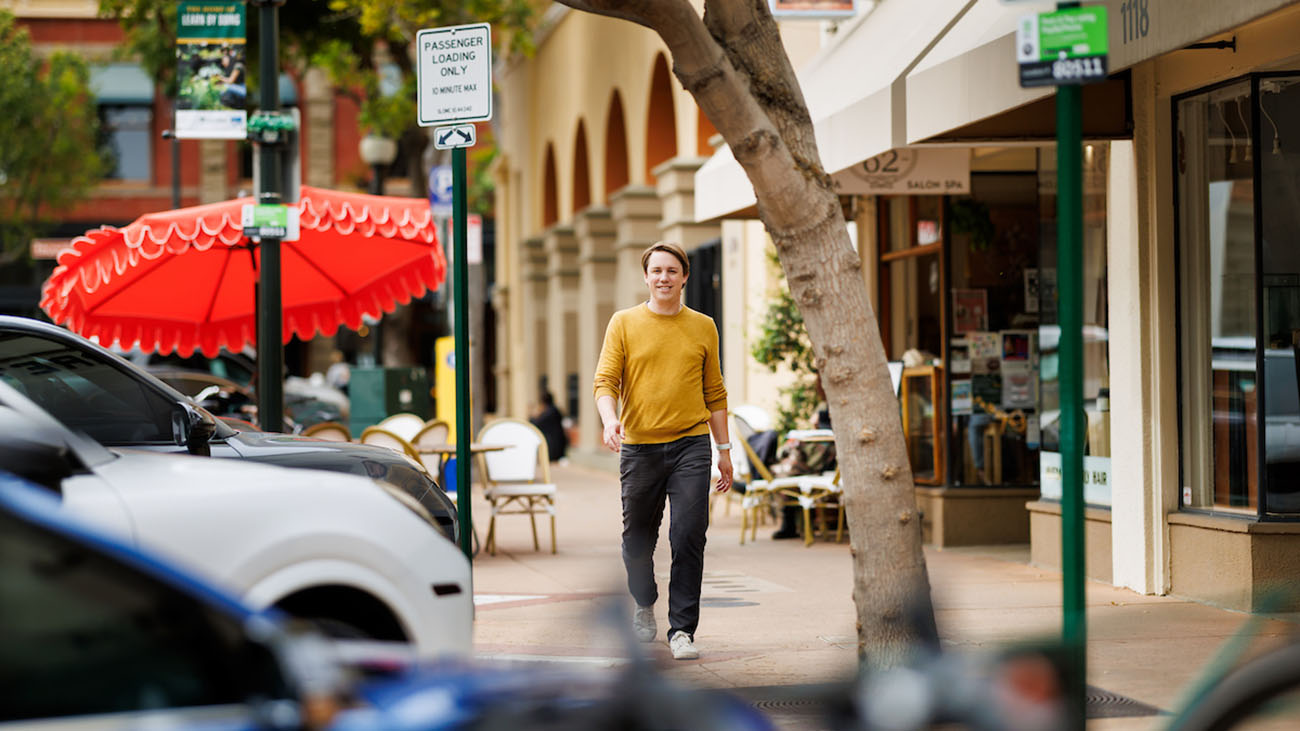
Amos walking in downtown San Luis Obispo.
The good news for me is that my favorite topic is also my most popular video — a video about Gary, Indiana. That video was inspired by another YouTuber I’d seen, who goes into cities with large minority populations and pretends that they’re really unsafe. He did a video about Gary claiming he had been run out of town by gangs. My father-in-law is from there, and I’ve spent a lot of time there, and that was not my experience. So I produced a video in response to racist stereotypes about Gary, telling the actual story of the city. That one was really personal to me, and the fact that it’s gotten close to 10 million views feels really good because I think it has helped paint the city in its true form.
The overall conceit is democratizing city planning education, taking what people learn in the classroom about this topic and giving it to the world. Most folks don’t have the opportunity to learn city planning from an educator, so I want to make this content digestible for everyone. The cool thing is that those skills also work in the classroom. So I’m trying to teach two different audiences on two different platforms, but the process is the same.

Favorite city in the U.S.
Washington, D.C., was built with a specific purpose in mind, so you can actually measure it up against the rubric of its intended purpose. It’s a good capital city for a lot of reasons, it serves its purpose really well, and it’s been mimicked in other capital cities since then.
Best U.S. city for public transportation
New York City, hands down. It has more stops than any other transit system in the world. You really can go underground and pop back up basically anywhere else in the city, and that’s magical. Public transit really doesn’t exist anywhere else in the U.S. at that level.
Favorite street
Pretty much any street in Eugene, Oregon. Everything is lush and green and overgrown
— it’s like living in a little rainforest. The sense of enclosure that foliage provides makes you feel like you’re in a really welcoming, human scale place.
Most unhinged city boundary
Birmingham, Alabama is a city whose crazy boundaries were drawn and redrawn as a
result of policies driven by racism. To me, that’s a pretty unhinged way to plan a city.
Favorite city outside the U.S.
I’m a sucker for Rome. You can walk around the city and see ancient, medieval,
Renaissance, Baroque and modern elements all coexisting. If a city is the history of past decisions, you can see all of Rome’s decisions right there.
Favorite thing to see in a new city
I was going to pick a specific design element, but really my favorite thing to see is just other people out and about. I like being in places where you don’t feel like it’s a ghost town. Anything that creates opportunities to run into other people is great.

Crossing oceans and overcoming every obstacle in her way, Professor Emeritus Moon Ja Minn Suhr revolutionized dance at Cal Poly.
A student club teaches members about leadership and team-building — and how to wield an axe.