Alumni News

Rocket Man

Following his historic lunar mission in April, astronaut Victor Glover returned to campus for a speaking engagement — and a new leadership role.

By Larry Peña // Photos by Joe Johnston

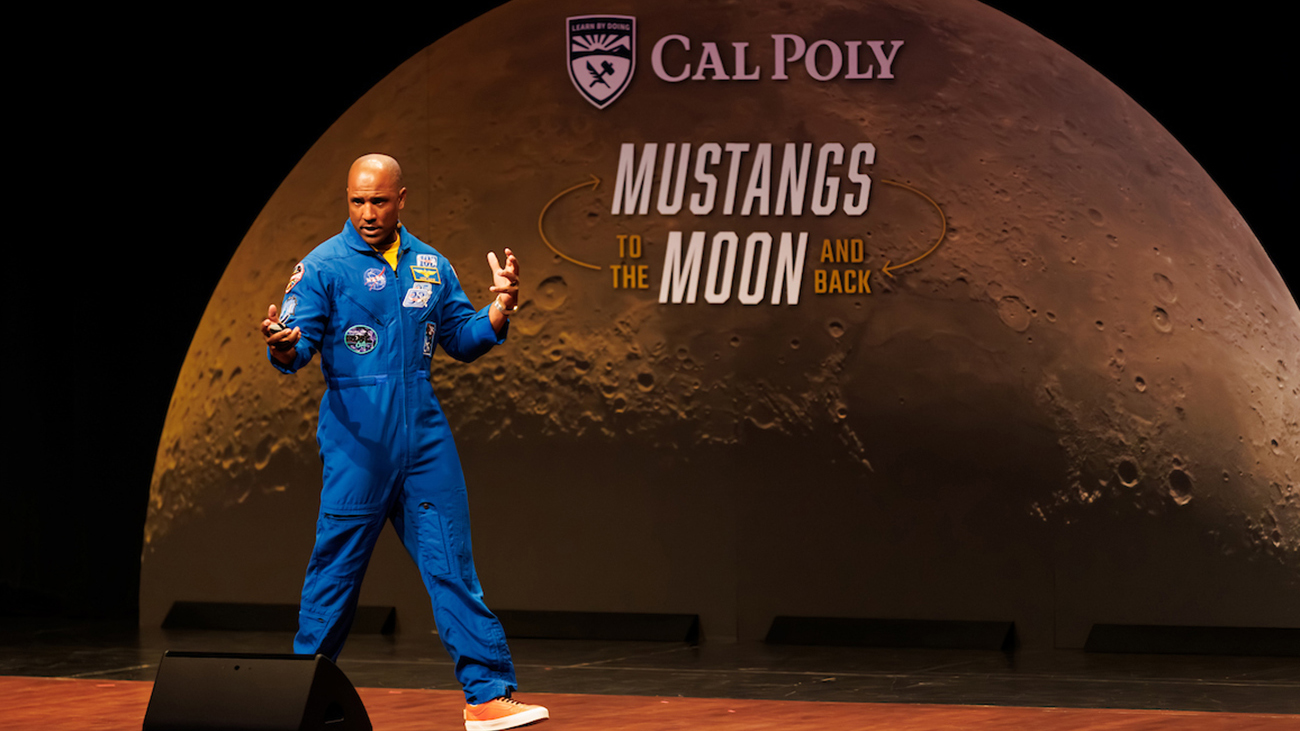
A man in a blue NASA flight suit speaks on stage in front of an image of the moon and the words "Mustangs to the Moon and Back"

Glover on stage at the Performing Arts Center during his sold-out speaking event in June.

At a campus event at the Performing Arts Center on June 15, alumnus and astronaut Victor Glover told a packed house about the journey that led him from Cal Poly to the moon and back.

“We donʼt have a room at Johnson Space Center where we can turn off gravity — you cannot simulate that anywhere,” said Glover at a media event before his presentation. “The only way to learn how to live in space is to live in space. And so every space mission is an opportunity to Learn by Doing.”

It was the first campus visit for Glover since he made history in April piloting NASA’s Artemis II lunar mission — humanity’s first voyage to the moon since 1972, marking the furthest a human space crew has ever been from Earth.

Glover described moments of awe on the record-breaking mission as the crew witnessed things that no human has ever seen, including a spectacular view of the moon silhouetted by the sun.

“There is only one little slice of the universe where you can see this at this moment, and weʼre in it, and it was just such a miracle to experience,” he said. “It has made me sift through other experiences in my life. Thereʼs all this wonder and magic in the universe, whether we witness it or not. Sometimes weʼre just moving too fast, and too busy, and have too many things in the way to know itʼs there. But we have to be quiet on the inside and observe it and listen.”

In his presentation, he described his time at Cal Poly as both a gem — a precious and rare experience — and a gym that pushed him to work hard to become stronger. In addition to a difficult course load as a general engineering student, he was also a member of the wrestling and football teams, a STEM outreach educator for middle school students across the state, and a leader in the Phi Beta Sigma fraternity.

He recalled having to retake a fluid mechanics class he had initially failed and realizing he hadn’t lived up to the standard set by his professor, James LoCascio.
“What I really gained from that class wasnʼt the academic material. I donʼt use fluid mechanics like that in my life on a regular basis,” he said. “We were talking about it later, and Dr. LoCascio said, ‘You know, you’re not here at Cal Poly to get trained to get a job. Youʼre here to learn to think.’”

There is only one little slice of the universe where you can see this at this moment, and weʼre in it, and it was just such a miracle to experience.

Glover joined the Navy while at Cal Poly and after graduation considered training for the SEALs. But his father pointed him toward a different path.

“He said, ‘I know you and thatʼs not what youʼd want to do,’” said Glover. “‘I think with an engineering degree from Cal Poly and wings, you go fly, you might mess around and become an astronaut.’”

In the Navy, Glover served as both a combat pilot and test pilot. He eventually took a job working as a legislative aide for Sen. John McCain and met a lifelong hero, Rep. John Lewis. It was while working in Congress that Glover got the call that he had been accepted into the NASA astronaut training program.

“We became ambassadors of NASAʼs mission: ‘We explore the unknown in air and space. We innovate for the benefit of humanity, and we inspire the world through discovery,’” he said. “I love it that our mission is not to explore for America or to explore for science- and technology-bent people but for all humanity.”

Glover was assigned to Artemis II in 2023 and began training for an unprecedented mission designed to test out equipment and processes being used for the very first time. He said that in many instances, his crew and his trainers were developing brand new protocols based on their best information on how the trip would go.

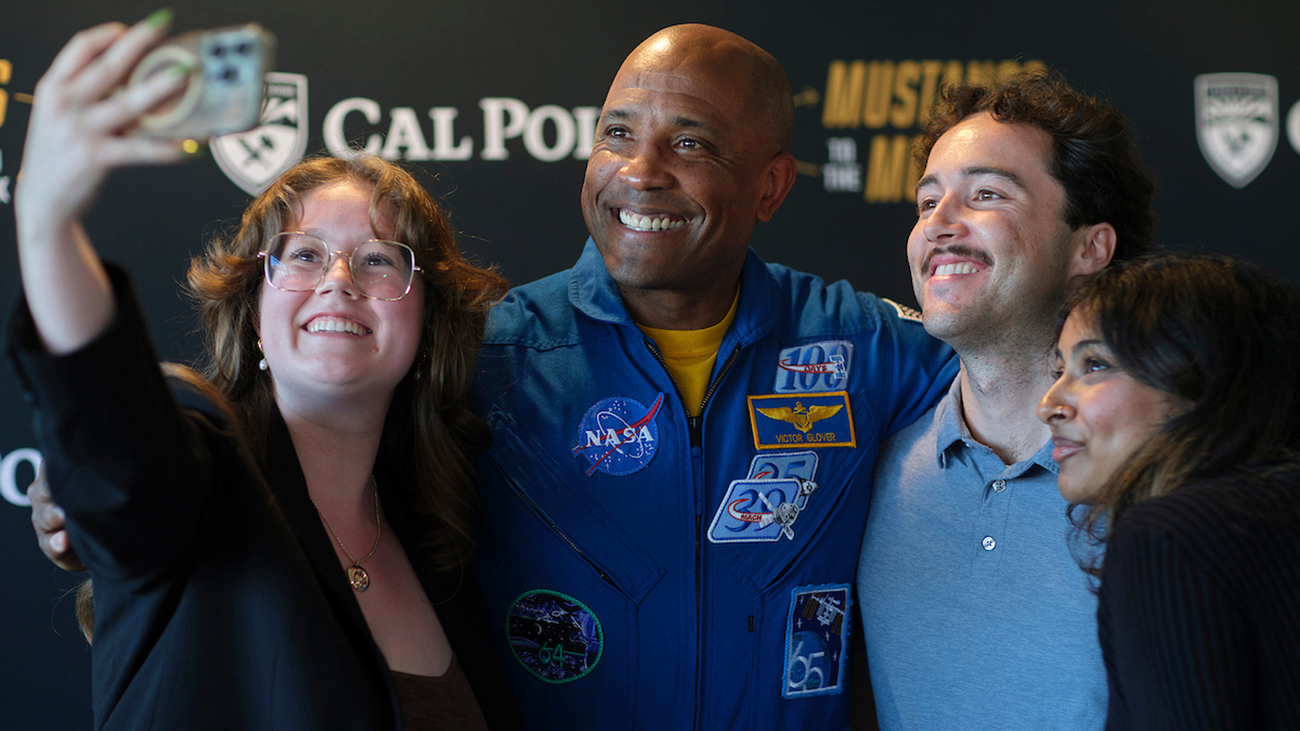
A man in a blue NASA flight suit poses for a photo with a group of Cal Poly students.

Glover posed for a photo with student journalists from Mustang News at a press event before his presentation.

He mentioned that one thing their crew particularly wanted to focus on was how they functioned as a team, not just as individual astronauts and scientists. They asked for the input of a group of counselors and psychiatrists to give them tools to not only work well together but genuinely care for each other.

“Now that the mission is behind us, it really stuns all of us how that work resonated with you all so much,” he said. “People are talking about the teamwork and how we treated each other as much as the number of miles we flew. I actually hear that number a lot less than I hear about love, empathy and teamwork. I love it.”

He spoke about the biggest societal value of space exploration: how it affects the minds of those observing it.

“Inspiration drives decision-making. When you’re inspired, you will do something differently,” he said. “When the astronauts on Apollo 8 went to the moon, they took the first picture of all of humanity, and 14 months later, we had the first Earth Day. Thatʼs why we go. We can do a whole lot more. I hope Artemis II started that discussion, and we just now gotta keep it going.”

He advised aspiring scientists, engineers and inventors that technical expertise isn’t enough to do work that truly matters.

“I would also encourage you to become a great communicator. Your curriculum might include that, but if it doesnʼt, find a way,” he said. “Itʼs not about just designing this cool widget — then you’ve got to explain it. Anything great designed by humans is done by teams. And if you’re a better communicator, your team is going to be a better process executor and therefore product creator.”

He also talked about how his own responsibilities as an astronaut have changed since returning to Earth.

“I got to do something that I donʼt believe any of us deserve to do,” he said. “God has given me a purpose and a passion, and sharing it — I owe that to you. Going and doing these things, I cannot hold this in and keep it to myself. I’ve got to give it away.”

Back to the Launch Pad
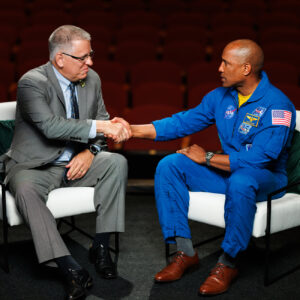
A man in a grey suit and a man in a blue NASA flight suit shake hands

Glover (right) with Cal Poly President Jeffrey D. Armstrong (left).

In September, Glover transitioned to emeritus astronaut status at NASA and returned to his alma mater in a leadership position.

“My Learn by Doing experience at Cal Poly was the launch pad for my journeys around the world and the moon,” Glover said. “Though I feel like I’ve never left, to be able to come back to this institution that has meant so much to me and to my family is a gift. I am excited to give that gift in service to student success!”

Glover will work with university leaders to identify and develop strategic partnerships and philanthropic opportunities in engineering, applied computing, aerospace, aviation, maritime, artificial intelligence, cybersecurity, autonomous systems and national defense. He will also serve as an ambassador representing the university and inspiring the next generation of students to pursue STEM-related disciplines.

“Victor is the embodiment of how far Learn by Doing can propel a Cal Poly graduate,” said Cal Poly President Jeffrey D. Armstrong. “We share a vision of ensuring that our university continues to produce future generations of pioneers and leaders.”

Your Next Read

An introduction to Cal Poly Maritime Academy: maritime vocabulary, a Q&A with the commander of the Corps of Cadets, a summer voyage, and the difference between boats and ships.

Explore the 75-year history of graduate education programs at Cal Poly.